This post contains affiliate links. We may earn a small commission when you buy through our links — at no extra cost to you.
Every gram counts in a backpack, but so does a charged phone. Many power banks advertise high capacity yet weigh over 12 ounces—a real burden on a multi-day hike. A 10,000mAh bank can give your phone two full charges, but a 20,000mAh one adds significant heft. The trade-off between power and weight is the first decision every backpacker faces.
Fast charging speeds are another promise that doesn’t always translate to the trail. A bank that quickly tops off your phone is useless if it takes hours to recharge itself. And built-in cables offer convenience but can become a weak point after months of stuffing in a pack.
The best banks for backpacking balance these factors honestly: light enough to carry without thinking, fast enough for a lunch-break charge, and durable enough to last years. This guide highlights which models actually hold up and what trade-offs are worth making.


Best for Retractable Fan
Anker Nano 10k 45W Retract

Rating: 4.6 ★ | Price: $$ | Capacity: 10000mAh | Weight: 232g | Output Power: 45W | Built-in Cable: Retractable
The Anker Nano delivers 45W fast charging through a built-in retractable USB-C cable, eliminating cable clutter in your pack. At 232g it’s about 50g heavier than the slimmest alternatives, so ultralight backpackers may prefer a lighter option. The retractable mechanism is convenient for tidy packing, but its moving parts may wear over time, and the integrated cable cannot be replaced if it fails. Build quality is high, and the 45W output charges phones and small tablets quickly on the trail.
Pros
- Retractable cable keeps your charging setup tidy and tangle-free in a pack.
- 45W fast charging rapidly tops up phones, tablets, and even some laptops.
- Solid build quality with a compact footprint that slips easily into a pocket.
Cons
- At 232g it’s heavier than sub-200g 10,000mAh options, a real difference for weight-conscious hikers.
- Retractable mechanism may wear over time; the built-in cable cannot be replaced if it fails.
Best suited for backpackers who value a tidy, all-in-one charging solution and are willing to carry an extra 50g over the lightest alternatives for the convenience of a retractable cable.
Best for Budget Backup
Anker PowerCore 10k
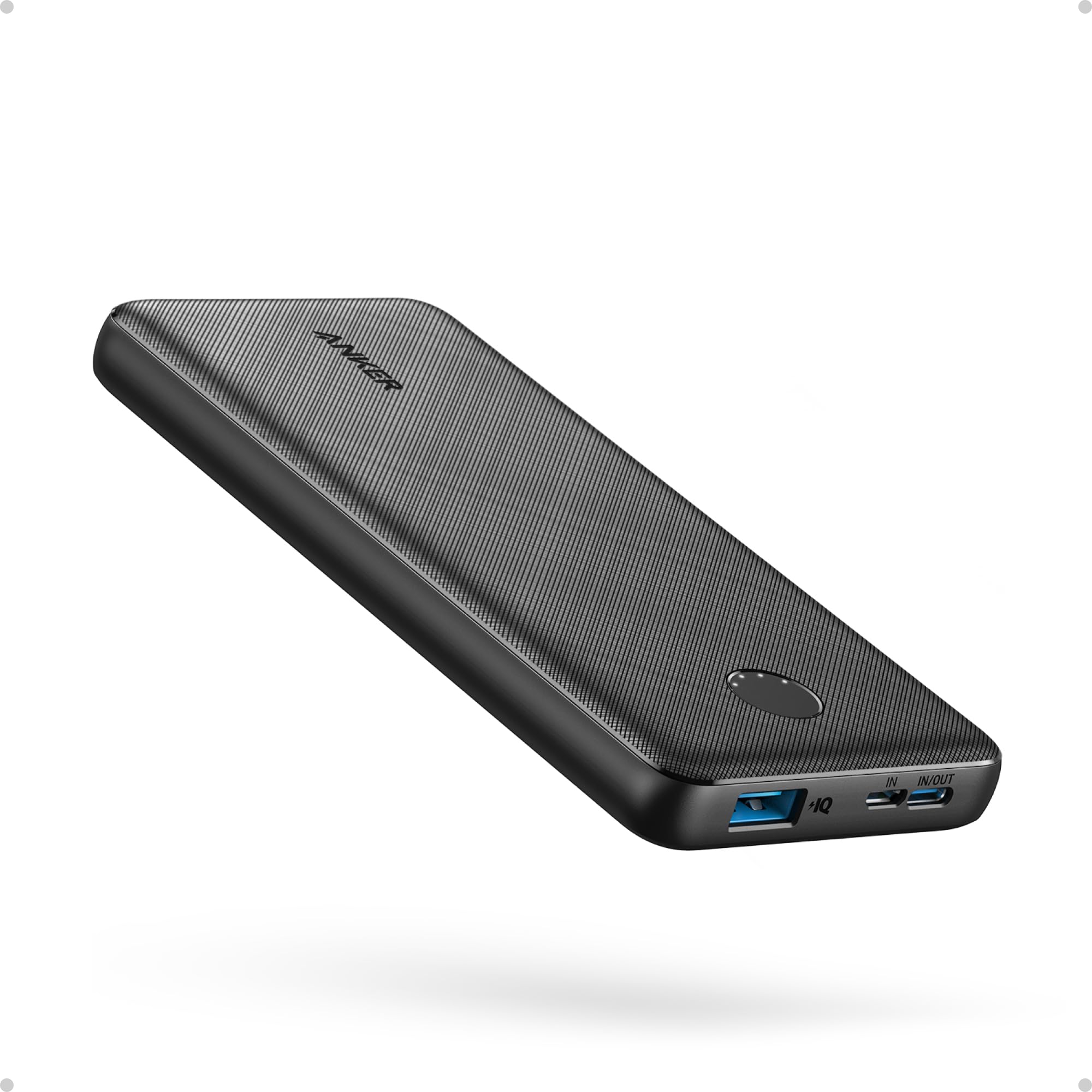
Rating: 4.5 ★ | Price: $ | Capacity: 10000mAh | Weight: 244g | Output Power: 15W | Built-in Cable: No
The Anker PowerCore 10K is among the lightest and most affordable 10,000mAh banks — easy to toss into a pack without adding noticeable weight. Its 15W output means charging a modern phone from empty takes several hours, so this is best left plugged in at camp overnight rather than relied on for midday refuels. The trade-off is clear: you save weight and money, but you give up the convenience of fast charging when you need it most.
Pros
- Lightweight and compact — slips easily into a pack or pocket.
- Good build quality at a budget price point.
- Decent 10,000mAh capacity for overnight charging or emergency backup.
Cons
- 15W output is slow — expect over three hours to fully recharge most phones.
- Battery longevity may degrade sooner than expected in some units; a flexible return window is advisable.
A suitable choice for budget-minded backpackers who can charge devices overnight at camp, but not for those who need quick top-ups during the day.
Best for Ultra-Light Hiking
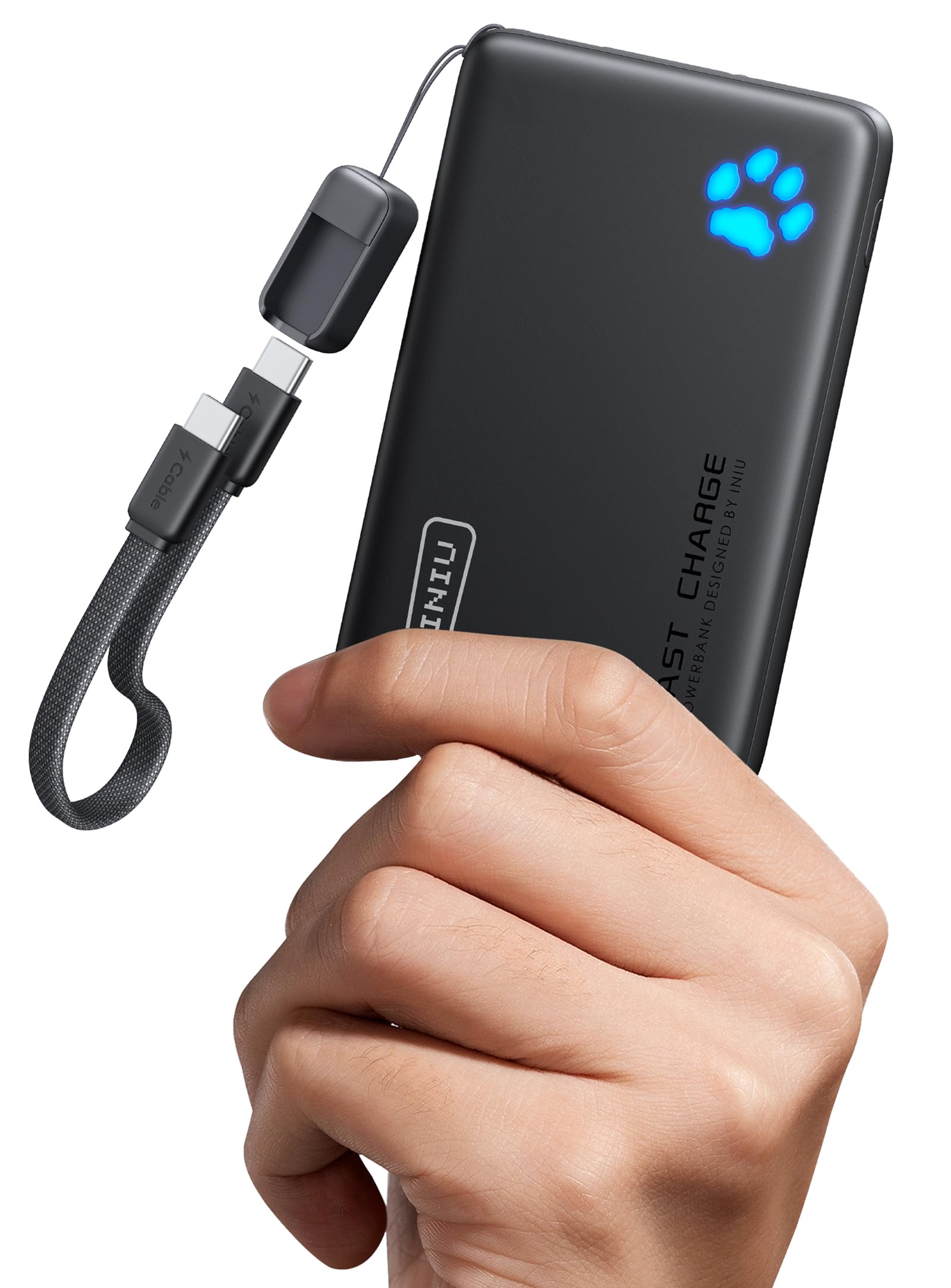
INIU 45W 10k
Rating: 4.5 ★ | Price: $ | Capacity: 10000mAh | Weight: 182g | Output Power: 45W | Built-in Cable: Detachable
Weighing just 182g (6.4 oz) and roughly the size of a deck of cards, the INIU 45W portable charger delivers fast charging without the bulk that typically accompanies 10,000mAh banks. Its 45W USB-C output replenishes an iPhone 15 from empty to 50% in about 30 minutes, and a Samsung S24 similarly quick—enough for a trail-side top-up while you grab water. The detachable braided cable avoids the durability gamble of fixed-cable rivals; if it frays, you just replace the cable, not the whole bank.
For a day hike or a weekend away, this bank covers one to two full phone charges depending on device size. The compact profile slides into a hip belt pocket or the mesh sleeve of a pack without adding noticeable strain. Build quality feels tight—the matte plastic resists scuffs, and the two USB-C and one USB-A ports offer reasonable flexibility for sharing with a camera or wireless earbuds. That said, the 10,000mAh capacity won’t stretch to charging a tablet more than once, and it’s not designed for laptops or repeated multi-device marathon charging sessions.
This bank suits ultralight backpackers and day hikers who want fast charging in the lightest possible package and are willing to accept a moderate capacity. It’s a budget-friendly option that outperforms many pricier 10,000mAh competitors on charging speed and portability. However, a minority of units have shown battery degradation over several months of light use—some owners report the bank no longer holds a full charge or stops outputting power entirely. While this doesn’t affect everyone, it’s a tradeoff worth noting when relying on a single power source for multi-day trips.
Pros
- Extremely lightweight and pocket-sized despite its capacity
- Fast 45W charging for quick phone top-ups
- Solid build quality and consistent performance
- Detachable braided cable reduces long-term failure risk
Cons
- Battery longevity can degrade; some units lose capacity or stop charging after several months of use
- Capacity limited to one or two phone charges per full charge—not enough for heavy multi-day use
For backpackers who value ounces and minutes equally, this is the most weight-efficient fast-charging 10k bank on the market. If you need a power supply for a week-long trip or plan to charge multiple devices daily, look at a higher-capacity option instead.
Best for Light Backpacking
Anker Nano 10k 30W
Rating: 4.5 ★ | Price: $$ | Capacity: 10000mAh | Weight: 215g | Output Power: 30W | Built-in Cable: Fixed USB-C
The Anker Nano sheds extra grams by integrating a fixed USB-C cable directly into the 10,000mAh body, so there’s nothing to forget or lose on the trail. At 30W, it charges phones quickly and recharges itself at the same speed, which means less time tethered to an outlet. Compared to the top pick’s detachable cable and 45W output, this Anker trades a bit of speed and cable flexibility for a more foolproof everyday carry—just grab and go.
This power bank suits backpackers who want one less item to fumble with—the cable stays attached, always ready. The tradeoff: if the cable gets damaged, the entire unit must be replaced; there’s no swapping in a fresh cord. Battery longevity has shown some variation between units, with occasional reports of faster-than-expected capacity loss after several months of use. It’s a capable companion for trips where weight matters and you don’t need more than a full phone recharge plus a partial second.
Pros
- Built-in USB-C cable eliminates carrying a separate cord.
- 30W charging tops up phones and the bank itself in under two hours.
- Compact 215g design fits easily in a pocket or hip belt pouch.
- Rigid build feels durable enough for daily packing.
Cons
- The fixed cable is convenient, but damage to it means the whole unit must be replaced.
- Some units may lose charge capacity sooner than expected after months of use.
For backpackers who value an attached cable and reliable 30W speed over the absolute lightest weight, the Anker Nano earns its place—just factor in the non-replaceable cable and the possibility of battery variance.
Best for Budget High Capacity
NOBIS 20k 45W
Rating: 4.5 ★ | Price: $ | Capacity: 20000mAh | Weight: 392g | Output Power: 45W | Built-in Cable: No
20,000mAh capacity and 45W fast charging at a budget price set this apart from lighter 10,000mAh alternatives. For group trips or multi-day stretches where topping up multiple devices matters more than shaving ounces, the NOBIS delivers real power without the premium. The digital display takes the guesswork out of remaining charge, a small but welcome detail when planning resupply stops.
This is the right call for backpackers who prioritize capacity over weight and work within a tight budget. The 392g mass is noticeable on a long carry, and like many high-capacity banks, real-world usable power may land a bit below the advertised 20,000mAh. If you can live with those limits – and you don’t need ultralight gear – the NOBIS provides more power per dollar than almost anything lighter.
Pros
- High 20,000mAh capacity with 45W fast charging at a budget price
- Digital display shows remaining battery percentage clearly
- Reliable performance for charging multiple devices simultaneously
Cons
- For ultralight hikers, the 392g weight will be too much compared to 10,000mAh alternatives
- Real-world usable capacity may test slightly below the advertised 20,000mAh, affecting trip planning
The best value-for-capacity option for budget-minded backpackers who don’t mind the weight – reserve ultralight picks for those who count every gram.
Best for Budget High Capacity
INIU 20k 22.5W

Rating: 4.6 ★ | Price: $ | Capacity: 20000mAh | Weight: 320g | Output Power: 22.5W | Built-in Cable: No
The INIU delivers exceptional capacity per dollar, packing 20,000mAh into a design that’s compact for its size. However, at 320g it’s notably heavier than 10,000mAh alternatives, and the 22.5W output lags behind budget rivals like the NOBIS, meaning slower top-ups for modern phones. This tradeoff makes sense for extended trips where weight isn’t the primary concern and you want maximum mAh for the least money.
Pros
- Exceptional capacity per dollar for budget-conscious buyers.
- Compact form factor for a 20,000mAh power bank.
Cons
- At 320g, it’s heavy for backpacking – better suited for car or hotel use.
- 22.5W output is slower than many competitors; modern phones may charge at reduced speeds.
Choose the INIU if your priority is maximum battery capacity for the lowest cost and you can accept the weight and slower charging – it’s a practical companion for extended trips where every mAh counts.
Best for Laptop Charging
INIU 20k 65W
Rating: 4.4 ★ | Price: $$ | Capacity: 20000mAh | Weight: 380g | Output Power: 65W | Built-in Cable: Included
The 65W USB-C output is the reason to consider this over the slimmer top pick. It gives backpackers enough headroom for a laptop, tablet, phone, headlamp, and camera battery setup without jumping into the much heavier high-output travel banks.
The 20,000mAh capacity also makes more sense for tech-heavy trips than a smaller 10,000mAh bank. At 380g, it is still compact for this output class, and the USB-C×2 plus USB-A layout keeps older and newer trail electronics covered without relying on one port.
This is for backpackers who need to keep a MacBook-class laptop, tablet, or multiple devices alive away from outlets. The tradeoff is clear: self-charging is slow, so the bank takes hours to refill, and the weight is moderate for backpacking rather than ultralight.
Pros
- Charges laptops and tablets that smaller trail banks cannot handle.
- Compact enough for a 20,000mAh 65W pack.
- Easy to carry for its capacity and output class.
- Build quality feels sturdy for travel and pack use.
Cons
- For outlet stops, the bank can take hours to recharge itself.
- For ultralight kits, 380g is a meaningful pack-weight commitment.
Choose this when your backpacking power needs include a laptop or tablet, not just a phone. It is the higher-output, higher-capacity alternative to the lighter top pick.
Best for Travel Convenience
Anker Nano 3-in-1 10k
Rating: 4.6 ★ | Price: $$ | Capacity: 10000mAh | Weight: 250g | Output Power: 30W | Built-in Cable: Fixed + wall plug
The built-in wall plug is the reason to consider this over the top pick. Instead of packing a separate USB-C charger and cable, you can plug the bank directly into an outlet at a lodge, airport, café, or trail-town resupply stop, then use the fixed USB-C cable to charge your phone.
The 30W output gives it enough speed for modern phones and small USB-C devices, while the 250g weight keeps it within reason for short backpacking trips. It is not the lightest fast-charging 10,000mAh option in this set, but the accessory savings partly offset that if you were already carrying a wall plug.
This fits travelers and day hikers who value a tidy, grab-and-go charging kit more than maximum trail capacity. The 10,000mAh capacity is best treated as moderate backup power, not a multi-day off-grid reserve, so backpackers needing more margin should step up to a 20,000mAh bank.
Pros
- Built-in wall plug and cable reduce the number of charging accessories you carry.
- 30W charging is quick enough for phones and small USB-C devices.
- Compact shape is easy to pack for travel and short hikes.
- Can recharge from a wall outlet without needing a separate charger.
Cons
- For longer backpacking routes, 10,000mAh may leave less reserve than higher-capacity banks.
- The fixed cable cannot be replaced if the connector wears out over time.
The Anker Nano 3-in-1 is the cleaner pick for backpackers who mix trail time with outlets and want fewer loose parts in the pack.
How to Choose
The most critical factor in choosing a backpacking power bank is weight—every extra ounce matters on the trail, and higher capacity always comes with a weight penalty.
Capacity (mAh)
Capacity determines how many times you can recharge your phone. A 10,000mAh bank typically gives 1.5–2 full charges for a modern smartphone; 20,000mAh delivers 3–4 charges. The trade-off: each additional 10,000mAh adds roughly 100–200g to your pack. For a weekend trip, 10,000mAh is often enough; for a weeklong trek, 20,000mAh may be worth the weight.
Be aware that real-world usable capacity is about 60–70% of the rated mAh due to energy conversion losses. A 20,000mAh bank may only deliver enough power for three phone charges, not four. Always plan for a buffer.
Weight
Weight varies widely even among banks with the same capacity. Lithium-polymer cells are lighter than cylindrical lithium-ion cells, and packaging choices add grams. A 10,000mAh bank can range from 180g to 250g; 20,000mAh banks go from 320g to over 400g. Always check the listed weight—don’t assume the capacity alone tells you the burden.
For backpacking, a bank over 350g starts to feel like a luxury. If you’re counting grams, a lightweight 10,000mAh bank beats a heavy 20,000mAh one that stays at the bottom of your pack.
Output Wattage
Output wattage determines how fast your device charges. A 30W bank can charge a phone from 0% to 80% in about 30 minutes, while a 15W bank takes over an hour. The catch: your device and cable must support the same fast-charging protocol (USB PD, QC, etc.). A 45W bank won’t charge a phone that maxes at 20W any faster than a 30W one.
The more important spec is often the bank’s own recharge speed. Many fast-output banks use slow input circuits, taking 5–6 hours to refill. Look for a bank that supports at least 30W input if you want to fully recharge it during a resupply stop.
Built-in Cable
Built-in cables mean one less item to pack and no risk of forgetting a cable. But they are a single point of failure: if the cable frays or breaks, the bank becomes much less useful. Fixed cables cannot be replaced; detachable cables offer more longevity. Retractable cables add mechanical complexity and are prone to jamming.
For long-term reliability, a separate high-quality cable often outlasts an integrated one. If you prioritize convenience over durability, a fixed cable model is fine for occasional trips.
Dimensions (Compactness)
A compact bank fits easily into a hip belt pocket or a small stuff sack. But compactness often means less surface area for heat dissipation, which can cause the bank to throttle charging speed under sustained load. A tall, slim design may be easier to pack than a short, thick one, even if the weight is the same.
Measure the space in your pack before choosing. A bank that’s just a few millimeters too thick won’t slide into your water bottle pocket. Prioritize shape as much as weight for your specific packing setup.
FAQ
How much does a backpacking power bank typically weigh?
Most 10,000mAh power banks weigh between 180g and 250g, while 20,000mAh models range from 320g to over 400g. For backpacking, aim for under 250g for a day trip and under 350g for multi-day. Every 100g adds up, so check the listed weight before buying.
Is a built-in cable more convenient or more fragile for hiking?
Built-in cables are convenient—you never forget a cable—but they are a single point of failure. If the cable breaks, the bank becomes much less useful. For extended trips, a separate quality cable is more reliable because you can replace it easily.
Can a 10,000mAh power bank charge a phone twice on a backpacking trip?
A 10,000mAh power bank can fully charge most modern smartphones about 1.5 to 2 times, depending on battery size and efficiency. For example, a 3,000mAh phone battery gets roughly two full charges. If you need more, consider a 20,000mAh bank, but be prepared for the extra weight.
Why does my power bank take forever to recharge itself?
Many power banks advertise fast output but use slower charging circuits for self-charging. A 20,000mAh bank can take 5-6 hours to recharge from a standard 15W charger. To speed it up, use a 30W or 45W wall charger—if the bank supports it. Always check the input wattage spec.