This post contains affiliate links. We may earn a small commission when you buy through our links — at no extra cost to you.
Many weighted vests advertised for running come with two hidden drawbacks: a strong chemical odor and a tendency to bounce with each stride. That combination turns a promising training tool into an irritating experience that most people abandon after a few tries.
The difference between a vest that works for running and one that only suits walking comes down to fit and material quality. Fixed-weight designs with multiple adjustable straps tend to stay snug during high-impact movement, while adjustable pocket vests often shift and chafe. Meanwhile, cheap neoprene and iron sand blends are the primary source of the lingering gasoline-like smells reported across budget models.
This guide focuses on vests that solve both issues — staying secure against your torso and staying odor-free — so you can add load without adding irritation.


Best for Runners All Levels
Renoj Weighted Vest
Key Features
- Weight Range: 6-20 lb fixed
- Comfort & Fit: Adjustable buckle, snug
- Material & Odor: Iron, Neoprene, no odor
- Reflective Strips: Reflective strips
- Seam Durability: Occasional sand leak
- Price: $
Zero chemical odor out of the box and a snug fit that stays put during runs — the Renoj weighted vest avoids the two biggest frustrations of budget options. The adjustable buckle and breathable mesh keep it comfortable even on longer outings, while reflective strips and a small pocket add practical utility for road runners.
After months of regular use, isolated reports of iron sand leakage through the seams have surfaced. This appears to be a unit-level variance rather than a design flaw — the vast majority of vests hold up well over time. For anyone who runs several times a week, the vest’s consistent no-bounce behavior and even weight distribution make it a standout at this price.
Best suited for runners of all levels who want an affordable fixed-weight vest without dealing with lingering smells or excessive movement. Not the right pick for heavy-duty rucking or those who need adjustable weight — but for running-specific training, it hits the mark. The potential for seam leakage after extended use is worth monitoring, though the odds are low.
Pros
- No shoulder or back discomfort even during long runs
- Stays securely in place with even weight distribution during running
- Solid build quality and good value for the price
Cons
- Iron sand may leak from the vest seams after months of use
For runners who prioritize comfort and odor-free use at a low price, this vest delivers without the usual compromises.
Best for Jogging & Strength
PACEARTH Weighted Vest
Key Features
- Weight Range: 6-30 lb fixed
- Comfort & Fit: Padded shoulders, double straps
- Material & Odor: Nylon/Polyester, no odor
- Reflective Strips: Reflective stripes
- Seam Durability: Strap breakage after use
- Price: $$
Padded shoulders and evenly distributed iron shot make this vest notably comfortable for sustained jogging. It suits runners who value comfort over maximum durability — the double straps provide security, though stitching failure has been noted after extended use in some cases. This is a mid-range option that balances comfort and value for those who don’t need daily high-intensity running durability.
Pros
- Padded shoulders reduce chafing during runs.
- Even weight distribution keeps the vest balanced for jogging and walking.
Cons
- Limited adjustability may not provide a secure fit for very large or very small chests.
If comfort and balanced weight matter more than raw durability, this vest delivers at a fair mid-range price.
Best for Progressive Training
Sportneer Adjustable Vest
Key Features
- Weight Range: 2-18 lb adjustable
- Comfort & Fit: Zippered, snug for chests
- Material & Odor: Iron sand, washable
- Reflective Strips: Reflective strips
- Seam Durability: Zipper issues occasional
- Price: $$$
The Sportneer Adjustable Vest uses removable weight packs to go from 2 to 18 pounds (or up to 42 pounds in the larger variant), and the entire vest can go in the washing machine once the packets are out. That combination of adjustability and hygiene is rare in this category. For runners, the vest sits snugly across the chest and shoulders, though the weight packets create a thicker profile than a fixed-weight design. Some users have noted occasional zipper stickiness over time. This vest suits anyone who wants to gradually increase load for walking or strength training, and who values a clean vest after sweaty sessions. It’s less ideal for runners who prioritize minimum bounce and a slim profile.
Pros
- Weight can be fine-tuned from 2 to 18 lb using removable packets
- Comfortable fit for both men and women, including those with larger chests
- Machine washable with weights removed — a practical hygiene advantage
Cons
- Zipper may become sticky or fail on certain units over time
- Bulkier profile than fixed-weight vests can cause noticeable bounce during runs
A good choice if you want to adjust weight progressively and keep the vest clean, but runners after a low-bounce, streamlined design should look at the top pick.
Best for Budget Runners
FUFF Weighted Vest
Key Features
- Weight Range: 5-30 lb fixed
- Comfort & Fit: Widened straps, minimal bounce
- Material & Odor: Iron, Nylon, no odor
- Reflective Strips: Reflective stripes
- Seam Durability: Some slipping reported
- Price: $
The FUFF Weighted Vest distributes weight well and adds intensity to running without uncomfortable bouncing. It is easy to put on and adjust, with reflective stripes for low-light safety. However, the fixed straps may not hold snugly for all body shapes, especially during jogging.
Best for runners on a budget who want a lightweight vest for walking, jogging, or treadmill workouts. Those with larger body frames may find the fit awkward and the straps prone to slipping — a tradeoff for the low price and minimal bounce.
Pros
- Comfortable weight distribution reduces bounce during runs.
- Easy to put on and adjust with reflective stripes for visibility.
Cons
- Fit may not stay snug for larger body types; straps can loosen during jogging.
For budget-conscious runners who prioritize low bounce over a precise fit, this vest delivers good value at a low price.
Best for Advanced Athletes
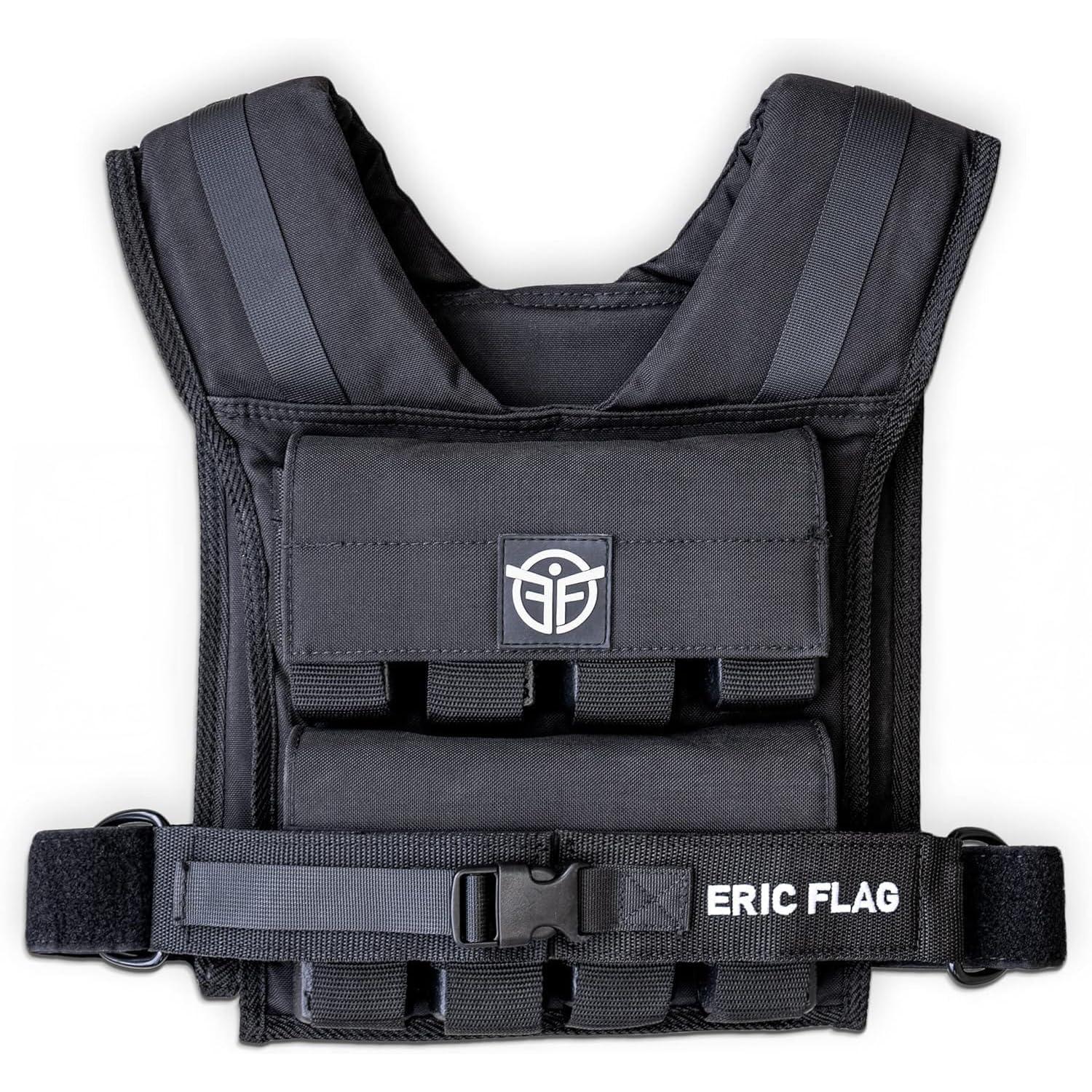
ERIC FLAG 40 lb Vest
Key Features
- Weight Range: 0-40 lb adjustable
- Comfort & Fit: Ergonomic, padded shoulders
- Material & Odor: 1000D Oxford, no odor
- Seam Durability: Robust stitching
- Price: $$$$
The Eric Flag vest differentiates itself with 2.4 lb iron weight increments and 1000D Oxford nylon construction that feels built to last. Weight distribution stays even during calisthenics or rucking, but the added material and higher max load make it less ideal for running — it can trap heat on longer runs and the shoulder padding may dig in at max weight. This vest suits athletes who want precise load progression for strength work, not casual runners looking for a lightweight, breathable option.
Pros
- 16 iron weights allow fine 2.4 lb increments for gradual load progression.
- 1000D Oxford nylon and iron construction hold up to repeated heavy use.
Cons
- In warm weather or during runs, the vest may trap heat and become uncomfortable.
- Shoulder padding can cause pressure points when loaded near 40 lb.
If your training calls for precise weight adjustments and rugged durability over lightweight running comfort, this vest delivers — just keep it off the pavement in hot weather.
Best for Budget Runners
ZELUS Weighted Vest

Key Features
- Weight Range: 6-30 lb fixed
- Comfort & Fit: Adjustable buckle, no rub
- Material & Odor: Iron sand, strong odor
- Reflective Strips: Reflective stripes
- Seam Durability: Tearing after limited use
- Price: $$
This popular ZELUS vest delivers a comfortable fit, reflective stripes, and storage for walking and light jogging at a budget price. Strong chemical odor on arrival and possible seam wear after extended use keep it from top-tier recommendation.
Pros
- Comfortable fit that avoids shoulder pressure and rubbing during movement.
- Solid construction feels substantial and well-made for the price range.
Cons
- Strong chemical odor may be present on arrival and can linger for some time.
A reasonable choice if you prioritize low cost and comfort over zero-smell and long-term seam integrity for walking and light jogging.
Best for Walkers & Hikers
Henkelion Weighted Vest

Key Features
- Weight Range: Fixed weight options
- Comfort & Fit: Comfortable, non-rubbing
- Material & Odor: Neoprene, gas-like odor
- Reflective Strips: Reflective strips
- Seam Durability: Sand leakage reported
- Price: $$
This weighted vest offers good comfort and weight distribution for walking and hiking, making it a decent choice for those adding light resistance. However, a strong gasoline-like odor is present on arrival, and seam tears have been reported after limited use, similar to other budget options. The fixed-weight design suits moderate activity, but the smell and durability concerns reduce its appeal for frequent workouts.
Pros
- Comfortable fit with minimal chafing during walks and hikes.
- Adds a challenge without bulk for moderate activity.
Cons
- Strong chemical odor may be noticeable on arrival and can linger.
Best suited for walkers and hikers who can tolerate the initial odor; not recommended for those sensitive to smells or needing long-term durability.
Best for Adjustable Gym
APEXUP Adjustable Vest

Key Features
- Weight Range: 4-32 lb adjustable
- Comfort & Fit: Stays in place, no shoulder pain
- Material & Odor: Ironsand, strong odor
- Reflective Strips: Reflective stripes
- Seam Durability: Solid stitching
- Price: $$
This vest adjusts from 4 to 32 lb via iron sandbags, with solid stitching that holds up during walking and gym workouts. The strong chemical odor on arrival needs airing out, and the vest isn’t ideal for running due to potential bounce — best for strength training or brisk walks where that smell and fit stability are less of a concern.
Pros
- Comfortable fit that stays in place during movement
- Adjustable weight system allows progressive overload without tools
Cons
- Strong chemical odor on arrival
Works well for progressive weight training where adjustability matters most.
Best for Petite Beginners
Zeerun Weighted Vest

Key Features
- Weight Range: 6-30 lb fixed
- Comfort & Fit: Thickened shoulder pads
- Material & Odor: Iron particles, Neoprene
- Reflective Strips: Reflective stripes
- Price: $
Zeerun’s weighted vest is affordable and offers comfortable padding for walking or strength training. Even weight distribution works well for low-impact sessions. However, it runs small and the adjustable buckle can loosen during movement, making it unsuitable for running or anyone with a larger frame. This is a budget option for casual use, not a reliable running companion.
Pros
- Budget-friendly with solid build quality for the cost.
- Even weight distribution for walking and light workouts.
Cons
- Strap can loosen during activity; sizing may be too snug for larger frames.
A passable choice for petite users doing light walking, but not recommended for running due to fit and stability compromises.
Best for Budget Walkers
VBSD Weighted Vest

Key Features
- Weight Range: 6-30 lb fixed
- Comfort & Fit: Well-padded, no chest discomfort
- Material & Odor: Iron sand, Neoprene, slight odor
- Reflective Strips: Reflective straps
- Price: $
The VBSD delivers comfortable padding and a detachable front pocket for phone storage, making it a practical option for walking and light jogging at a low price. Some units have a factory smell that fades after airing out — a minor tradeoff for the storage and value.
Pros
- Well-padded design keeps weight evenly distributed for walking.
- Detachable front pocket securely holds a phone during exercise.
Cons
- Some units arrive with a slight factory odor that fades after airing out.
Best for budget-conscious walkers who want a phone pocket and can tolerate a brief odor period.
Best for Walking/strength
Poudee Weighted Vest

Key Features
- Weight Range: 6-30 lb fixed
- Comfort & Fit: Soft padding, no irritation
- Material & Odor: Polyester, iron sand
- Reflective Strips: Reflective stripe
- Price: $
This vest is well-padded and comfortable for walking and light strength training, offering solid quality at a budget-friendly price. However, the fit is too loose for running — it bounces and shifts during high-impact movement. It also runs large, so petite individuals may struggle to get a secure fit. A good option if your routine stays on the ground and you have an average-to-large frame.
Pros
- Comfortable and well-padded
- Good quality for the price
Cons
- Bounces during running due to loose fit
A practical choice for walking-focused training on larger frames, but not for running.
Best for Rucking/crossfit
Wolf Tactical Weighted Vest

Key Features
- Weight Range: Adjustable plate not incl
- Comfort & Fit: Secure, no bounce
- Material & Odor: 600D nylon, no odor
- Seam Durability: Robust tactical build
- Price: $$$$
This vest uses durable 600D nylon and MOLLE panels for attaching gear, making it a strong option for rucking or CrossFit. But its bulky design can cause chafing during runs, and weight plates are sold separately – better suited for tactical training than running.
Pros
- Robust 600D nylon build withstands heavy rucking loads
- Secure fit keeps weight plates stable during dynamic movements
Cons
- Bulky build can cause chafing during high-mobility activities like running
For rucking and CrossFit, this vest delivers durability and customization – but runners should opt for a lighter, slimmer vest.
How to Choose
The key to a weighted vest that works for running is a secure, bounce-free fit — fixed-weight designs often outperform adjustable ones in this regard.
Weight Range and Adjustability
Fixed-weight vests are lighter and less bulky than adjustable models, which reduces bounce during high-impact movement. They trade away the ability to progress weight gradually, but for running consistency matters more than micro-increments.
Adjustable vests with removable iron weights offer fine control (like 2.4 lb increments) but the extra fabric and openings create more shifting. If you plan to use the vest solely for running, a fixed-weight vest in the 6–20 lb range is the practical choice.
Comfort and Fit
A running vest must stay tight against the torso without restricting breathing. Double adjustable straps — one across the chest, one around the waist — allow you to dial in snugness individually. Single-buckle designs tend to loosen as you move.
Padded shoulders help distribute load evenly and prevent chafing on longer runs. Look for vests with at least 1/4 inch of foam or gel padding, especially if you plan to carry 15 lb or more.
Material and Odor
The chemical smell reported in many budget vests comes from low-grade neoprene and iron sand mixtures that off-gas during manufacturing. This smell may not fully dissipate even after airing out, and it can be strong enough to cause headaches during exercise.
Vests made from nylon or polyester with encapsulated iron pellets rarely have odor issues. If you see ‘neoprene’ in the material list and the price is under $25, expect some factory smell.
Reflective Strips
Reflective elements are a safety essential for road running, but their quality varies. Some vests use printed reflective ink that wears off after a few washes, while others sew in retroreflective tape that lasts the life of the vest.
For early morning or dusk runs, choose a vest with reflective panels on both the front and back. A single strip across the chest is less visible from the side.
Seam Durability
Seam failures and sand leakage are the most common reasons a weighted vest becomes unusable. Double-stitched seams and bar-tacking at stress points (shoulder connections, buckle anchors) significantly extend lifespan.
Vests that use iron sand rather than solid iron pellets are more prone to leaking because the fine particles can work through stitching over time. If you run daily, a vest with sealed internal weight pouches is a safer bet.
FAQ
Why does my weighted vest smell like chemicals and how do I get rid of it?
The smell comes from cheap neoprene and iron sand compounds used in budget manufacturing. Air the vest outside for 2-3 days, then wipe down with a mild vinegar solution. If the odor persists after a week, it is embedded in the material and unlikely to fade. At that point, replacing the vest is the only effective fix.
Can I run in a weighted vest without it bouncing?
Yes, but only with a vest that has a snug fit and minimal bulk. Fixed-weight vests with double adjustable straps — one around the chest, one at the waist — eliminate most bounce. Avoid adjustable pocket vests with loose fabric; they shift with each stride. A vest that fits like a second skin will stay put during a 5K run.
What weight vest is best for running versus walking?
For running, go with a fixed-weight vest in the 6–20 lb range that has no moving pockets and a low-profile design. For walking, a heavier adjustable vest up to 30 lb works fine because the lower impact allows more movement. Running requires stability; walking tolerates bulk.
How tight should a weighted vest be for running?
Snug enough that you cannot slide a full hand between the vest and your chest, but not so tight that your breathing is restricted. You should be able to take a deep breath without the vest lifting off your shoulders. Adjust both the chest and waist straps, then do a few jumping jacks — if the vest shifts, tighten further.