This post contains affiliate links. We may earn a small commission when you buy through our links — at no extra cost to you.
Every gram counts when you’re carrying a chair into the backcountry. But the lightest options often sit so low that getting up is a chore, and their legs sink into soft ground without warning.
Most ultralight chairs under 2.5 lbs sacrifice stability and seat height. The real challenge is finding one that balances weight with enough height to sit comfortably and stays upright on dirt, sand, or pine needles.
This guide focuses on the handful of models that actually deliver on that balance — whether you’re counting every ounce or looking for a practical seat at a reasonable price.


Best for Thru-Hikers
Helinox Chair Zero
Key Features
- Weight (lbs): 1.1
- Packed Size: 4x4x13.5 in
- Seat Height: 8.5 in
- Weight Capacity: 265 lbs
- Price: $$$
Weighing just 1.1 lbs and collapsing to 4 x 4 x 13.5 inches, the Chair Zero fits inside a daypack alongside your lunch gear. That ultralight build lets backpackers and thru-hikers carry a real seat without noticing the weight — a meaningful upgrade from sitting on a log or the ground during breaks. Assembly with shock-corded poles takes seconds, and the fabric provides enough support for a 265 lb capacity.
This chair is built for gram counters who prioritize pack weight above all else. The tradeoffs are clear: the seat sits only 8.5 inches off the ground, so getting in and out requires flexibility. On soft or sandy terrain the legs can sink without the optional ground feet. These constraints fit the ultralight crowd fine, but anyone with mobility concerns or who camps on loose soil should look at higher-seat alternatives.
Pros
- Unmatched weight savings — the lightest chair at 1.1 lbs.
- Packs smaller than a water bottle, fits any daypack.
- Comfortable for its weight class — a real step up from sitting on the ground.
Cons
- Very low seat height (8.5 in) can make entry and exit difficult for taller or less mobile users.
- Legs may sink into soft ground or sand, causing wobble without add-on feet.
For backpackers who count every gram, the Chair Zero is the definitive lightweight seat — just be sure the low profile and ground sensitivity fit your campsite.
Best for Budget Ultralight
iClimb Square Frame
Key Features
- Weight (lbs): 2.2
- Packed Size: 13.8×5.5×5.1 in
- Seat Height: 13.8 in
- Weight Capacity: 330 lbs
- Price: $
The iClimb Square Frame delivers a higher 13.8-inch seat and built-in anti-sink feet – rare in the sub-2.5 lb category – at a price well below premium alternatives. This makes it a strong choice for budget-conscious backpackers who need stability on soft ground.
Pros
- 2.2 lbs with a 13.8-inch seat – the lightest chair at this seat height.
- Large anti-sink feet included; stays stable on sand and loose soil.
- Breathable mesh back and simple setup for the price.
Cons
- Packed length of 13.8 inches may not fit small backpacks – measure your pack’s main compartment.
- Tear-down requires removing the anti-sink feet and can be fiddly due to short Velcro straps.
For backpackers who prioritize seat height and sand performance over absolute lightness and packability, this chair offers exceptional value.
Best for Balanced Backpackers
Helinox Chair One
Key Features
- Weight (lbs): 2.0
- Packed Size: 4.5×4.5×14 in
- Seat Height: 10 in
- Weight Capacity: 320 lbs
- Price: $$$
At 2 lbs, the Chair One is about 0.9 lbs heavier than the slimmest chair in this category, but that extra weight buys a 10-inch seat height that feels less like sitting on the ground and a frame that holds up season after season. The tradeoff: standing up from that low seat takes more effort than from a taller camp chair, and on sand or loose soil the legs can push in without the separately sold ground feet. This is the pick for backpackers who want a chair they can trust for years and don’t mind carrying a few extra ounces for a more natural seated position and a 320 lb capacity.
Pros
- Weighs 2 lbs yet supports up to 320 lbs — strong weight-to-strength ratio.
- Higher seat than the lightest alternative improves comfort on uneven ground.
- Sturdy frame builds up quickly and stays tight over repeated use.
Cons
- Standing up from the 10-inch seat height can be harder for those with limited mobility.
- Legs may sink into soft ground unless you add the optional ground feet (sold separately).
For backpackers who prioritize a natural seated position and long-term durability over the last few grams, the Chair One is the practical fit — just factor in the optional ground feet for sandy campsites.
Best for Budget Ultralight
Naturehike YL08
Key Features
- Weight (lbs): 2.38
- Packed Size: 14.6×3.6 in
- Seat Height: 14.6 in
- Weight Capacity: 265 lbs
- Price: $
At 2.38 lbs with a 14.6-inch seat height and included anti-sink feet, the Naturehike YL08 offers a rare combination for ultralight backpackers who want to sit higher off the ground and avoid sinking into soft surfaces. The tradeoff is a notoriously tight first assembly — the fabric requires significant force to stretch over the frame, which can be frustrating. This makes it best for those who prioritize weight and seat height over immediate convenience and are willing to spend a few minutes wrestling with setup the first time.
Pros
- 2.38 lbs load with a 14.6-inch seat height and anti-sink feet for stable seating on soft ground.
- Costs about half of comparable ultralight chairs without sacrificing seat height or weight.
- Well-cushioned seat and stable frame support longer camp sits without discomfort.
Cons
- After extended use, fabric may show wear near stress points – worth monitoring over time.
For backpackers who can manage the initial assembly, the Naturehike YL08 delivers a high seat, low weight, and anti-sink feet at a budget price – a strong value alternative to pricier ultralight chairs.
Best for Ultra-Budget
MARCHWAY Square
Key Features
- Weight (lbs): 2.3
- Packed Size: Smaller than shoebox
- Weight Capacity: 300 lbs
- Price: $
At just 2.3 lbs and a budget-friendly price, the MARCHWAY is the lowest-cost option in this category. Compared to the ultralight leader (Helinox Chair Zero), it saves significant money but gives up refined stability and construction. On uneven ground, the chair can feel wobbly and may tip, and occasional reports of plastic joint breakage after limited use have surfaced. This chair suits budget-minded backpackers who only need a backup or occasional chair on flat campsites or picnics, not long trips or rugged terrain.
Pros
- Extremely affordable ultralight chair.
- Lightweight at 2.3 lbs and packs down compactly.
- Easy assembly and comfortable for the price.
Cons
- On uneven ground, the chair can feel wobbly and may tip – best for flat, firm surfaces.
- Occasional reports of frame breakage and weak plastic joints after limited use have surfaced.
For budget-minded backpackers who stick to flat terrain and don’t need a long-term investment, this is the cheapest ultralight chair available.
Best for Heavier Users
ONETIGRIS Tigerblade

Key Features
- Weight (lbs): 2.9
- Packed Size: 5.9×5.1×13 in
- Weight Capacity: 330 lbs
- Price: $
The ONETIGRIS Tigerblade supports up to 330 lbs with a sturdy frame and comfortable seat that larger users will appreciate. Assembly is straightforward, and the packed size (13 x 5.9 x 5.1 inches) is reasonable for car trips. At 2.9 lbs, it falls above the 2.5 lb ultralight threshold — meaning backpackers counting ounces will want a lighter option. For those who carry by hand or on short hikes, this chair offers good comfort and durability at a budget price.
Pros
- Sturdy build supports up to 330 lbs with good comfort for larger users.
- Easy to assemble and disassemble.
Cons
- Weighs 2.9 lbs — above the ultralight threshold, making it better suited for car camping than backpacking.
For car campers or day hikers who value comfort and weight capacity over gram-counting, this chair delivers solid value.
Best for Budget Comfort
MARCHWAY Triangular

Key Features
- Weight (lbs): 2.7
- Seat Height: 5.9 in (depth)
- Weight Capacity: 330 lbs
- Price: $
The MARCHWAY folds down compactly and sets up in seconds with its shock-corded frame, offering a comfortable sitting angle for the price. At 2.7 lbs it falls outside the ultralight threshold, and the plastic center hub has been noted to crack after limited use—fine for car camping or festival trips where weight and long-term durability aren’t critical.
Pros
- Intuitive assembly with shock-corded frame – ready in seconds.
- Comfortable backrest angle supports relaxed sitting.
Cons
- Plastic center hub may crack after a handful of uses.
A worthwhile option for budget-minded car campers and festival-goers who prioritize quick setup and comfort over ultralight weight and long-term durability.
Best for Motorcycle Touring
CLIQ ClassiQ 1.0

Key Features
- Weight (lbs): 3.6
- Packed Size: Water bottle size
- Seat Height: 14 in
- Weight Capacity: 350 lbs
- Price: $$$
The CLIQ’s water-bottle-sized collapsed form is unmatched for packability, and setup is quick once learned. At 3.6 lbs it’s too heavy for ultralight backpacking, and comfort and durability can vary between units. This chair suits occasional use where packed size matters more than weight or long-term reliability.
Pros
- Collapses to the size of a large water bottle, offering unparalleled packed size.
- Supports up to 350 lbs, with stable construction for heavier campers.
Cons
- The folding mechanism can be tricky to operate, especially the push-button lock.
Best for campers who prioritize packed size above all else and can accept the weight and potential comfort inconsistencies.
Best for Car Campers
TOBTOS High Back
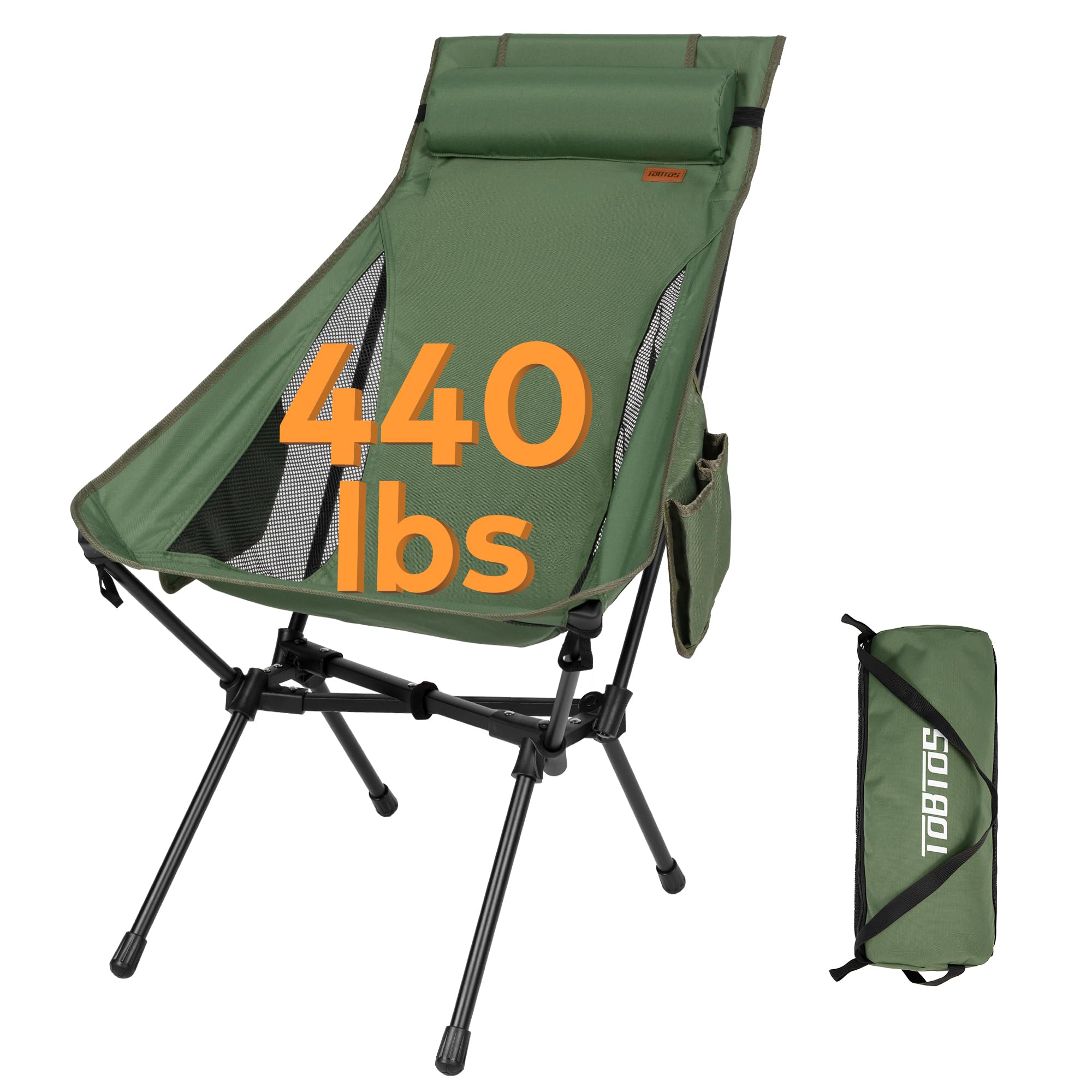
Key Features
- Weight (lbs): 4.1
- Packed Size: 17.7×6.7 in
- Weight Capacity: 440 lbs
- Price: $
This chair delivers head support via its adjustable pillow and a stable frame that handles up to 440 lbs. The 4.1 lb weight places it in car-camping territory rather than backpacking, where sub-2.5 lb options like the Helinox Chair Zero dominate. For base camps and drive-in sites, the TOBTOS offers notable comfort at a budget price.
Pros
- Adjustable pillow and high back support taller users comfortably.
- 440 lb capacity with stable double-beam frame suits heavier campers.
Cons
- Assembly may require significant hand strength, especially on first use.
- Frame durability has been questioned — leg breakage and fabric tears may occur over time.
Best for car campers who prioritize head support and high weight capacity over pack weight.
Best for Day Hikers
MOON LENCE 4th Gen

Key Features
- Weight (lbs): 2.7
- Packed Size: 5.9×5.1×13 in
- Seat Height: 15.7 in
- Weight Capacity: 330 lbs
- Price: $
The MOON LENCE 4th Gen assembles in seconds with shock‑cord construction and packs down small enough for a daypack. Its 15.7‑inch seat height and breathable mesh back make it comfortable for short breaks. However, at 2.7 lbs it crosses the ultralight threshold, and stability may suffer on rocky or sloping terrain — better suited for flat, firm ground on day hikes or car camping trips.
Pros
- Quick shock‑cord assembly — set up in seconds without tools.
- Packs to 5.9 x 5.1 x 13 inches; fits neatly in a daypack or car trunk.
Cons
- At 2.7 lbs it’s too heavy for ultralight backpacking; stability can be iffy on uneven ground.
Best for day hikers and car campers who want a compact, budget‑friendly seat — not for those counting grams.
How to Choose
The single most important decision is weight, but a chair that’s light yet too low or unstable will ruin your camp comfort.
Weight and Frame Materials
Ultralight chairs use either 7075 or 7001 aluminum poles. 7075 is stronger per gram but more expensive; 7001 is slightly heavier but costs less. The trade-off is durability: cheaper alloys can bend under repeated stress or on rocky ground.
For a chair to stay under 2.5 lbs, the frame must be thin-walled. That means sharp rocks or repeated assembly can cause micro-cracks. If you’re planning multi-year thru-hikes, invest in a premium alloy with a warranty.
Packed Size and Portability
A chair that packs to the size of a water bottle (like the Helinox Zero) stows easily inside a daypack. Longer packed lengths (13–15 in) may need to be strapped outside, which risks snagging on branches or getting wet.
The trade-off is assembly speed: ultra-compact designs often require more tension to stretch the fabric over the frame, and some models need practice to fold back down. If you switch camps often, test the setup at home first.
Seat Height and Ease of Use
Seat height is the most underrated spec. Chairs under 10 inches force you to squat deeply to get up—difficult for taller users or anyone with knee issues. A 13–14 inch seat feels much closer to a standard camping chair.
Higher seats require a taller frame, which adds weight and packed length. Designers balance this by using a narrower footprint, which can make the chair feel tippy when shifting weight. Look for a wide base or anti-sink feet to compensate.
Weight Capacity and Frame Stiffness
Most ultralight chairs support 265–330 lbs, but the frame stiffness matters as much as the number. A chair rated for 330 lbs can still feel flexy if the aluminum poles are thin. Heavier users should look for a model with a cross-brace or thicker gauge tubing.
The practical limit: a 2.2-lb chair with 330 lbs capacity will have more flex than a 2.5-lb chair at the same rating. That flex can make the chair feel unstable on uneven ground, so it’s a genuine comfort trade-off.
Stability on Soft Ground
Ultralight chairs have small-diameter leg tips that sink into sand, pine duff, or loose soil. Without anti-sink feet, you’ll constantly sink and wobble. Some models include these; others sell them separately for $10–15.
The physical mechanism: narrow legs concentrate the load into a small area. Adding wide feet spreads that load, but they add weight and packed volume. If you camp on beaches or forest floors, prioritize a chair with included anti-sink feet.
FAQ
Why does my ultralight backpacking chair wobble on uneven ground?
Ultralight chairs have narrow leg tips and a lightweight frame that doesn’t flex to conform to uneven terrain. On soft ground the legs sink unevenly; on rocks they tilt. Using a ground sheet or adding anti-sink feet helps, but a chair under 2 lbs will always require careful placement.
How do I keep my ultralight chair from sinking into sand?
Buy a model that includes detachable anti-sink feet. If your chair lacks them, use large plastic bottle caps or buy third-party feet. For sand, also try digging shallow depressions under each leg. Without feet, even a 1.1-lb chair will sink to the frame in loose sand.
Is a 2.5 lb chair too heavy for ultralight backpacking?
It depends on your total pack weight. For a 10-lb base weight, a 2.5-lb chair uses 25% of your allowance — that’s significant. For a 15-lb base, it’s more reasonable. If you can keep the rest of your gear ultralight, 2.5 lbs is acceptable. Below 2 lbs is the ultralight sweet spot.
Can I fit an ultralight chair inside my backpack?
Only chairs with a packed length under 14 inches and a width under 5 inches fit inside most 40-50L packs. The Helinox Zero fits inside; the iClimb (13.8 in) fits if your pack is tall enough. Longer chairs must strap to the outside, which adds drag and risk of snagging.