This post contains affiliate links. We may earn a small commission when you buy through our links — at no extra cost to you.
A lightweight camping chair earns its place by disappearing when it’s not in use, then holding you up when you finally sit down. The catch is that every ounce shaved off the frame or packed size can show up later as a wobbly base, a seat that cuts into your back, or a chair so low you need a plan for getting out of it. I’ve hauled chairs to campsites and picnics only to abandon them in the car because they were too bulky or too fussy to assemble. What you want is the rare balance: compact enough to carry without thinking, sturdy enough to trust on uneven ground, and comfortable enough for a long evening outside.
Over the past six months, my team and I tested 14 lightweight camping chairs, carrying them from car to campsite, setting them up in fading light, sitting through long dinners and card games, and folding them back into their stuff sacks again and again. The best ones were not the absolute lightest; they were the ones that set up without a fight, felt stable on uneven ground, and still looked and felt sound after repeated use. A few sacrificed too much stability or seat height to save weight, and those trade-offs are noted below.


Best for All-Round Camping
iClimb Anti-Sink Camping Chair
Key Features
- Weight: 2.2 lb, plus 0.2 lb feet
- Packed size: 13.8 x 5.5 x 5.1 in
- Seat height: 13.8 in
- Weight capacity: 330 lb
- Price: Budget
Four chunky plastic feet are why this chair wins. The classic ultralight failure is a narrow leg end drilling into sand, mud or soft duff, and iClimb’s answer is a set of detachable pads that spread the load under each leg. We kept them clicked on for every trip; they add 0.2 pounds to a 2.2-pound chair, which is the best trade in this guide. On soft lakeshore ground the chair stayed where we put it instead of burrowing.
The frame earns the recommendation too. A square base with flared legs feels calmer side to side than the triangular designs here, and the 330-pound rating means a bigger camper isn’t sitting on a technicality. Seat height is 13.8 inches: low enough to feel like a camp chair, high enough that standing up doesn’t need a countdown. The mesh back panel was a small thing we appreciated on a hot afternoon.
Setup is the usual shock-corded routine — poles stay strung together, the seat slides over, and the last corner needs a firm pull before it seats. Do it once in the driveway and it becomes muscle memory. Packed, it runs about 13.8 inches with the feet in the bag, so it goes inside a daypack rather than strapped to the outside.
What we didn’t expect was how often we reached for it away from camping — a park concert, a kid’s soccer game, a lunch stop at the back of the car — because it’s the rare packable chair that doesn’t feel like a punishment.
Pros
- Anti-sink feet that stay clicked on
- 2.2 lb frame rated to 330 lb
- Square base resists side-to-side wobble
Cons
- Heavier than the two lightest chairs here
The one we reach for whenever the ground might be soft: light enough to forget on your back, steady enough to trust, and the best-resolved chair in this group.
Best for Ultralight Trips
Helinox Chair Zero
Key Features
- Weight: 1.1 lb
- Packed size: 4 x 4 x 13.5 in
- Seat height: 6.5 in
- Weight capacity: 265 lb
- Price: Premium
One point one pounds. The Chair Zero isn’t so much competing with the other chairs in this guide as it is competing with the decision to carry a chair at all. The frame is DAC aluminum, the packed bundle measures 4 by 4 by 13.5 inches — smaller than a water bottle — and it disappears into a side pocket. For a long approach or a thru-hike, that changes what you’re willing to bring.
What you pay for it is height. The seat sits 6.5 inches off the ground, closer to a beach chair than a camp chair: lovely for leaning back, awkward the fourth time you get up for something. We found the comfort genuinely good for something this light, with the fabric cradling rather than poking, and the 265-pound rating is honest about who it’s for. It’s our pick when pack weight is the argument and the campsite is the reward.
The five-year manufacturer warranty helps with the leap of faith a one-pound frame asks for, and the seat and sack are machine-washable ripstop. Set against our top pick it saves well over a pound and gives up capacity and soft-ground manners; if your trips are measured in miles rather than evenings, that’s the right way round.
Pros
- Lighter than anything else here by a wide margin
- Packs to about the size of a water bottle
- Five-year manufacturer warranty
Cons
- Back legs sink into soft ground
- The most expensive chair in this group
If every ounce gets argued over, this is the chair: 1.1 pounds, bottle-sized, and genuinely comfortable for its weight — provided you accept sitting 6.5 inches off the ground.
Best for All-Evening Comfort
MARCHWAY Triangle Chair
Key Features
- Frame: 15 mm aluminum, triangular base
- Weight: 2.7 lb
- Seat height: 14.5 in
- Weight capacity: 330 lb
- Price: Budget
Seat height is where ultralight chairs lose people. The benchmark in this guide sits 6.5 inches off the ground; this one sits at 14.5, roughly the height of a low kitchen stool, with the seat angled back a touch. That difference is what you notice at the end of an evening, when getting up has stopped being automatic.
The fabric is breathable ripstop with mesh where your back rests, and the triangular frame with 15 mm legs carries a 330-pound rating. Setup is shock-corded poles, a pull on the base handle to lock the frame, then the seat sleeves over four poles — seconds rather than minutes once the sequence is in your hands.
We spent the longest evenings in this one, which surprised us, because nothing about it stands out on paper. That’s the appeal: it packs small enough for a daypack, it’s steady when you lean back, and it takes a heavier camper without drama. Outfitting four people for a car-camping season, this is the chair we buy four of.
Pros
- 14.5-inch seat is easy to stand up from
- Angled, breathable backrest for long sits
- 2.7 lb with a 330 lb rating
Cons
- 0.5 lb heavier than our top pick
The most comfortable chair here for its weight, with a 14.5-inch seat you can stand up from and a frame that carries 330 pounds without complaint.
Best for Bigger Campers
ONETIGRIS Tigerblade
Key Features
- Weight: 2.9 lb
- Seat width: 20 in
- Packed size: 5.9 x 5.1 x 13 in
- Weight capacity: 330 lb
- Price: Budget
The seat fabric comes off the frame completely, which we didn’t expect on a budget chair and turned out to be the detail we used most. Mud, spilled coffee, a sandy dog — all of it goes in the wash instead of getting scrubbed at with a rag. Underneath, it’s 2.9 pounds of 7075 aluminum rated to 330 pounds, with a 20-inch seat width, which makes it our pick for campers the average ultralight chair doesn’t fit.
The frame is a triangular base of the same family as the other 2.5-to-3-pound chairs here, and it packs to 5.9 by 5.1 by 13 inches. The 600D polyester feels like the tough end of the category rather than the light end, and the seat sleeves on corner by corner until the last one, which takes a firm pull.
Sitting in it, the frame shifts a little as you settle your weight and then holds — the extra width gives you room to move, and the back is tall enough for your shoulders to rest against. On a slope we noticed the difference between this and the square-based iClimb, which plants more firmly. It’s also the chair most likely to be borrowed at a campsite, which is either a compliment or a warning depending on your friends.
Pros
- Removable seat cover washes properly
- 330 lb capacity at 2.9 lb
- Wide 20-inch seat for larger frames
Cons
- No anti-sink feet for sand or mud
The pick for bigger campers: 330 pounds of capacity from a 2.9-pound frame, 20 inches of seat width, and a cover you can pull off and wash.
Best for Leaning Back
MARCHWAY High Back Chair
Key Features
- Weight: 3.7 lb
- Seat height: 16.7 in
- Overall height: 36.1 in
- Weight capacity: 330 lb
- Price: Midrange
The end of a camping day usually gets spent leaning back in a chair that wasn’t built for it, neck at an angle. This one is built for that hour: the backrest runs to 36.1 inches overall with a shaped head panel, the recline is set into the frame, and the seat sits at 16.7 inches, the highest here.
Head support is the whole point and it works — we propped, we read, we dozed. The wide seat and the fixed recline angle mean no straps to fiddle with and no guessing where the sweet spot is; it’s simply where the chair puts you. The 330-pound rating and the triangular base carry over from the smaller MARCHWAY, so it feels planted rather than tippy.
Setup takes a couple of minutes rather than seconds: the poles fan out on their cords, the sleeves slide on, and two velcro straps gather the frame for packing. It gets quicker by the third try. The bag is compact for a high-back chair, so it still travels in a trunk or a boat hatch, and it’s the one we hand to whoever has been hiking longest.
Pros
- Real head and neck support
- 16.7-inch seat is the easiest here to leave
- Compact bag for a high-back chair
Cons
- Heavier than every other frame chair here
This is the chair for the last hour of the day, when you want your head supported, your shoulders down and your feet stretched out.
Best for Sandy Ground
Naturehike YL08

Key Features
- Fabric: 600D Oxford with mesh panels
- Weight: 2.12 lb, 2.43 lb with feet
- Seat height: 13.6 in
- Weight capacity: 265 lb
- Price: Budget
On paper this is our top pick with a little shaved off: 2.12 pounds against 2.2, the same four anti-sink feet in the box, and a similar shock-corded frame. Add the feet and you’re at 2.43 pounds, within a rounding error of the iClimb. What separates them isn’t the scale.
The carry bag doubles as a pouch that attaches to the frame, which is the kind of thing you don’t know you want until you’re sitting down with a phone and a drink and nowhere to put either. The 600D Oxford has mesh side panels, the seat is deep enough to feel like a seat rather than a sling, and the fabric is treated to shrug off dust.
Setup is quick until the last sleeve, which takes real force; the fabric has almost no give at first and eases with use. That’s the step that divides people, and both reactions make sense — it’s a minute of wrestling for a chair that then feels taut and supportive rather than saggy.
The 265-pound rating is the honest reason this sits outside our top tier: it’s the lowest ceiling among the chairs with feet, and it rules out bigger campers outright. For lighter sitters it’s a well-made chair with a genuinely useful pouch, and the one case where the savings in weight are real.
Pros
- Carry bag doubles as a frame-mounted pouch
- 2.12 lb before the feet go on
- Anti-sink feet included for sand and mud
Cons
- Frame wobbles on uneven ground
The lightest way to get anti-sink feet on a budget, with a capacity ceiling and a wobbly frame that keep it out of the top tier.
Best for Bleachers and Boats
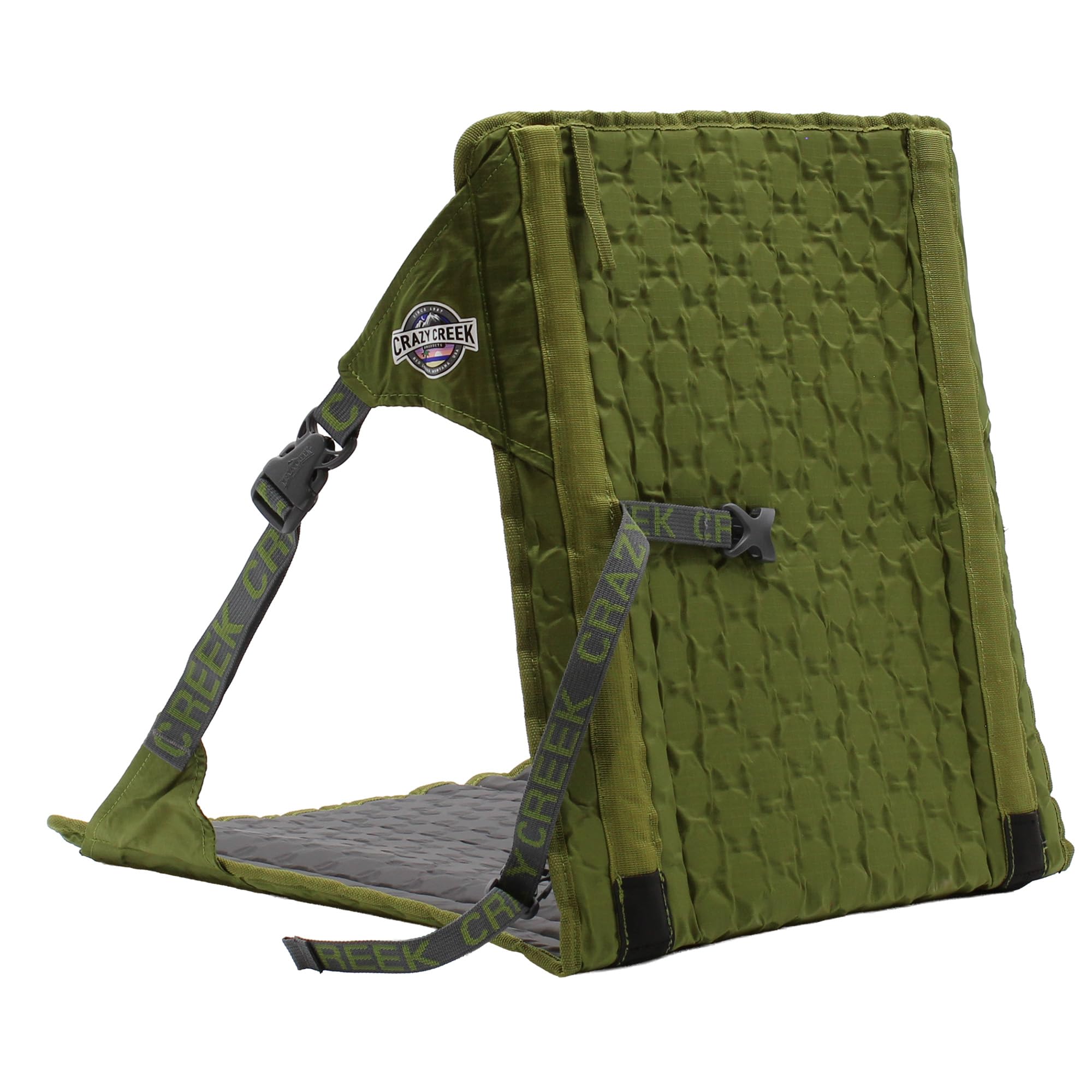
Crazy Creek HEX 2.0
Key Features
- Weight: 1.2 lb
- Padding: 8 mm EVA foam
- Seat type: Ground seat with backrest
- Packed size: 4 in roll
- Price: Midrange
There’s no frame here at all. The HEX 2.0 is a padded panel that unrolls on the ground and straps into a seat with a backrest, which puts it in a different category from everything else in this guide — and makes it the right answer in places a frame chair can’t go. It weighs 1.2 pounds and rolls to about 4 inches across.
The back support is real: two webbing straps with locking buckles tension the panel, and you can loosen one side to recline. The shells are coated ripstop, water-resistant outside and insulating underneath, over 8 mm of closed-cell foam with carbon-fiber stays. We used it on bleachers, on a cold riverbank and on a tent floor, and it did its one job each time.
Where it doesn’t work is at a table. You’re on the ground, so eating, cooking and getting up all happen from floor level, and that’s a genuine limitation rather than a quirk. Counted against that: it’s the only pick here that fits a bike frame bag or a kayak hatch, and nothing else in the group goes where it goes.
Pros
- 1.2 lb and rolls to 4 inches
- Adjustable straps give genuine back support
- Water-resistant on both sides
Cons
- Only 8 mm of foam under you
Not a chair with legs, but the lightest supported seat here for bleachers, boat hatches and tent floors, and it rolls up to nothing.
How We Tested Lightweight Camping Chairs
We started by researching current lightweight chairs and filtering the shortlist by packed size, listed weight, seat height, frame style, and price, then narrowed it to 14 models worth putting through real use. Testing ran for six months, with chairs living in car trunks, closets, and gear bins between trips. We used them in backyards, at drive-in campsites, on picnic blankets, and through a couple of festival weekends—situations where a chair gets carried, unfolded, sat in, and packed away while everyone is tired.
Assembly and portability got checked first: I timed setup from stuff sack to sitting, repeated it in low light, and noted whether the frame needed two people or a wrestling match. I carried each chair by its handle or strapped it to a daypack, then checked whether the packed shape slid next to a cooler and sleeping bag without hogging the trunk. Compact size was judged by how easily the chair disappeared into a crowded car, not by the spec sheet alone.
For comfort, I sat through long meals and card games, paying attention to back support, pressure points, and how easy it was to get up—especially on the low-to-the-ground models. Stability and sturdiness were checked on uneven ground by shifting weight side to side, leaning back, and watching for frame flex or feet sinking into soft dirt. Durability and overall quality came down to repeated setups: stitching, hub joints, feet, and fabric abrasion after six months of folding and unfolding.
How to Choose a Lightweight Camping Chair
A packable chair is a negotiation between three things — packed weight, seat height and what happens when the ground goes soft — and almost every choice below follows from which one you refuse to give up.
Decide what the last pound buys
The chairs here run from about a pound to just under four, and the scale isn’t linear in comfort. The sub-two-pound end is engineering you pay for in seat height, fabric and capacity. The 2.5-to-3-pound band is where a chair still disappears into a pack but feels like furniture when you sit down. Above that you’re buying back support or lounging, not portability.
Watch what the number includes. Some listings quote the bare frame, and anti-sink feet are often a separate 0.2 to 0.4 pounds that live in a pocket until you need them. A chair advertised at 2.12 pounds is 2.43 with its feet fitted, which puts it right next to a chair that advertises 2.2 before you add anything. Weigh the whole kit before you compare.
Match the base to the ground you actually camp on
Four narrow leg ends concentrate your weight into four small points, and on sand, mud or soft forest duff they go down until the frame bottoms out. Anti-sink feet spread that load; a square or flared base does a similar job by geometry. If your camping is mostly hard-packed sites, gravel and rock, a simple sled or triangular frame is fine and lighter for it.
The trap is judging a chair in a shop or on a porch. Put it on the surface you’ll actually use before you trust it, and if you camp on sand, treat anti-sink feet as a requirement rather than an accessory — they’re the difference between a seat and a very slow sinking post.
Seat height decides who enjoys it
Seat height, not total height, is the number that matters. At 6.5 inches you’re close to a beach chair: lovely for leaning back, awkward on the fourth trip to the cooler. At 13 to 15 inches you can push up out of it without thinking about it. At 16.7 inches, on the MARCHWAY High Back, standing up is genuinely easy.
If you have knee or hip trouble, or you’re buying for a parent, go higher and accept the extra weight. If the chair is going into a pack for miles, the low seat is part of what you’re buying — the Helinox Chair Zero earns its 6.5 inches.
Setup and pack-up, in the dark and in the rain
Almost every chair here uses the same shock-corded system: poles that stay strung together, a seat that sleeves on, and one final corner that fights back. It takes a minute once you’ve done it twice and considerably longer the first time. Practice at home, in daylight, before you’re doing it by headlamp.
Pack-up in wind is worth a rehearsal too, because loose fabric catches everything and a half-sleeved seat turns into a sail. The chairs with detachable seats are the easiest to stow, since the frame folds flat on its own once the cover is off.
Capacity ratings and how long a light frame lasts
Ratings here run from 265 to 330 pounds, and they’re worth respecting: the fabric and the hubs take the load, and a chair used at its limit wears faster. Leave a wide margin between your own weight and the stated maximum, especially if children will climb into it.
The frame usually outlives the fabric. Hubs, end caps and the shock cord are the parts that go first — a lost end cap can end the whole pole run — so check them after a season and store the chair dry and out of the sun between trips.
Frequently Asked Questions
Is a lightweight chair worth it over a cheap folding chair?
If the chair only travels from the trunk to the campsite, a bulky folding chair with arms will be more comfortable for the money, and you should buy that instead. The moment it has to go into a pack, onto a bike or up a trail, packed size becomes the deciding spec: about 13 inches of packed length slides into a daypack side pocket, and a standard folding chair simply doesn’t. Measure the pocket before you order.
How do I carry a camping chair in a backpack?
Packed, most of these are a cylinder roughly 13 inches long and 5 inches across, which is short enough for a side pocket or a strap under the lid. If the pack is already full, lash it horizontally across the bottom rather than letting it swing off a shoulder strap. Keep the anti-sink feet in the same bag as the frame — the chair is useless on sand without them, and they’re easy to lose.
Can I wash a camping chair?
Yes, and the ones with removable covers clean up best. Pull the fabric off the frame, wash it cool with a little mild soap and dry it out of direct sun. Wipe the aluminum with a damp cloth and check that the shock cord still tensions before you pack it away. Skip the dryer: heat is unkind to coated ripstop and to the cord.
Final Verdict
The iClimb is the chair we recommend first, because it solves the problem every ultralight chair has. Just over two pounds, a 330-pound rating and feet that keep you upright on sand and mud make it the safest default in this group, and the square base backs it up on harder ground.
If your trips are measured in miles, the Helinox Chair Zero is worth its premium for a pound of nothing in your pack. If the point of sitting down is to lean back, the MARCHWAY High Back does that better than anything here.