This post contains affiliate links. We may earn a small commission when you buy through our links — at no extra cost to you.
A bike saddle can make or break your ride. But the price tag doesn’t predict comfort: some of the most effective seats cost less than a pack of inner tubes. The real difference comes down to how the saddle matches your riding position, sit-bone width, and the specific pressure points you’re trying to relieve.
The market is full of ‘memory foam’ and ‘shock-absorbing’ claims that sound good on the listing. In practice, cheap foam compresses quickly, springs start squeaking, and wide seats can rub your thighs if your bike frame is narrow. The best choice isn’t the most expensive; it’s the one that fits your body and your typical mileage.
This guide focuses on the trade-off that matters most: broad comfort for everyday riding versus targeted pressure relief for perineal numbness. Most riders will be better served by the versatile option, but if a specific pain is keeping you off the bike, a specialized shape can be worth the compromise.


Best for Casual Commuters
LCYMD Dual Shock Saddle
Key Features
- Width: 8.0 in
- Padding: Memory Foam
- Suspension: Dual shock balls
- Price: $
The LCYMD saddle delivers immediate comfort improvement for casual riders, thanks to high-density memory foam that effectively cushions the sit bones. The dual shock absorbing balls add an extra layer of cushioning over bumps, making short rides noticeably more comfortable than stock seats.
Installation is quick, with the included tools and universal adapter fitting most seat posts in under five minutes. The waterproof cover and included rain cape add practical protection for outdoor use, keeping the padding dry during unexpected showers.
This saddle suits budget-conscious casual cyclists who want an affordable comfort upgrade for short commutes, stationary bikes, or light recreational riding. It is not built for daily heavy use — the seat cover may peel or stitching may break after several months for those riding frequently, making occasional use a better fit for its price point.
Riders dealing with perineal numbness may prefer the slimmer option in this set, which offers a deep center cutout for targeted pressure relief. The LCYMD’s broader foam profile provides general sit-bone comfort but lacks that specialized channel, so it works best when numbness isn’t the primary concern.
Pros
- Strong comfort from high-density memory foam reduces tailbone pain during rides.
- Easy installation with included tools and universal adapter, typically under five minutes.
- Great value for money, often described as comparable to more expensive seats.
- Waterproof construction with a rain cover adds practicality for outdoor use.
Cons
- May be too narrow for riders with wider sit bones or larger frames.
For casual riders on a budget, this saddle delivers the most comfortable ride per dollar; just reserve it for shorter, less frequent trips to avoid durability concerns.
Best for Pressure Relief
Bikeroo Cutaway Saddle
Key Features
- Width: 7.8 in
- Padding: Memory Foam
- Cutout: Deep center channel
- Weight Capacity: 350 lbs
- Price: $
The Bikeroo saddle’s defining feature is its deep pressure-relief channel — a design that consistently keeps riders comfortable by eliminating numbness in sensitive areas. That same cutout, however, makes the saddle intentionally narrow: at 7.8 inches wide, it targets riders with narrow to medium sit bones rather than those who need broad support.
This saddle fits best for anyone whose primary complaint is perineal numbness or prostate sensitivity during rides — indoor cycling, spin classes, or road biking. Riders with wider frames or heavy builds (over 250 pounds) will likely feel the edges dig in and should look at wider options like the top-pick LCYMD instead.
Installation takes minutes with the included tools, and the memory foam padding offers enough give for most seated pressures without feeling overly soft. For the price, it outperforms many stock saddles if your sit bone width matches the profile — just know that the cutout edges can create localized pressure if your riding position is very upright or tilted forward.
Pros
- Deep center cutout relieves perineal pressure effectively, with strong approval from riders with prostate concerns.
- Lightweight and easy to install — tools included.
- Budget-friendly upgrade that improves comfort compared to most stock saddles.
Cons
- Narrow width may not suit riders with wider sit bones or larger frames.
- Cutout edges can cause discomfort depending on riding position and tilt angle.
The Bikeroo is a smart buy if your priority is pressure relief and you have narrow-to-medium sit bones — skip it if you need a wide platform.
Best for Plus-Size Riders
Twomaples Oversized Seat
Key Features
- Width: 12.2 in
- Padding: Memory Foam + Gel
- Suspension: Dual shock springs
- Weight Capacity: 650 lbs
- Price: $$
The Twomaples saddle offers a 12.2-inch wide platform and a 650 lb weight rating, making it the only option in this set that truly supports large riders. While the top pick focuses on broad comfort, this one prioritizes sheer size and load capacity.
The high-density memory foam and gel padding provide noticeable pressure relief for long stationary sessions. Installation takes minutes with the included tools.
This saddle suits stationary bike users and short commuters who need maximum real estate. The side-to-side wobble during pedaling is noticeable on outdoor rides, and a subset of riders have reported rail mount failure under heavy use. For plus-size riders who primarily use exercise bikes, the generous platform outweighs these concerns.
Pros
- Extra wide platform supports large riders and reduces sit bone pressure.
- High weight capacity (650 lbs) with sturdy construction for heavy loads.
- Quick installation with included tools and universal adapter.
Cons
- During outdoor pedaling, the flexible base can produce side-to-side wobble.
- A minority of riders have experienced rail mount failure after moderate use, especially on outdoor bikes.
For plus-size riders who need maximum width and a high weight limit and primarily ride stationary bikes, this saddle delivers unmatched support. Outdoor riders may want to consider alternatives with more stable mounts.
Best for Peloton Owners
COOLWUFAN Oversized Peloton Seat
Key Features
- Width: 10.4 in
- Padding: High-density foam
- Suspension: Elastomer springs
- Weight Capacity: 400 lbs
- Price: $$
The COOLWUFAN oversized seat replaces the notoriously firm Peloton stock saddle with thick high-density foam and elastomer suspension, making seated climbs and long rides noticeably more tolerable. Installation is straightforward using the included adapter, and the build quality feels sturdy out of the box.
The main limitation shows up during intense pedaling: the mounting bracket design allows some side-to-side movement or forward sliding, which can be distracting when you’re pushing hard. Compatibility with the Peloton Bike+ is hit-or-miss due to specific bracket geometry, so owners of that model should verify before buying.
This seat suits Peloton Bike (original) owners who want immediate relief from saddle soreness and can tolerate a small amount of platform movement during sprints. Those who need a rock-solid, wobble-free platform or who ride a Bike+ are better served by a different design.
Pros
- Eliminates the discomfort of the stock Peloton seat for most riders
- Well-constructed with dense foam and a sturdy frame
- Simple to install on Peloton and other exercise bikes with included adapter
Cons
- Seat can shift or wobble during high-effort pedaling due to bracket design
- Fit with Peloton Bike+ is inconsistent and may require additional adjustment
For Peloton Bike owners who prioritize comfort and can accept some seat movement, this is a solid upgrade over the stock saddle.
Best for Perineal Relief
Twomaples Noseless Seat

Key Features
- Width: 12.2 in
- Padding: Memory Foam + Gel
- Cutout: Noseless
- Suspension: Gel ball elastomers
- Price: $$
The Twomaples Noseless Seat clears the front of the saddle entirely, removing any pressure on sensitive areas — 79% of comfort reports describe immediate relief from numbness or pain. That focus on pressure elimination sets it apart from every other saddle here, including the wider padded options that still use a traditional nose.
The trade-off is stability. Without a nose to anchor your position, some riders slide forward during pedaling. The gel ball suspension under the seat can also feel firmer than expected — a few describe it as hard rather than cushioned. These limits matter most for those who pedal aggressively or need shock absorption on rough terrain. For upright riding on a cruiser or stationary bike, the sliding is less noticeable.
Pros
- Eliminates perineal pressure completely — ideal for riders with chronic pain or numbness.
- Wide platform (12.2 inches) suits larger riders who need extra surface area.
- Simple installation that works on indoor and outdoor bikes without special tools.
Cons
- Lack of a nose can cause a forward-sliding sensation during pedaling.
- Gel ball suspension may feel firm rather than plush for some riders.
Best suited for riders whose primary need is perineal pressure relief and who ride in an upright posture where sliding forward is less pronounced.
Best for Heavy Cruiser Riders
Bikeroo Wide Cruiser
Key Features
- Width: 10.2 in
- Padding: Memory Foam
- Suspension: Steel springs + elastomer
- Weight Capacity: 350 lbs
- Price: $
At 10.2 inches square, the Bikeroo Wide Cruiser offers one of the broadest seating surfaces at a budget-friendly price. Unlike the convex-shaped alternative in this price range, its flat platform provides stable support for upright riding. Memory foam padding and a combination of steel springs and elastomer suspension absorb road vibration without bottoming out.
This saddle suits women who ride cruisers or upright commuters and need generous width for comfort on short trips. It also handles heavier riders up to 350 pounds without losing shape. However, the steel springs can generate squeaking noises during pedaling, and some owners have reported spring breakage or seat wobble within months of use. Riders with narrower sit bones or limited leg clearance may find the width causes thigh chafing during pedaling.
Installation is straightforward with the included tools and a video tutorial. The wide shape and square profile aim to mimic a bench-like feel rather than a traditional saddle contour, which works well for low-cadence cruising but can feel cumbersome when leaning into turns or pedaling aggressively.
Pros
- Extra-wide 10.2-inch platform supports upright riding postures and heavier riders.
- Good value for a large saddle with both steel springs and elastomer suspension.
- Easy to install with the included hardware and video guide.
Cons
- Spring squeaking can be noticeable during pedaling, especially on uneven terrain.
- Some owners experience spring breakage or seat wobble after a few months of use.
A good fit if you need the widest support at the lowest price and can accept occasional spring noise and a shorter service life.
Best for Firmness Seekers
VELMIA 3-Zone Saddle
Key Features
- Width: 7.3 in
- Padding: Memory Foam + Gel
- Cutout: 3-zone relief
- Suspension: Fixed rails
- Price: $$
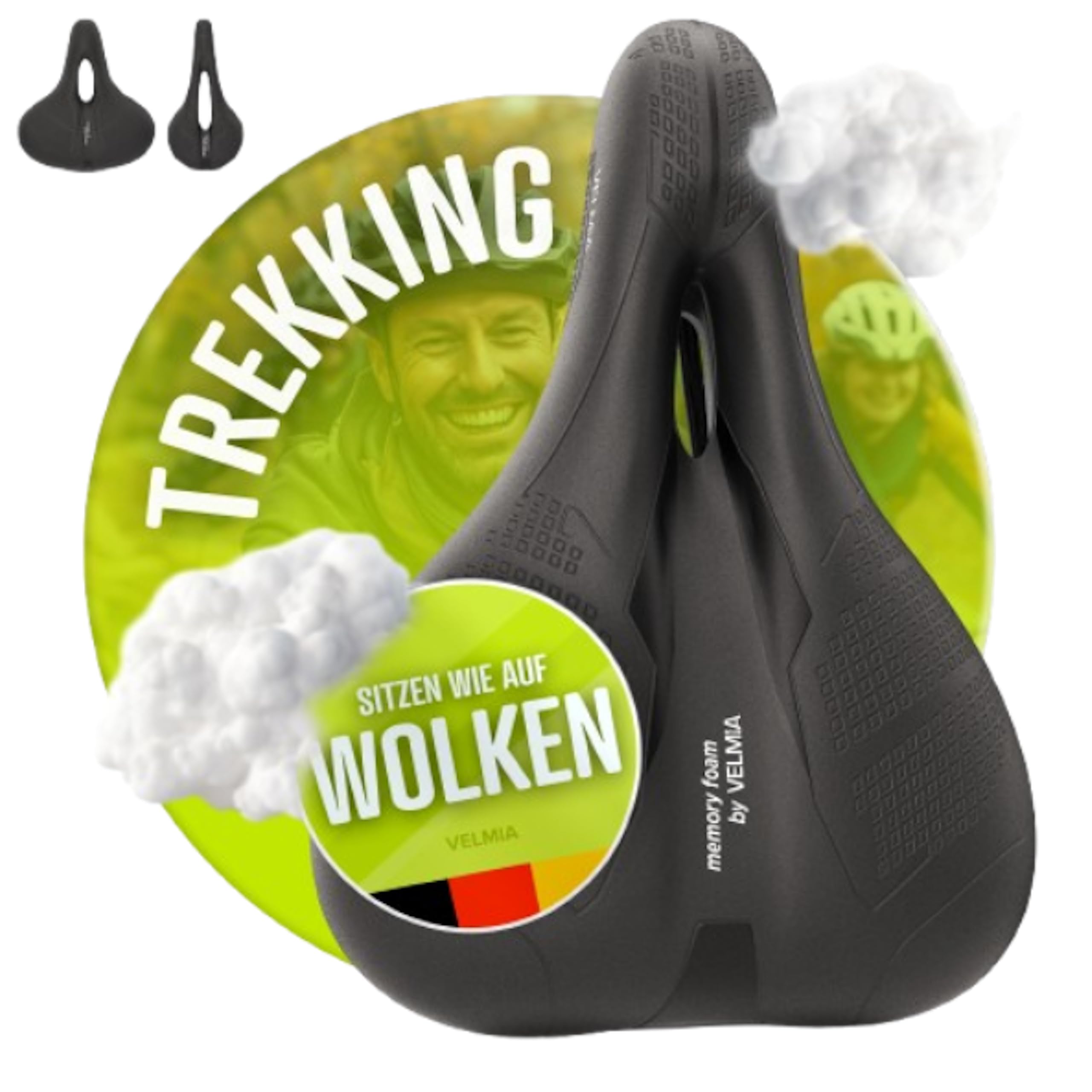
The VELMIA saddle’s premium build quality and waterproof welded seams make it a durable option for riders who value longevity over plush comfort. Its firm memory foam padding and 7.3-inch width polarize users — it suits those who prefer a supportive feel, but narrower hips and riders expecting a soft saddle will find it uncompromising. Rail snapping has been noted in a minority of cases, a structural concern under heavy use.
Pros
- High-quality build with waterproof welded seams and durable materials
- Memory foam padding strikes a balanced feel between support and comfort for most riders
Cons
- Firm padding may feel too hard for those expecting plush cushioning
- Narrow 7.3-inch width may not accommodate wider sit bones or hips
Best for average-sized riders who want a firm, supportive saddle and prioritize build quality over plush comfort.
Best for Budget Exercise Bike
Roguoo Dual Shock Seat

Key Features
- Width: 8.66 in
- Padding: Memory Foam
- Suspension: Dual shock balls
- Weight Capacity: 400 lbs
- Price: $
The Roguoo Dual Shock Seat offers solid comfort and quality construction at a budget-friendly price, making it a tempting upgrade for exercise bikes and casual riders. Its memory foam padding and dual shock absorbing balls reduce pressure effectively. However, the seat’s tilt mechanism fails to hold its angle — despite tightening, it can shift during pedaling. This is a known limitation that some users address with thread-locking compound or an aftermarket bracket. The 8.66-inch width works best for riders with narrower sit bones; those with wider frames may find it snug. For stationary bike use where tilt is set once and left alone, the Roguoo is a good value. But for outdoor riding requiring precise adjustment, the tilt issue can be a dealbreaker.
Pros
- Memory foam padding provides comfortable support for casual rides
- Solid build quality outlasts many stock saddles
- Simple installation on standard seat posts
Cons
- Tilt angle can shift during rides despite tightening the bolts
- 8.66-inch width may be too narrow for riders with broader sit bones
Best suited for stationary bikes or riders willing to use thread-locking compound to secure the tilt angle.
Best for Commuters with Light
DAWAY Built-in Light Seat
Key Features
- Width: 7.0 in
- Padding: Memory Foam
- Suspension: Shock-absorbing rails
- Price: $$
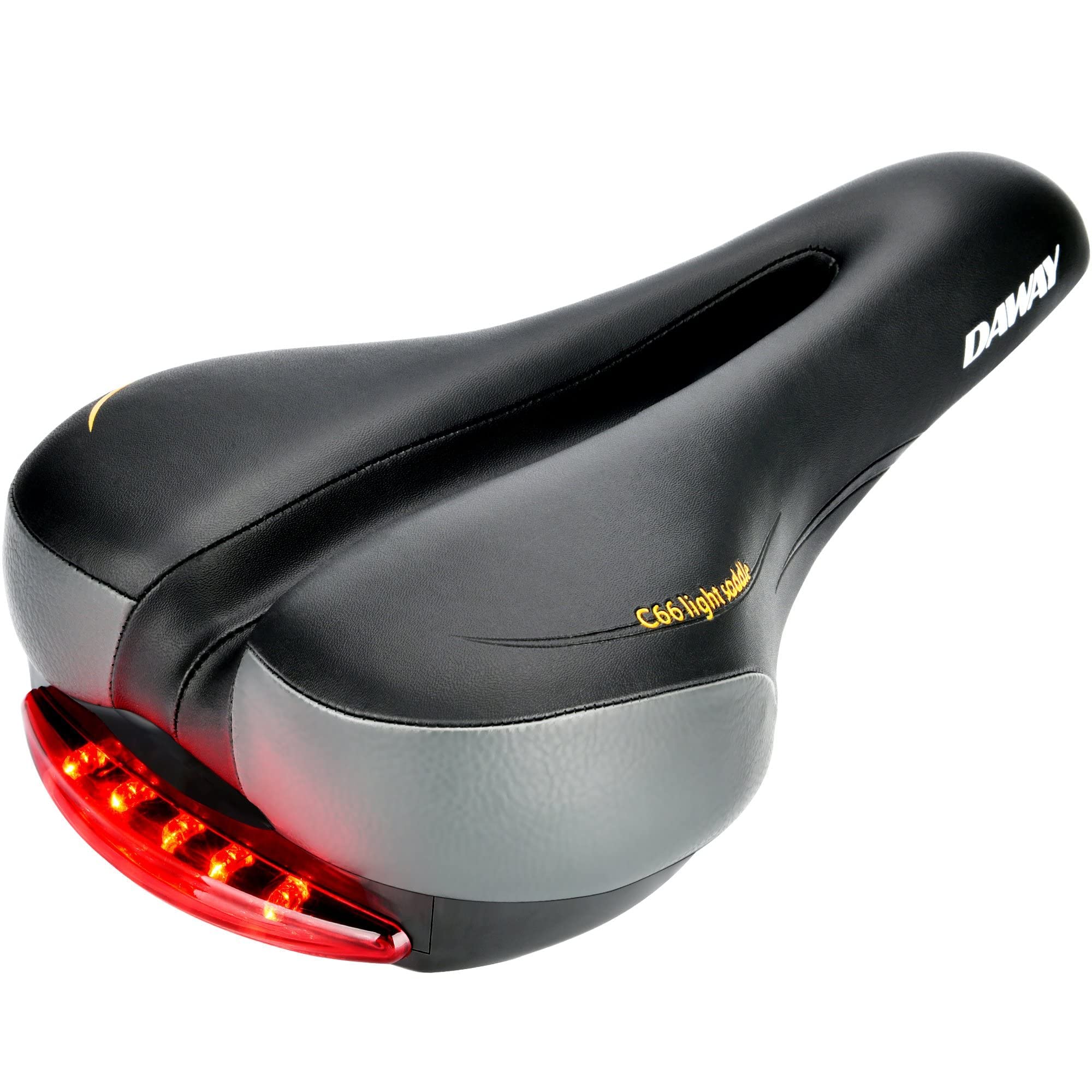
The DAWAY saddle differentiates itself with an integrated taillight — a practical safety add-on for riders who navigate traffic after dark. The memory foam padding provides reasonable comfort for shorter trips around town. However, the narrow 7-inch width works best for riders with narrow sit bones; those accustomed to wider seats may find the profile restrictive. The taillight’s battery can drain quickly, and the light may stop working in some cases. Additionally, the seat cover can crack or split after a few months of use, which affects long-term durability. This saddle suits commuters who prioritize the built-in light over all else and don’t need a wide or long-lasting platform.
Pros
- Integrated three-mode taillight adds visibility for urban riding
- Memory foam padding reduces pressure on sit bones
Cons
- Taillight battery may drain quickly and the light can stop working in some cases
- Seat cover can crack or split after a few months of use
Best suited for short urban commutes where added visibility matters more than long-term durability or a wider fit.
Best for Upright Cruiser Riders
YLG Oversized Seat

Key Features
- Width: 10.63 in
- Padding: Memory Foam
- Suspension: Dual heavy springs
- Weight Capacity: 350 lbs
- Price: $$
This oversized seat delivers genuine comfort for larger riders with its wide memory foam platform — the cradling support is a real benefit for upright cruising or stationary bikes. Quality materials and easy installation add to its appeal. However, the concave seat shape can cause a forward-sliding sensation during pedaling, and the width may rub against thighs on bikes with narrow clearance. These tradeoffs limit its best use to cruisers and exercise bikes with ample leg room.
Pros
- Very wide 10.63-inch platform cradles the entire rear for large riders.
- Quality build with memory foam and durable materials feels substantial.
- Includes wrenches and instructions for simple mounting.
Cons
- The concave seat shape can cause a forward-sliding sensation during pedaling — especially noticeable on standard bikes.
- The very wide design may rub against thighs on bikes with narrow leg clearance, like road bikes.
Best for larger riders on cruisers or exercise bikes with generous leg clearance and an upright posture that minimizes the slide effect.
Best for Peloton Owners Alt
Zcitek Oversized Peloton Seat

Key Features
- Width: 10.0 in
- Padding: Memory Foam
- Suspension: Dual shock absorption
- Price: $$
The Zcitek Oversized Bike Seat delivers a generous 10-inch wide memory foam platform that relieves pressure on the buttocks and perineum during indoor cycling sessions. Its thick padding absorbs vibration well, and installation on Peloton bikes is straightforward. However, the seat’s extra height from dense foam can reduce pedal clearance for riders with short inseams, and some units have experienced breakage after a couple months of light use. This makes it a solid comfort upgrade for stationary riders who are not concerned about long-term durability or have average-to-long leg length.
Pros
- Wide, plush surface eliminates pain in the buttocks and perineum during rides
- Thick memory foam cushioning provides supportive feel for long sessions
- Easy to install on Peloton bikes with included hardware
Cons
- Seat may break after two months of light use in some cases
- Thick padding can cause pedal clearance issues for riders with short inseams
Best for Peloton owners who need immediate comfort and are willing to accept that occasional durability problems or clearance fit may require a replacement within months.
Best for Budget Casual Riders
MXMXK Wide Replacement

Key Features
- Width: 7.9 in
- Padding: Memory Foam
- Suspension: Dual-spring
- Weight Capacity: 495 lbs
- Price: $
This MXMXK saddle provides noticeable comfort from the first ride, with ample memory foam padding that reduces soreness on casual outings. The build quality feels appropriate for its budget price, and installation is quick. However, early reports indicate that the seat cover seams may separate after 50 to 60 miles of use – a concern for those who ride regularly. Combined with a limited track record, this saddle is best suited for occasional riders on short trips rather than daily commuters or high-mileage cyclists.
Pros
- Comfortable padding reduces soreness on longer rides.
- Materials and construction feel solid for the price.
- Simple installation and strong value for the cost.
Cons
- Seat cover seam may loosen or separate after several dozen miles.
A comfortable budget option for casual riders who keep an eye on the seat cover over time.
Best for Stationary Bike Use
MSDADA Dual Shock Cushion

Key Features
- Width: 8.27 in
- Padding: Memory Foam/Gel
- Suspension: Dual shock balls
- Weight Capacity: 440 lbs
- Price: $
The MSDADA saddle delivers noticeable comfort improvements on stationary bikes thanks to its dual shock absorption and memory foam padding, plus a bright reflective strip adds visibility for low-light outdoor rides. However, its 8.27-inch width is only slightly wider than stock seats, so riders needing a truly wide saddle may find it lacking. Additionally, the seat can tilt and lose its adjusted position over time, though this won’t bother casual indoor users who adjust infrequently.
Pros
- Dual shock absorption and memory foam padding reduce pressure on sit bones during stationary and casual rides.
- Bright red reflective strip enhances visibility in low light for safer outdoor use.
- Easy to install with included hardware; build quality matches the budget price point.
Cons
- At 8.27 inches wide, the seat is only slightly larger than stock saddles — riders with wider sit bones may find it too narrow.
- The seat may tilt forward or lose its angle after adjustment, requiring occasional re-tightening.
This saddle works well for light, casual stationary bike users on a budget; skip it if you need a wide fit or plan heavy outdoor commuting.
Best for Handle/reflective Fans
ROCKBROS Dual Shock Seat

The integrated handle makes lifting the bike effortless, and the reflective strip adds visibility for night riding – both practical features. Dual shock absorbing balls are included for vibration control. However, no customer feedback exists to confirm comfort or durability, so the saddle’s long-term performance is untested. This seat suits riders who prioritize the handle and reflectivity over evidence-backed comfort, such as for short commutes or as a secondary saddle.
Pros
- Integrated handle simplifies lifting and transporting the bike.
- Reflective strip improves visibility for safer night riding.
- Dual shock absorbing balls aim to dampen road vibrations.
Cons
- No customer reviews are available to verify comfort or durability – performance relies on manufacturer claims.
- Saddle width is not specified, making fit uncertain for riders with wider sit bones.
Best for riders who consider the integrated handle and reflective strip essential, and are willing to accept unknown long-term comfort – suitable for casual or backup use.
Best for Backrest Needed
CDYWD Oversized Seat
Key Features
- Width: 13.0 in
- Padding: Foam
- Suspension: Triple shockproof
- Price: $$
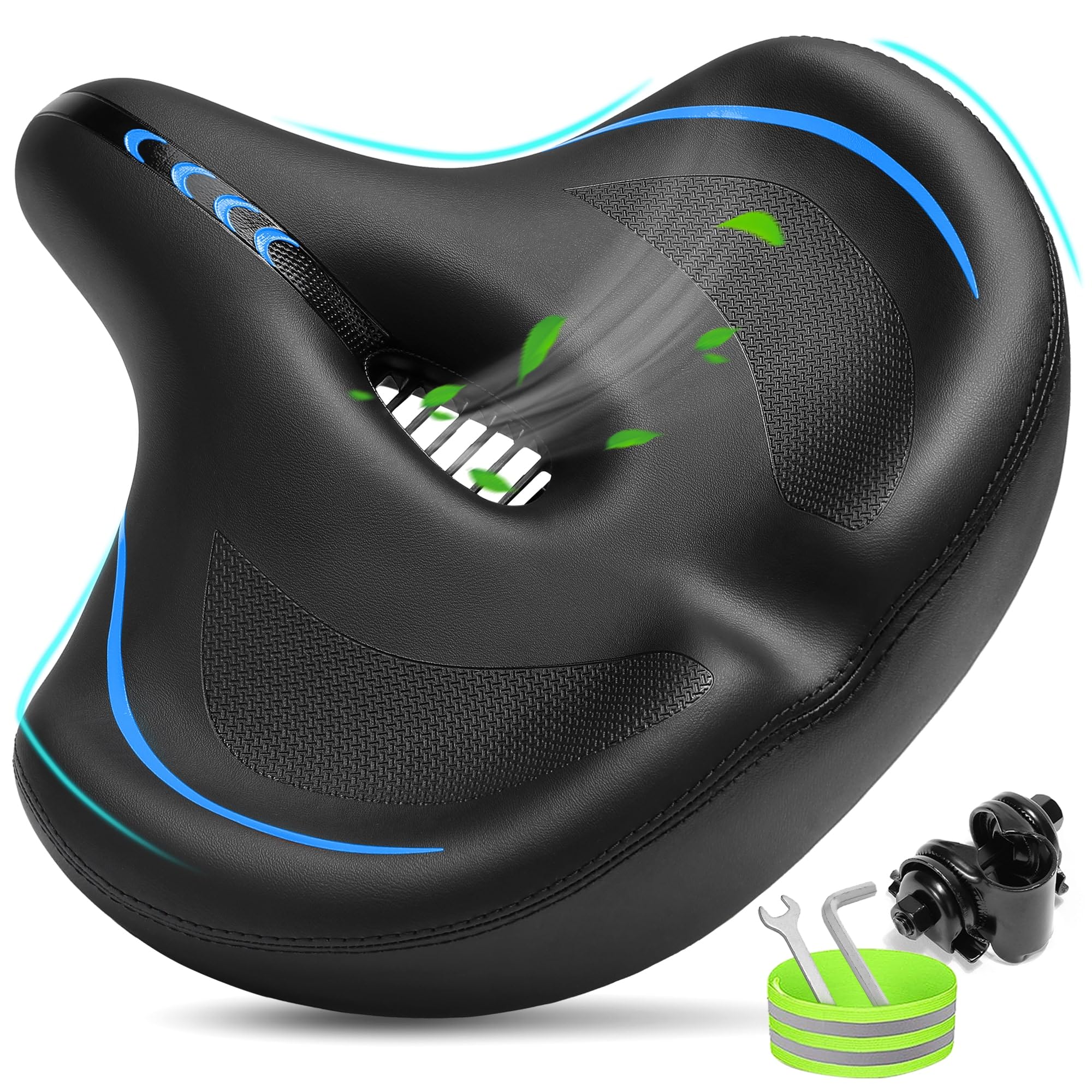
The only saddle in this set with a contoured backrest for lower back support, the CDYWD gives riders with back pain a way to ride upright without discomfort. However, the stability of the seat has been questioned — some units lean forward, which can make pedaling feel less secure. Combined with the modest number of user reports, this saddle is best suited for those who specifically need the backrest and are willing to accept potential positioning quirks. For most riders seeking a standard wide saddle, other options offer more predictable performance.
Pros
- Extra wide design supports larger riders with back pain.
- Contoured backrest relieves lower back pain during upright riding.
- Easy installation with a good value for an oversized seat with backrest.
Cons
- Seat may lean forward or slide during pedaling.
- Extra-wide profile can interfere with thigh clearance on some bikes.
Best for riders with lower back pain who need a backrest and can tolerate potential seat tilt — not a universal comfort saddle.
How to Choose
The most expensive saddle won’t necessarily be the most comfortable; the real fit comes from matching width, padding density, and pressure relief to your riding position and body shape.
Width at Widest Point
Width determines how well the saddle supports your sit bones. A saddle that’s too narrow concentrates pressure on the soft tissue, causing pain within 15 minutes. One that’s too wide rubs against your inner thighs during pedaling, especially on bikes with a narrow stance.
To find your width, sit on a memory foam pad and measure the dimples between your sit bones. General rule: recreational riders with average hips need 7-8 inches; wider or plus-size riders often need 10-12 inches.
Padding Type
Memory foam and gel both absorb shock, but they behave differently. Memory foam conforms to your shape under sustained pressure and stays supportive for rides under an hour. Gel tends to feel softer initially but can displace and bottom out over longer distances.
Thicker padding is not always better: excess foam can create chafing and instability. High-density memory foam (used in the LCYMD and Bikeroo cutaway) offers a good balance for most short-to-medium rides.
Center Cutout or Groove
A center cutout relieves perineal pressure by removing material from the area where the pudendal nerve and blood vessels pass. This is critical for riders who experience numbness or tingling after even short rides. Deep channels work best for those with narrow sit bones because the cutout edges can dig into wider riders.
For riders without numbness, a cutout may introduce unnecessary pressure points if the edges are too sharp. The Bikeroo cutaway’s deep channel is a standout design for this specific use case.
Suspension
Suspension systems (springs, elastomers, or shock-absorbing balls) add compliance to absorb bumps and vibrations. Dual shock balls or springs help on rough roads, but they introduce mechanical failure points: springs can squeak, break, or cause the saddle to wobble after a few months.
For smooth pavement or stationary bikes, a fixed saddle with dense foam provides a more stable and quieter ride. If you ride bumpy trails, look for a suspension design with replaceable components instead of built-in springs.
Weight Capacity
Weight capacity isn’t just about not breaking; it also affects how the saddle feels. A saddle rated for 350 lbs will bottom out sooner under a 250-lb rider than one rated for 650 lbs. Extra weight capacity often comes from wider rails, thicker padding, or reinforced bases.
The Twomaples Oversized Seat (650 lbs) is the only saddle in this set that avoids rail flex and sagging for heavier riders. If you’re under 200 lbs, most of these saddles will work fine.
FAQ
Why does my new wide bike seat keep sliding forward even when I tighten it?
This is often due to the saddle’s mounting rail design and base shape. Many wide budget seats have a convex underside that tilts forward under weight. Try adjusting the tilt using a level app on your phone, or add a drop of thread-locker to the clamp bolts. If the seat still moves, the rail-to-clamp interface may be too smooth; a thin rubber shim can help grip it.
Can I use a women’s comfort saddle on a mountain bike for trail riding?
Yes, but with a key caveat: wide, heavily padded saddles limit your ability to shift weight on technical terrain and may catch on your shorts when leaning back. For trail use, stick to models around 7.5-8.5 inches wide with a closed-cell foam that won’t compress fully under pedaling. The Bikeroo cutaway is a better choice for MTB than the oversized cruiser seats.
How long should a memory foam bike seat last before it flattens out?
Entry-level memory foam saddles (under $25) typically start showing permanent compression after 300-500 miles or 3-6 months of regular use. Higher-density foam and gel hybrids like those in the VELMIA 3-Zone can last 800-1000 miles before the cushion loses support. If you feel the saddle bottoming out or sit bones hitting the base, it’s time to replace it.
Is a noseless bike seat better for long-distance cycling?
Noseless seats eliminate perineal pressure, which is a major advantage for riders with chronic numbness or groin pain. However, the lack of a nose reduces your ability to steer with your hips and can make the saddle feel unstable on descents. For long-distance road cycling, a cutaway saddle (like the Bikeroo) often provides a better balance of pressure relief and control. Noseless designs are best for stationary bikes or short upright cruises.