This post contains affiliate links. We may earn a small commission when you buy through our links — at no extra cost to you.
Many backpacking cook sets promise a complete kitchen but deliver melted handles and extra weight. Budget mess kits often use plastic components that deform under stove heat, while bulky sets add ounces you don’t need.
The smarter approach is a single, well-chosen pot. Titanium pots offer the best strength-to-weight ratio for backpacking, and a 750ml capacity covers most solo freeze-dried meals. For fuel efficiency, a heat-exchanger aluminum pot boils water faster but adds a few grams.
Your choice comes down to trade-offs: simplicity and low weight versus cooking speed and fuel savings. This guide matches each option to the right hiking style so you buy once and pack light.


Best for Solo Backpackers
TOAKS 750ml Titanium Pot
Key Features
- Material: Titanium
- Capacity: 750ml
- Weight: 103g
- Pieces: 2
- Lid / Nesting: Loose lid, nests fuel
- Price: Mid
At 103g with lid, the TOAKS 750ml is one of the lightest pots in its capacity class, yet it fits a standard 110g fuel canister and a Nalgene bottle inside — a rare combination of weight savings and pack-friendly nesting. The simple titanium construction handles boiling water efficiently without any coating to wear off.
This pot is best for solo backpackers and thru-hikers who boil water for dehydrated meals and want the lightest possible setup. The lid sits loosely rather than snapping on, and the handles transfer heat rapidly — a pot gripper or glove is necessary for safe handling. Those cooking for two or using open fire should look at the 1100ml version or the bail-handle variant.
Pros
- Ultralight design saves ounces — at 103g with lid, this is among the lightest 750ml pots available.
- Fits a standard 110g fuel canister and Nalgene bottle inside, saving pack space.
- Good value for titanium — costs less than many competitors while offering same weight savings.
Cons
- Lid can slip off if the pot is jostled during pouring — requires attention.
- Handles get hot enough to need a pot gripper or glove — expected for thin titanium.
For solo backpackers who prioritize weight and simplicity, this pot delivers everything needed with minimal compromise.
Best for Open-Fire Campers
TOAKS 750ml Bail Pot
Key Features
- Material: Titanium
- Capacity: 750ml
- Weight: 110g
- Pieces: 2
- Lid / Nesting: Loose lid, nests fuel
- Price: Mid
The detachable bail handle lets you hang this pot over a campfire without adding meaningful weight — the 110g total with lid is still ultralight for backpacking. It nests a standard fuel canister inside, keeping your kit compact.
This suits campers who cook over open fires and want a hanging option without the bulk of separate hardware. The side handles sit close to the pot body, which can make them harder to grip with thick gloves; lid fit may be loose on some units.
Pros
- Detachable bail handle for hanging over open-fire cooking adds versatility without weight penalty.
- Lightweight and rigid titanium build keeps pack weight low while handling direct fire.
- 750ml capacity nests fuel canisters and small gear inside saving pack space.
Cons
- Side handles are set close to the pot body, making them awkward to grip when wearing thick gloves.
- Lid fit can be loose on some units, allowing slight spill risk when packed tightly.
If you cook over campfires and want a titanium pot that hangs, this adds just a few grams over the standard TOAKS 750 — a focused upgrade for fire users.
Best for Ultralight Soloists
TOAKS 550ml Ultralight
Key Features
- Material: Titanium
- Capacity: 550ml
- Weight: 72g
- Pieces: 2
- Lid / Nesting: Loose lid, no nesting
- Price: Mid
At 72g with lid, this 550ml titanium pot shaves grams off the standard 750ml version. The compact size fits exactly one freeze-dried meal pouch. Capacity is limited to solo use — no room for cleaning water or second servings. The lid rests loosely on top rather than snapping shut, so it may shift inside a pack. For ultralight backpackers who prioritize weight savings above all else and only need to boil water for single portions, this is the lightest option from TOAKS.
Pros
- Weighs only 72g — among the lightest pots on the market
- Compact 550ml capacity fits standard freeze-dried meal pouches
Cons
- Lid sits loosely and can fall off if not secured while packing
The lightest pot in the TOAKS lineup for ultralight solo hikers who value every gram over extra capacity.
Best for Budget Beginners
MalloMe 10-Piece Mess Kit
Key Features
- Material: Anodized aluminum
- Capacity: 1L (pot)
- Weight: 1 lb
- Pieces: 10
- Lid / Nesting: Snap lid, nests all
- Price: Budget
This kit bundles a pot, pan, bowls, utensils, and a carrying bag at a price that undercuts most standalone pots. The anodized aluminum construction keeps the weight manageable for short hikes or car camping, and the compact nesting design fits in a small bag. For beginners who want one box solution, it’s a practical start. However, the non-stick coating can wear off after repeated use, and the handles can get hot during cooking — fine with a towel or pot gripper, but not ideal for ultralight trips where every ounce matters and durable non-stick is needed.
Pros
- Complete 10-piece set includes pot, pan, bowls, utensils, and bag at a low price.
- Nests compactly and weighs about 1lb — easy to pack for short trips or as car camping backup.
- Suits 1-2 people for simple meals like boiling water, pasta, or reheating camp food.
Cons
- Non-stick coating can wear off over time — food may stick unless lightly oiled.
- Pot handles can become hot during cooking; a cloth or gripper is helpful.
Best for budget-conscious beginners or car campers who want a full kit without a high price tag. Not a fit if you need ultralight gear or long-lasting non-stick.
Best for Fuel-Efficient Solo
Fire-Maple Petrel 600ml
Key Features
- Material: Hard anodized aluminum
- Capacity: 600ml
- Weight: 162g
- Pieces: 2
- Lid / Nesting: Snap lid, nests stove
- Price: Mid
The Fire-Maple Petrel’s heat exchanger shaves about a third off boil time compared to a plain pot – a meaningful fuel savings for solo trips. Weighing 162g and holding 600ml, it’s light enough for a day hike yet big enough for one freeze-dried meal. The handle stays cool during use, which is a rare find at this weight. Downside: the aluminum walls can dent if stuffed carelessly, and 600ml won’t fit larger meal pouches or cook for two.
Best for solo hikers who want faster boiling and don’t mind trading titanium’s dent resistance for aluminum’s heat transfer. Not a fit for pairs or anyone who packs gear loosely.
Pros
- Boils water faster than standard pots, saving fuel on longer trips.
- At 162g with a heat-proof handle, it balances low weight with practical handling.
- Handle stays cool during cooking, reducing burn risk.
Cons
- Thin aluminum walls may dent if the pot is compressed in a packed bag.
- 600ml capacity fits single portions only – larger freeze-dried bags may need a separate bowl.
For solo backpackers who value speed and fuel economy over dent-proof durability, this pot delivers a clear advantage over a simple titanium cup.
Best for Two-Persons Backpack
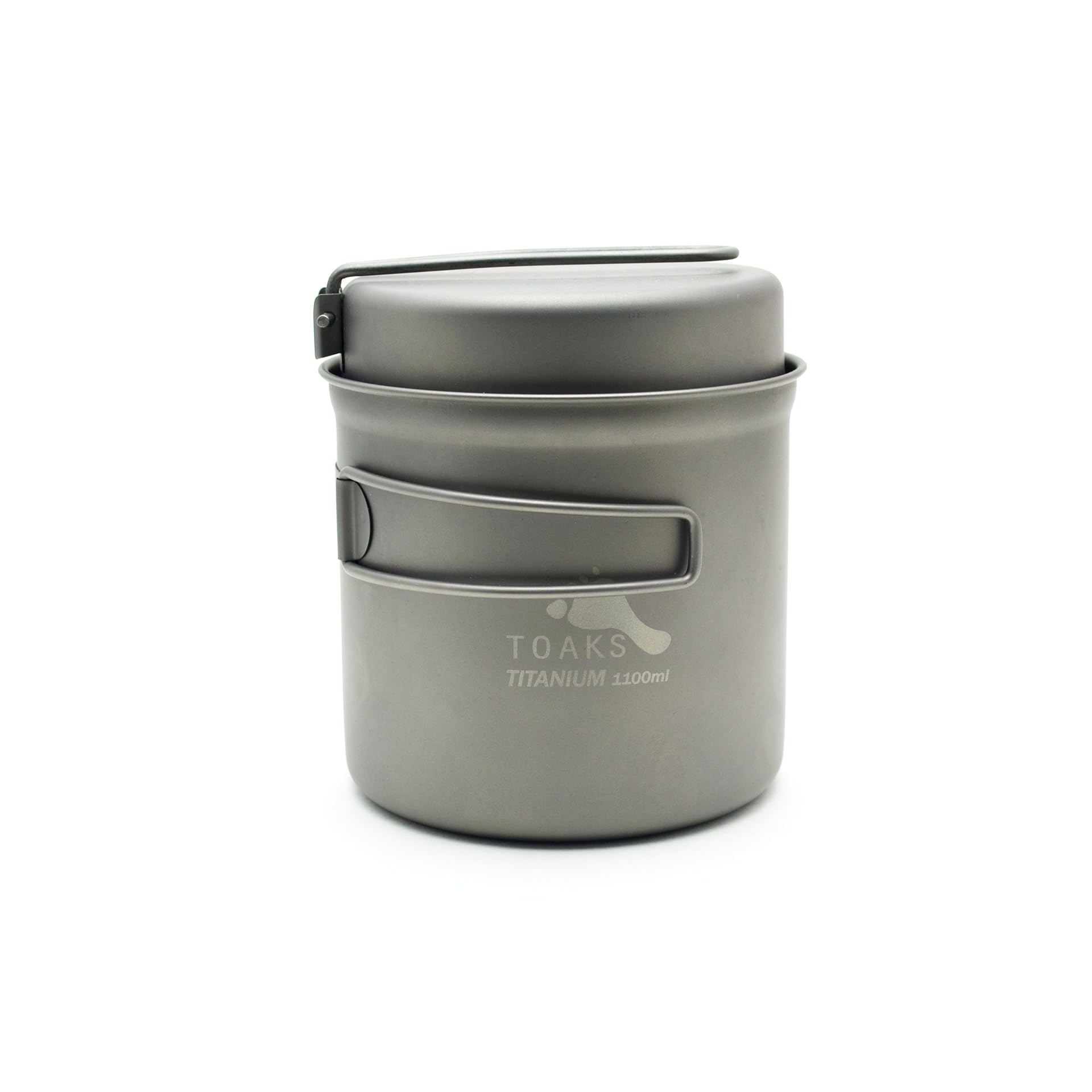
TOAKS 1100ml Pot+Pan
Key Features
- Material: Titanium
- Capacity: 1100ml / 280ml
- Weight: 159g
- Pieces: 2
- Lid / Nesting: Pan as lid, nests 750
- Price: Premium
The TOAKS 1100ml set packs a pot and pan/lid into one ultralight package for pairs, contrasting with the solo-focused 750ml top pick. The 280ml pan is too small for eggs and its handle can detach under load, so this suits backpacking duos who mainly boil water and rehydrate meals rather than fry.
Pros
- Ultralight two-piece set at just 159g total for pot and lid/pan.
- Good size for preparing two portions of dehydrated meals or sides.
- Nests neatly with other TOAKS pots and gas canisters for a compact system.
Cons
- The 280ml pan is very small and not practical for frying an egg or similar tasks.
- The lid/pan handle can be flimsy and may detach or bend when lifting a full pan.
Lightweight and modular for pairs who prioritize weight and system compatibility over actual frying capability.
Best for Car Campers
MSR Alpine 475ml Pot
The MSR Alpine pot is built to survive rough treatment—direct flames, drops, even packed inside a duffel. However, at 270g with just 475ml capacity, it’s heavier and smaller than titanium backpacking pots. This pot suits car campers and bushcraft users who prioritize toughness over weight savings.
Pros
- Extremely durable stainless steel withstands direct fire and abuse
- Locking lid keeps contents secure during transport
Cons
- Weight (270g) and small capacity (475ml) make it unsuitable for backpacking trips
Choose this pot if you’re car camping or cooking over an open fire and need something that won’t dent or bend under rough use.
Best for Car Campers
Stanley Wildfare Go

Key Features
- Material: Stainless steel
- Capacity: 1L
- Pieces: 4
- Lid / Nesting: Locking lid, nests cups
- Price: Budget
This 4-piece set combines a sturdy 1L stainless steel pot with two insulated cups that keep drinks hot while the exterior stays cool to the touch. The folding handle locks the lid in place for secure transport. However, the stainless steel construction adds heft compared to titanium or aluminum cookware, and the 1L capacity can feel tight when cooking for two — fine for boiling water or simple meals, less suited for extended backcountry trips where every gram counts.
Pros
- Durable stainless steel resists dents and scratches
- Insulated cups keep drinks hot, exterior stays cool
Cons
- Stainless steel adds noticeable weight versus titanium or aluminum alternatives
Best suited for car campers, picnickers, or emergency kits where durability matters more than weight — skip this if you’re counting ounces for a backpacking trip.
Best for Bushcraft Car Camp
Fire-Maple Antarcti Set

Key Features
- Material: Stainless steel
- Capacity: 1L / 1L
- Pieces: 2
- Lid / Nesting: Nesting design
- Price: Premium
The Fire-Maple Antarcti set offers premium stainless steel craftsmanship and fast boiling, but the combined 697g weight and a handle that gets very hot (gloves required) make it impractical for backpacking. It’s a better match for car campers and bushcraft users who value durability over gram counting.
Pros
- Beautiful 18-8 stainless steel construction with a polished, corrosion-resistant finish.
- Boils water quickly for a steel pot – comparable to aluminum in speed.
Cons
- Combined 697g weight is heavy for backpacking; better left in the car.
This set fits car campers and bushcraft enthusiasts who prioritize durability and style over weight — not for backpackers.
Best for Jetboil Users
Jetboil Summit Skillet

Key Features
- Material: Aluminum ceramic
- Weight: 300g
- Pieces: 1
- Lid / Nesting: No lid, no nesting
- Price: Premium
This non-stick skillet lets Jetboil users fry eggs and pancakes on a backpacking stove. The ceramic coating releases food easily and the folding spatula nests in the handle. However, it only works with Jetboil systems, the coating may peel over time, and at 10.6 oz it’s heavier than a typical titanium pot — best for car campers or those prioritizing hot breakfasts over ultralight weight.
Pros
- Non-stick surface releases fried eggs and pancakes easily.
- Folding spatula nests into handle for convenient storage.
Cons
- Non-stick coating may peel after repeated use.
This skillet fits best for Jetboil owners who want cooked breakfasts at camp and don’t mind carrying an extra pan — it is not a replacement for a lightweight cook set.
Best for Casual Campers
Odoland 6pc Mess Kit

Key Features
- Material: Anodized aluminum
- Pieces: 6
- Lid / Nesting: Nesting set
- Price: Budget
The Odoland 6pc Mess Kit provides a complete cooking setup including a folding stove, making it convenient for casual outings. The anodized aluminum pots are lightweight and pack neatly into the carry mesh bag. However, the stove flame can be inconsistent, and the build quality is entry-level – suitable for occasional car camping or emergency kits rather than regular backpacking trips.
Pros
- Includes a folding stove, saving a separate purchase.
- Compact design packs all pieces neatly into the mesh bag.
Cons
- Stove flame can be inconsistent; build quality suits occasional use only.
Best as an emergency kit starter or for car campers who want a ready-to-go set without investing in separate gear.
Best for Solo Hikers
THTYBROS 17pc Kit

Key Features
- Material: Aluminum + stainless
- Weight: 2.4 lbs
- Pieces: 17
- Lid / Nesting: Nesting set
- Price: Budget
This 17-piece cook set packs a pot, kettle, pan, two sets of stainless steel cups/plates and cutlery into a compact carry bag. The plates and cups are smaller than expected – suitable for snacks rather than full meals – and handle melting has been reported on high stove flames, making it less suited for serious backpacking.
Pros
- Includes stainless steel cups and plates with good quality materials.
- Heats efficiently and cleans up easily on a camp stove.
Cons
- Handle can melt when exposed to high stove flames – requires careful heat management.
Works for car campers or short hikes where stove heat can be monitored and full-size plates aren’t needed.
How to Choose
Choosing backpacking cookware comes down to three core trade-offs: weight vs durability, capacity vs pack size, and simplicity vs cooking versatility.
Material: Titanium vs Aluminum vs Stainless Steel
Titanium is the lightest option and resists corrosion, but it conducts heat unevenly, leading to hot spots. Aluminum heats more evenly and is cheaper, but it dents easier and can react with acidic foods. Stainless steel is nearly indestructible but heavy — fine for car camping, not for carrying miles.
The choice depends on your weight budget. For ultralight backpacking, titanium is the standard. For fuel efficiency, hard-anodized aluminum with a heat exchanger offers faster boil times at a slight weight penalty.
Capacity: Solo vs Group
Most freeze-dried backpacking meals require about 400ml of boiling water. A 550ml pot covers one meal; 750ml gives you room for a second serving or cleanup water. For two people, 1100ml works, but you will often cook sequentially.
Capacity directly affects pack weight and volume. A 750ml pot fits a standard 110g fuel canister and a spork inside, saving space. Larger pots reduce nesting options.
Weight: Every Gram Counts
A typical titanium solo pot with lid weighs 70–110g. A stainless steel pot of the same capacity can be 270g or more. That 160g difference may seem small, but over a multi-day hike it adds up in your pack and on your shoulders.
Weight also influences stability. Thinner titanium walls can dent if dropped on rocks, while thicker aluminum or steel handles more abuse. Decide what you prioritize: saving grams or accepting a few extra ounces for durability.
Number of Pieces: Single Pot vs Mess Kit
A single pot with a lid is the lightest and simplest option. You boil water, rehydrate food, and eat out of the pot. Mess kits add a pan, bowls, and utensils, which can be convenient but add weight and packing complexity.
For most solo backpackers, a single 750ml pot is sufficient. Groups or car campers benefit from a kit that includes a pan for frying. Avoid kits with plastic handles that melt on stoves.
Lid Design and Nesting Ability
A loose-fitting lid is common on titanium pots to save weight. It works fine for boiling but can slide off when pouring. Locking lids are more secure but heavier. Nesting the pot around a fuel canister and stove saves pack space and protects gear.
Check that your pot fits your specific stove and fuel canister. Many titanium pots are designed to nest a standard 110g canister and a small stove inside, making for a compact unit.
FAQ
How much capacity do I need for freeze-dried backpacking meals?
Most single-serve freeze-dried meals require about 2 cups (500ml) of boiling water. A 550ml pot is the minimum; 750ml gives you room for stirring and a bit of extra water for cleaning. For two meals at once, look for at least 1100ml.
Can I use a titanium pot directly on a campfire?
Yes, titanium can withstand open flames, but the thin walls increase the risk of denting and the handles get extremely hot. A titanium pot with a bail handle, like the TOAKS bail version, is better suited for hanging over a fire. Always use a pot gripper or gloves.
Are non-stick camping pots safe for backpacking?
Non-stick coatings are safe when used at medium heat and with plastic or silicone utensils, but they wear off quickly with rough treatment. Most backpackers prefer titanium or aluminum without coating because it lasts longer and avoids potential flaking into food.
Which is lighter: titanium or aluminum backpacking cookware?
Titanium is generally lighter for the same strength. A typical 750ml titanium pot weighs around 100g, while a hard-anodized aluminum pot of similar size weighs 150-200g. Aluminum with a heat exchanger adds more weight but improves fuel efficiency.