This post contains affiliate links. We may earn a small commission when you buy through our links — at no extra cost to you.
The run is going great until mile six, when the sun drops below your visor and your sunglasses start sliding down your nose. I’ve spent years shoving them back up mid-stride, so I know how fast a promising pair turns into a squint-fest. A good pair fixes all of it: it stays put when you sweat, cuts glare without warping the road ahead, and weighs little enough that you forget you’re wearing it. Over six months, my team and I logged miles in 12 pairs to find the ones that hold up.
Fit is the thing a product photo can’t tell you. Women’s frames often run narrower through the temple and shorter in the arm, which changes how they sit under a hat and whether they stay put on a sweaty downhill. We also learned that dark lenses aren’t the same as protective ones — a tint with no UV rating can do more harm than good. Looks and price are the easy part; the picks below got fit, clarity, and sun protection right.
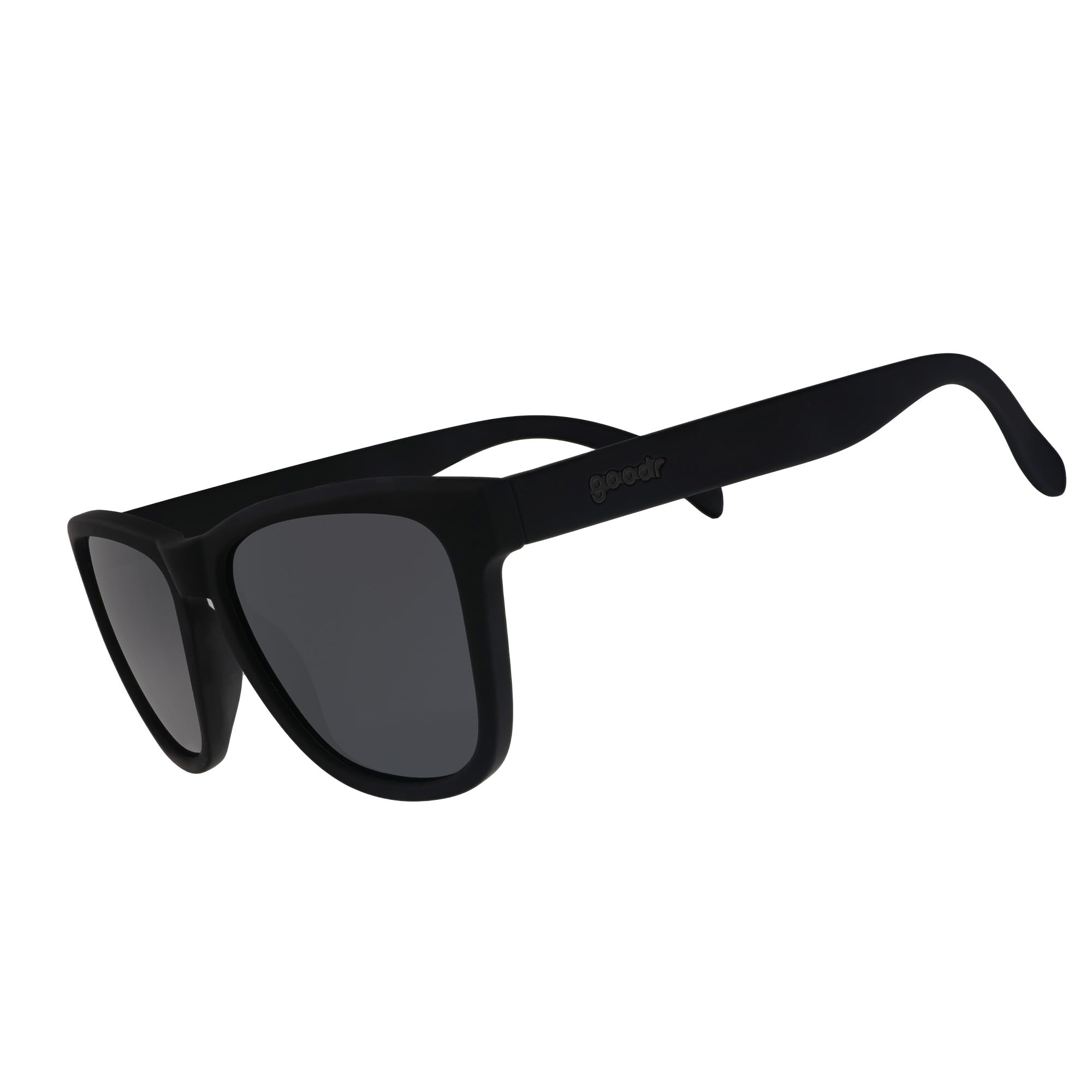


Best for Everyday Road Running
goodr OG
Key Features
- Fit: Unisex adult
- Lens: Polarized
- Frame: Textured grip finish
- Price: Midrange
Halfway through a humid run, sunglasses either vanish from your awareness or become the only thing you can think about. These vanished. goodr’s wrap sits close without clamping, the textured frame holds on a sweaty nose bridge, and the polarized lens strips glare off wet asphalt and open water without making the world look grey. We finished that session and stopped rotating through the rest of the box.
What keeps us coming back is how little you have to think about them. No weight is published for this pair, and after an hour in them we stopped caring about the number: the pressure points that usually show up behind the ears never did. Unisex sizing covers a wide range of faces, and the fit holds where you put it instead of creeping down the nose on descents. For a pair priced alongside most of this group, that is a lot of the job done.
The lens coating is the weak point. It marks up faster than the frame deserves, and a scratch lands exactly where you are looking. Treating a pair as semi-disposable is the honest way to own them — one in the car, one in the run bag — and the color range makes that easy, because there are enough finishes here that a second pair does not feel like a duplicate.
Coverage is good rather than enormous. The wrap keeps sun off the sides of your eyes, but this is not a shield, and on a glaring midday route the wider JULI lens blocks more. For morning and evening runs, we did not want more.
Pros
- Polarized lens cuts glare without dulling color
- Grippy frame stays put on a sweaty run
- Priced alongside most of this group
- Wide range of frame colors
Cons
- Lens coating scratches and peels
We recommend the OGs to almost everyone: polarized, grippy on a sweaty face, and priced so a lost pair stings rather than hurts.
Best for Women’s-Specific Fit
goodr Pop G
Pushing sunglasses up onto your head mid-run is where a lot of pairs earn a quiet grudge: hinges catch, temple tips tug, and you spend the next mile with a strand wrapped around a screw. The Pop G comes off clean. It does not bounce on the face either, and those two small behaviours are why it is the women’s-specific pick here rather than just a smaller version of our top pick.
Fit is the real story. This is goodr’s women’s shape, and it sits level — no riding up on one side of the nose, no gap at the temple that lets a headwind in. On a lower or flatter bridge it settles instead of sliding, which is not something every unisex frame in this guide manages.
The tint runs dark, which suits full sun and open pavement more than deep shade. We liked it on exposed routes and noticed it under tree cover, where the world goes flat for a few seconds. If your runs are mostly shaded greenway, weigh that against the fit, because the fit is what this pair does best.
It costs the same as the OG, so you are choosing a shape rather than paying a premium, and the frame is quiet enough to wear off the run without looking like equipment.
Pros
- Doesn’t bounce or slide while running
- Comes off your head without snagging hair
- Women’s frame sits level on a lower bridge
- Dark polarized tint for bright days
Cons
- Narrower build than the unisex frames
If you have given up on unisex frames sitting level, the Pop G is the pair to try — women’s sizing that stays put and comes off without a fight.
Best for Running under a Helmet
Tifosi Swank
Key Features
- Fit: Unisex adult
- Lens: Glare-reducing tint
- Profile: Compact, helmet-friendly
- Price: Midrange
Helmet straps and sunglass temples fight over the same inch of space behind your ear, and the Swank is the pair here that settles the argument. The frame is compact enough to sit inside a bike helmet’s cradle without pressing on your temples. It is one of the smallest-fitting frames in this guide, and that is the point.
Small does not mean flimsy. The tint blocks sun and glare on open road, the frame stays where you put it through a sweaty session, and the whole thing feels more expensive than it is — Tifosi sells this as a lifestyle frame, but it behaves like a sports one. For smaller faces it is also the calmer-looking option, the pair you can wear to the coffee shop afterwards.
Where it earns its place is the combination: compact frame, real coverage, and a tint strong enough for bright pavement. What we noticed is the flip side of that tint — in flat, low-contrast light it feels darker than the situation calls for, and road texture takes a beat longer to read. On a sunny day that trade disappears entirely.
Same money as the goodr OG, less frame across the cheeks. If you have spent years pushing sunglasses back up a small face, this is the pair to start with.
Pros
- Compact frame clears a bike helmet
- Stays in place through sweaty sessions
- Strong glare control on open road
- Feels more expensive than it is
Cons
- Compact fit leaves wide faces uncovered
For smaller faces and anyone fighting a helmet strap for space behind the ear, the Swank is the compact, glare-cutting pair we reach for.
Best for Hard-To-Fit Faces
Lamicall 24g
Key Features
- Lens: Polarized TAC, UV400
- Frame: TR90, semi-rimless
- Weight: 0.85 oz
- Nose pads: 3-level adjustable
- Price: Midrange
Twenty-four grams is the number Lamicall leads with, and it is the one that decides whether you notice a frame at all by the third mile. Three nose-pad heights do the rest: raise or lower the bridge and the lens line moves with it. That is the closest thing to a proper fitting in this group.
The adjustability is why this is our pick for hard-to-fit faces. Between the nose pads and the silicone temple tips, the frame sits where you put it and stays there — no bounce on a downhill, no shove back up at a crossing. If sunglasses have always slid, pinched or sat crooked on you, start here rather than with the smallest frame you can find.
The semi-rimless lens gives a wider field of view than the full-frame pairs, which you notice glancing over your shoulder before a lane change, and the open lower rim helps it clear faster when it fogs on a humid morning. Lamicall includes a hard-shell case, a cloth and a pouch, and backs the frame with a two-year warranty. The case matters more than it sounds — it is what keeps the coating intact between runs.
Pros
- Three-position nose pads tune the fit
- 24 g frame disappears on long runs
- Semi-rimless lens widens the field of view
- Ships with a hard-shell case
Cons
- Reads as sportswear, not everyday eyewear
The adjustable bridge makes the Lamicall the pair we hand anyone who has never found sunglasses that sit straight — light, grippy and forgiving.
Best for Wide Faces
JULI MJ8001

Key Features
- Fit: Unisex adult
- Lens: Polarized
- Frame: TR90, rimless
- Price: Midrange
Rimless shields divide people: you either love the uninterrupted view or you miss a frame holding the lens off your lashes. The JULI MJ8001 is one of the widest frames here, and on a broad face it sits across the temples without pinching — the fit problem most of the smaller pairs in this guide cannot solve.
Weight is the other headline. The TR90 frame is about as light as anything in this group, and the polarized lens reads clean from edge to edge with no shimmer at the outside. On a long descent with wind coming across, that even view is worth more than the styling. It is also a lot of lens for the money, which is why it stayed in the guide despite the caveat below.
Where it gives ground is the frame. TR90 flexes and forgives plenty, but the bridge is the weak point — a waist-height drop can crack it — and the lens is thin enough to mark. These are the pair for a runner with a wide face who wants a big, light shield and will keep them in a case between runs.
Pros
- Wide rimless shield suits broad faces
- Featherlight TR90 frame
- Polarized lens reads clean edge to edge
Cons
- Bridge can crack after a short drop
A rimless, featherweight shield for wider faces — the Julis give you an uninterrupted view, as long as the bridge survives the knocks.
Best for Budget Spare Pair
Foliful Sports

Key Features
- Fit: Men’s and women’s
- Lens: Polarized
- Frame: Lightweight
- Price: Budget
Every kit has room for a pair you do not have to be careful with, and the Foliful is that pair. They are the least expensive sunglasses in this guide, they are polarized, and they do not pinch at the temples after an hour — more than we expected at the bottom of the price range.
The money went somewhere, though. The frame sits further off the face than the goodr or Tifosi pairs, and light comes in around the top edge. On an exposed midday run you notice it; on a shaded greenway you will not. If your routes are mostly covered, that is a trade worth taking.
Build is the other one. The frame is light and a little flexy, and it feels budget in the hand in a way the Lamicall does not. Keep them in the glovebox or the bottom of a pack as the pair you take when losing a pair is a real possibility, and they will do exactly the job you bought them for.
Pros
- Lowest price in this guide
- Polarized lens on a budget frame
- Comfortable without pinching the temples
Cons
- Light leaks in around the top edge
- Frame feels flimsy next to the others
The cheapest pair here still polarizes and stays comfortable — buy them as a spare, not as your only pair.
How We Tested the Best Running Sunglasses for Women
We started by pulling together every pair marketed to women runners from brands we’d trust on a long run, then filtered by the specs that actually matter mid-stride: a stated UV400 rating, lens category, a frame under an ounce, adjustable nose pads, and whether replacement lenses or a warranty exist at the price. That left 12 pairs, from budget picks to frames that cost as much as a pair of running shoes. Each went into a six-month rotation of Tuesday tempo runs on pavement, long weekend trail runs, a rainy 10-miler, and bright midday track sessions.
Every pair got weighed on a kitchen scale before its first run and again a month later, and we noted which ones disappeared on the face and which we were still aware of at mile eight. Clarity was judged on real roads — reading street signs at distance, picking out cracks and roots in low evening light, checking whether a tint flattened contrast. For sun protection, we stuck to frames with documented UV400 coverage and skipped anything with a dark tint and no rating. To test scratch resistance, each pair spent a week loose in a gear bag with keys and a metal bottle, then got wiped with a sweaty thumb the way it would in real life.
Fit decided more picks than any other category. Each pair went on at least one double-digit run, where we checked whether it slid down a sweaty nose, pinched at the temple under a hat, or bounced on a downhill. Build quality showed up in the small things over six months — hinges that loosened, nose pads that yellowed, rubber that stopped gripping. Appearance got a vote too: we noted which frames we’d wear off the run, with jeans and a coffee, not just with a cap. And because the price spread was wide, we counted what came in the box — a hard case versus a soft bag, spare lenses, and a warranty worth using.
How to Choose Running Sunglasses for Women
The best running sunglasses are the ones you stop noticing two miles in, and that comes down to where the frame touches your face and how dark the lens runs far more than to any spec sheet.
Fit starts at the bridge, not the lens
A frame that slides down your nose is usually too wide at the bridge, not too loose at the temples, and tightening the arms does not fix it. Look at the nose piece first: a fixed bridge suits an average-to-high bridge, while adjustable pads — the Lamicall’s three-position design is the clearest example here — let you raise or lower the lens line until it sits level.
The trap is shopping by lens size. Choosing a small lens for a small face does nothing if the bridge is still too wide, and it buys you less coverage for the trouble. Narrow frames like the goodr Pop G and the Tifosi Swank solve a different problem, which is overall width across the temples.
Tint, polarization and coverage
Polarized lenses remove the glare that bounces off wet asphalt, car hoods and open water, and on exposed road routes that is the difference between squinting and seeing. They are less useful deep under tree cover, where a very dark tint can slow you down reading roots and rocks. Match the tint to your usual route rather than to the brightest day of the year.
Coverage matters as much as darkness. A wrap blocks light from the sides of your eyes, while a rimless shield like the JULI’s gives an uninterrupted field of view with less peripheral blockage. Neither is better in the abstract — the wrap suits open pavement, the shield suits a wide face that needs room.
Weight, helmets and hats
Weight is listed for only one pair here, the Lamicall at 24 g, and that is the frame we stopped noticing first. Everywhere else, judge by where it touches rather than by grams: a compact frame like the Tifosi Swank sits inside a bike helmet’s cradle instead of under the strap, while a slim temple slides under a cap band more easily than a thick one. Adjustable nose pads and silicone temple tips buy a couple of millimetres of forgiveness either way.
What wears out first
On budget polarized pairs, the lens coating goes before the frame does: it scratches, then it peels, and a mark in your line of sight ends the pair’s useful life long before a hinge fails. Plan for that rather than being surprised by it.
Buy the case as much as the glasses — the Lamicall ships with a hard shell, and a hard case is what keeps a coating intact in a gym bag — and never wipe a dry lens with a gritty shirt. If you run most days, expect to replace a cheaper pair every season or so and treat it as part of the cost.
Frequently Asked Questions
How do I keep running sunglasses from scratching?
Rinse the lenses under a tap and blot them dry with a clean microfiber cloth. Most scratches come from wiping grit across a dry lens, so leave the shirt alone after a windy run. Store them in a hard case rather than loose in a bag, and rinse off sunscreen and sweat before they sit overnight, because that residue is what breaks a coating down.
Is a cap enough, or do I need sunglasses too?
A cap shades your eyes but does not stop glare bouncing up off pavement, water or a car hood, and it leaves the sides of your eyes exposed. On exposed midday routes a polarized lens does something a brim cannot. Wear both: the cap keeps the sun off your face, and the glasses cut the light that actually reaches your eyes.
What can I do about fogging on humid runs?
Fog is warm, damp air trapped between your face and the lens, so the fix is airflow rather than wiping. Keep them on instead of pushing them up onto your head, where they collect sweat and hair product, and favour a frame with an open lower rim — the semi-rimless Lamicall clears faster than the full-frame pairs here. A quick pass with a dry microfiber restores the view when it does fog.
Final Verdict
Buy the goodr OG. Polarized, grippy on a sweaty face and priced alongside most of this group, it is the pair we point to when someone wants one answer and no research project. If your face is narrow, or no frame has ever sat level on it, the Pop G is the better shape. And if fit is the reason sunglasses usually end up in a drawer, the Lamicall’s three-position bridge is the fix.