This post contains affiliate links. We may earn a small commission when you buy through our links — at no extra cost to you.
Climbing chalk does one job: it pulls moisture off your skin so your fingertips stay put on a hold. What separates one bag from the next is everything around that job — how fast it dries your hands, whether it leaves a crust on the holds, how much of it ends up on the floor instead of your fingers. A chalk that grips beautifully on a cool morning can turn slick the moment the gym heats up.
The right one keeps your hands dry through a full session without turning your gear bag into a snow globe. I’ve climbed long enough to have opinions here: liquid chalk dries into a thin, tacky film that survives sweat better than powder, though it stings on split tips, and pressed blocks are denser and slower to disappear than loose powder. Over the past four months, my team and I have put 16 chalks through the gym and outside, and the gaps in grip, texture, and mess are wider than I expected. The picks below are the ones we kept reaching for.



Best for All-Around Climbing
Friction Labs Premium Loose
Key Features
- Size: 2.5 oz/70.8 g – Loose Chalk
- Grind: Chunky Texture – Gorilla Grip
- Formula: High-purity magnesium carbonate
- Packaging: 100% recyclable bag
- Price: Midrange
Against the other loose bags here, Friction Labs’ Gorilla Grip is the one we reach for when the forecast is humid and the holds are small. It is a chunky grind rather than a fine powder, so you crush it between your palms as you chalk up. The 2.5 oz/70.8 g bag is easy to carry, and the chunks break down into a coat instead of a puff of dust.
That chunky texture is not a gimmick. The high-purity magnesium carbonate absorbs moisture quickly, and we noticed the chalk stayed on our fingers through repeated attempts instead of turning slick. It also left our hands dry without the tight, over-dried feeling we get from some cheap gym blocks.
The bag is a session bag, not a family-size bucket. If you climb several times a week, you will refill sooner than you expect, and the chunks vary in size from bag to bag. Climbers who want a fine, ready-to-use powder may find the extra crushing annoying. For most of us, the trade-off is worth it because a little goes a long way.
We appreciate the clean formula: silica-free, pigment-free, and non-toxic, with no artificial drying agents. It washed off with water at the end of the session, and none of us felt like we needed a scrub brush to get it out of the creases in our hands.
For most climbers, this is the loose chalk we recommend first. It has the grip and longevity to justify the premium, and it works as well outdoors as it does in a humid gym. The only climber we steer away is someone who wants a fine powder with no crushing at all.
Pros
- Grippy chunky grind that crushes into a lasting coat
- High-purity magnesium carbonate with no silica or pigment
- Long-lasting bag for regular climbers
- Works indoors and outdoors
Cons
- Premium price for the amount
- Chunk size varies; requires crushing
For most climbers, this is the loose chalk we recommend first: a chunky grind that crushes into a lasting coat and keeps its grip through humid sessions.
Best for Value Loose Chalk
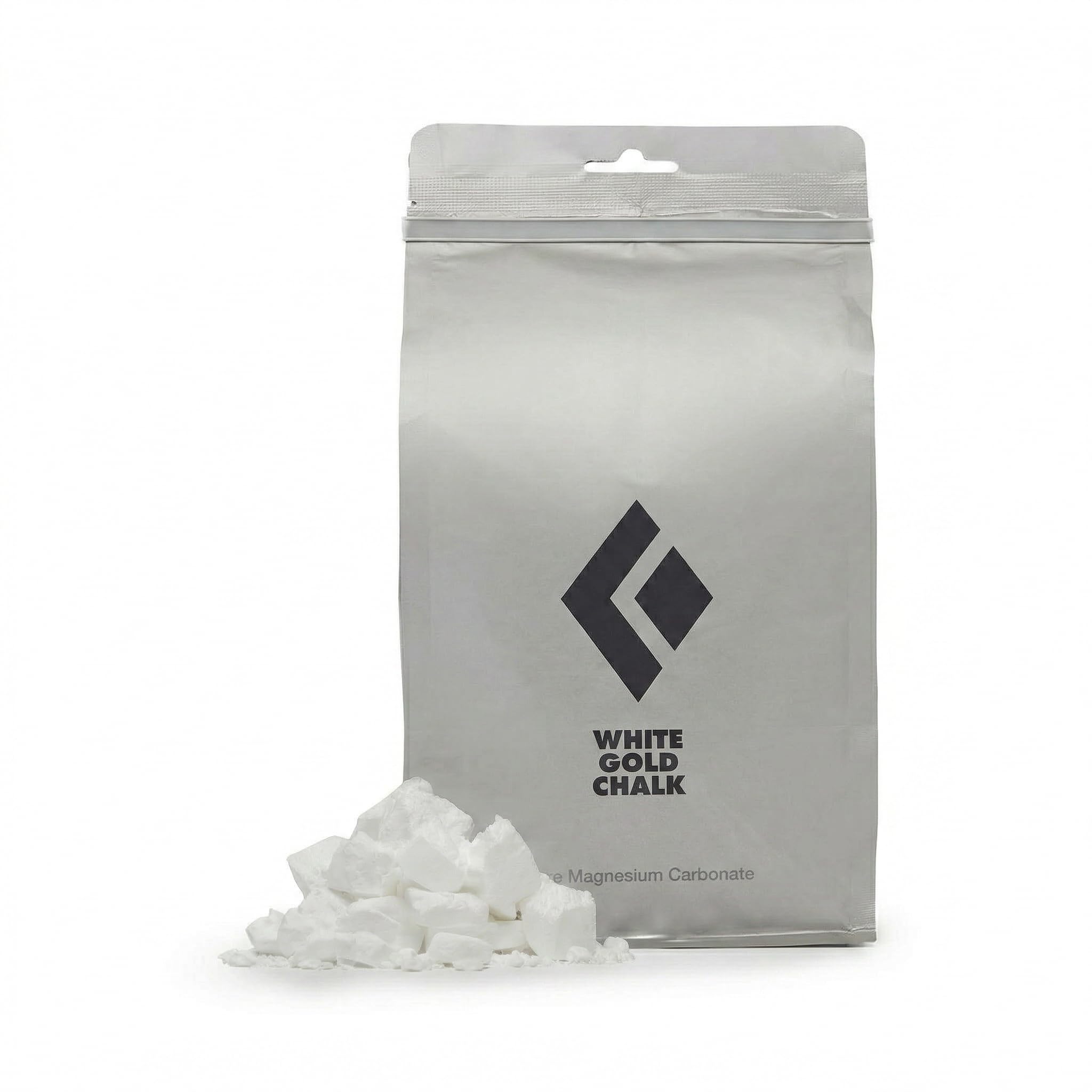
Black Diamond White Gold
Key Features
- Size: 7.05 oz
- Format: Loose chalk
- Material: 100% magnesium carbonate
- Packaging: Resealable bag
- Price: Midrange
The 200-gram bag is the value play in this group: it holds nearly three times the chalk of the small 2.5-ounce bags for a modest step up in price. If you go through chalk quickly, that math matters more than the label on the bag.
We like it as a refill bag for a home wall or for decanting into a crag bag. The chalk is 100% magnesium carbonate, it feels gritty rather than silky, and it stays on the hands for a couple of sets. The trade-off is texture: the chunks are harder to break down than Friction Labs’ Gorilla Grip, so it takes more work to get a fine coat.
The resealable bag keeps the chalk together in a pack, though the coarse chunks can be a nuisance if you want instant powder. It is also a good bag to split with a partner, since you can fill two smaller bags without opening a tiny pouch. For a big bag to leave by the home wall or divide into smaller bags, it earns its place.
For outdoor climbers, the resealable bag is the practical part: it gives you enough chalk to refill a chalk bag without carrying the whole bag to the crag. It is not the most refined chalk here, but it is one of the most useful bags to have around.
Pros
- Large 200 g bag for refilling
- Pure magnesium carbonate formula
- Gritty texture gives a positive bite on holds
- Resealable bag travels well
Cons
- Can feel drying on already dry skin
We point value-minded climbers to this big bag of pure magnesium carbonate for refilling a chalk bag without paying premium rates for every ounce.
Best for Low-Mess Chalking
Friction Labs Magic Chalk Ball
Key Features
- Size: 2.2 oz/62.36 g – Chalk Ball
- Covering: 100% cotton
- Refillable: Yes
- Price: Midrange
A chalk ball is the answer to the dust cloud that follows a loose bag around the gym. The Friction Labs Magic ball is pre-filled with 2.2 oz/62.36 g of fine chalk and wrapped in a cotton sock with an adjustable drawstring.
We found it easy to top up between attempts: one or two squeezes put a fine coat on the fingers without a cloud of powder. The chalk feels smooth rather than gritty, and it stays on the hands long enough that we were not rechalking every few moves.
We recommend it for gym climbers, apartment-wall owners, and anyone who shares a car with other climbers. The refillable sock means you can keep using the bag instead of tossing a plastic ball, and it fits neatly in a chalk bag. It is still a fabric sock, so fine dust can sift through if you leave it loose in a pack.
For outdoor bouldering, the ball is less fuss than a loose bag, though it gives you less control over grind than a bag of chunky loose chalk. It is the one we hand to someone who hates chalk dust on the car seats.
Pros
- Refillable cotton sock cuts airborne dust
- Fine chalk sticks well to hands
- Pre-filled and ready to use
- Fits neatly in a chalk bag
Cons
- Drawstring hardware can break
The Magic ball is our pick for gym climbers who want a low-dust top-up that still puts fine chalk where it matters.
Best for Premium Feel
Rungne Magdust
Key Features
- Size: 7.05 oz
- Format: Loose chalk
- Formula: High-purity magnesium carbonate
- Price: Premium
Where Friction Labs feels chunky and deliberate, Rungne Magdust feels almost creamy between the fingers. It is a 200 g bag of high-purity magnesium carbonate, and the grind is fine enough to coat quickly without a lot of rubbing.
We were impressed by how little it took to cover our hands, and the chalk stayed on through a bouldering session without the slick, powdery feeling we get from cheaper bags. It is also less dusty in the air than a coarse block, which makes it pleasant to use in a small group. The price is the hurdle: it is the most expensive loose chalk here, and the premium is real. If you climb hard and want a luxurious feel, it is worth the step up.
The bag is a simple pouch, and it holds enough chalk to decant into a crag bag or leave by the home wall. It does not leave a heavy residue on the hands, and the fine grind does not need much rubbing. The premium is real, but so is the smoothness.
Pros
- Smooth, fine texture that coats quickly
- High-purity magnesium carbonate
- Large 200 g bag
- Stays on hands through sessions
Cons
- Premium price
We pick Rungne for climbers who want a smoother, finer loose chalk and a big bag for long bouldering sessions.
Best for Budget Gym Bag
Z Athletic Chalk Ball
Key Features
- Size: 2 oz
- Format: Chalk ball
- Covering: 100% cotton
- Price: Budget
The Z Athletic 2-ounce ball is the budget pick we hand to a new gym climber: it is cheap, simple, and small enough to live in a chalk bag without taking over. It is a cotton-covered chalk core, so there is no plastic shell to crack.
One squeeze coats the hands, and the cotton cover feels comfortable against the skin. Durability is the weak point, and it is the main reason this is a budget pick rather than a long-term one. For a casual gym climber, the trade-offs are acceptable.
Pros
- Low-cost first chalk ball
- Cotton cover feels comfortable
- Small size fits a chalk bag
Cons
- Cover can split and leak chalk
- May run out before a long session
We keep the Z Athletic ball as the low-cost way to put chalk in a gym bag, and it suits casual climbers who do not need a premium grind.
Best for Indoor Gym Climbing
Sportmediq Liquid Chalk
Key Features
- Size: 8.5 oz
- Scent: Light fresh fragrance
- Format: Liquid chalk
- Price: Midrange
Liquid chalk earns its keep indoors, where a cloud of loose chalk is unwelcome and the front desk is watching. Sportmediq’s 8.5-ounce bottle is the bulk option here, and it is the one we leave in a gym locker rather than carry to the crag.
You squeeze a little onto your palms, rub, and wait for it to dry. It dries fast and leaves a grippy film that does not feel wet or slippery, and it washes off with water at the end of the session.
We recommend it for indoor climbers who want a big bottle and do not mind a liquid application. The catch is that it is a film, not a powder, so you cannot top up with a quick dip in a bag. For a gym with a no-dust rule, it is a practical pick.
Pros
- Fast-drying liquid formula
- Large 8.5 oz bottle
- Low mess compared with powder
- Washes off with water
Cons
- Wears off faster than loose chalk
- Light scent may not suit everyone
Indoor sessions where dust is unwelcome are where Sportmediq’s big bottle earns our recommendation, as a leave-in-the-locker liquid chalk.
Best for Travel Kit
Gripzilla Liquid Chalk Kit

Key Features
- Size: 250ml + 50ml Kit
- Format: Liquid chalk
- Warranty: 1 year
- Price: Midrange
The useful trick in the Gripzilla kit is the 50 ml bottle: the 250 ml bottle stays home, and the small one goes in a pack. Both are filled with the same liquid chalk, so you can keep the big one by the home wall and carry the mini for gym sessions.
The formula dries quickly and leaves a grippy, almost tacky film that does not dust off easily. We liked the travel size for a gym bag, and the two-bottle setup makes it easier to keep one clean and one topped up.
The kit is not the cheapest way to buy liquid chalk, and the durability is mixed; some applications wear off faster than others. It is also a liquid, so it will not replace a loose bag for a long outdoor day.
For a climber who splits time between gym and crag and wants a clean pack, this is a sensible kit. The mini bottle is the one that lives in our bag, and the big one is a good locker refill.
Pros
- Two bottle sizes for home and travel
- Fast-drying, low-mess liquid
- Grippy film stays on hands
- Mini bottle fits in a pack
Cons
- Mixed longevity on longer sessions
- Higher cost than a single bottle
We like the Gripzilla kit for its home bottle and packable mini, with a fast-drying film that stays put through a session.
Best for Home Wall
Primo Chalk Bucket

Key Features
- Size: 16 oz
- Format: Loose chalk
- Additives: Essential oils
- Packaging: Resealable bucket
- Price: Premium
The Primo bucket is the only loose pick here that arrives in a resealable tub rather than a bag, and that changes how you use it: you can dip a hand without decanting. Inside is a 1 lb resealable bag of very fine chalk.
This is the softest, finest loose chalk in the group. The formula includes essential oils, which is a love-it-or-hate-it detail: it feels less drying on the skin, but it is not the pure chalk some climbers want.
It absorbs moisture and leaves a smooth coating, and the fine powder goes on almost like a liquid. The bucket helps contain the dust, and the inner bag keeps the rest sealed.
We recommend it for a home wall or a gym where you want a softer feel and do not mind a scented formula. For outdoor climbing, a pure chalk like Black Diamond is more straightforward. It is the pick for someone who treats chalk as skin care as much as grip.
Pros
- Very fine, soft powder
- Essential oils condition skin
- Resealable bucket contains mess
- Large 1 lb supply
Cons
- Scented formula won’t suit purists
- Fine powder can puff when decanting
Primo is our choice for a soft, skin-friendly loose chalk on a home wall, as long as a scented, oil-infused formula appeals.
Best for Bulk Block Value
Z Athletic Block Chalk

Key Features
- Size: 2oz Block (8 Pack – 1lb Total)
- Format: Block chalk
- Material: 100% magnesium carbonate
- Fragrance: Fragrance and pigment free
- Price: Midrange
Eight 2-ounce blocks add up to a full pound of chalk, and we like that kind of redundancy for a home wall or a shared gym: you can stash one in a gym bag, one in a car, and one by the wall.
The blocks are pure magnesium carbonate with no fragrance or pigment, and they break apart easily enough to fit a chalk bag. The trade-off is consistency: the blocks do not all behave the same way, and a few can arrive in rough shape. For the price, it is a low-risk way to keep chalk around, but it is not the pick for a climber who wants a premium feel.
Pros
- Eight blocks make a large 1 lb supply
- Pure magnesium carbonate with no fragrance
- Blocks can be broken to fit a chalk bag
Cons
- Blocks can crumble before use
- Texture varies from block to block
For a home wall or shared gym, our value pick is the Z Athletic block pack, where a pound of breakable blocks goes a long way.
How We Chose and Tested 16 Climbing Chalks
We started by gathering what climbers actually re-buy: loose powder, pressed blocks, chalk balls, and liquid chalks from the brands that keep turning up on gym mats and in crag packs. From an initial list of nearly 40 products, we cut anything with fillers that caked in the bag, a perfumed smell strong enough to notice on the wall, or a consistency that arrived as dust — then ordered 16 to live with for four months.
Testing happened where chalk actually lives. Each of us kept a bag going through twice-weekly bouldering sessions, including a humid gym in July where nothing wants to stay dry, plus a few outdoor days on coarse granite and 6 a.m. hangboard sessions in a garage. Every session we counted how many problems we got through before reaching back into the bag, and noted whether hands felt tacky at problem three or already slick by problem eight.
Texture got judged between the palms before any climbing — silky, gritty, or baby-powder fine — and we watched for the film some chalks leave that makes holds feel greasy an hour in. Messiness had its own check: black pants, a light-colored chalk bucket, and a look at the floor afterward. Blocks were tracked for how fast they crumbled and how many sessions they survived; liquid chalk for drying time and whether the bottle clogged mid-session. Value came down to cost per session, not cost per bag.
How to Choose Climbing Chalk
The best climbing chalk is the one that matches your format to your climbing day and then gets out of the way.
Start with the form, not the brand
Loose chalk gives you the most control over how much you apply, and it is the default for outdoor bouldering and trad climbing. A chalk ball is a sock filled with loose chalk; it cuts dust and makes top-ups cleaner, which is why we like the Friction Labs Magic ball for gym bags. Blocks are the cheapest way to buy bulk chalk, but you have to break them up, and they can crumble. Liquid chalk is a film for indoor sessions and gyms that dislike dust; it is not a direct replacement for a loose bag on a long crag day. Pick the form that matches where you climb most.
Match the grind to your hands and skin
Chunky loose chalk, like Friction Labs’ Gorilla Grip, breaks down as you rub it in, so it can feel less dusty at first and gives you a little more control over coverage. Fine powders, like Primo, coat quickly but puff more easily. Neither is better in every case: dry, cracked skin does better with a chalk that does not over-dry, while sweaty hands need fast moisture absorption. If a chalk lists oils or fragrance, decide whether you want skin conditioning or a pure, neutral feel. Test a small amount before committing to a big bag.
Judge value by the session, not the bag
A 200 g bag of Black Diamond or Rungne goes further than a 2.5 oz bag, but the bigger bag is only a better value if the chalk does not crumble into dust or dry out in storage. Blocks are usually the lowest cost per ounce, and the Z Athletic eight-pack is a good example of bulk value for a home wall, though blocks can break in transit. Liquid chalk is different: it wears off and needs reapplication, so a large bottle is only worth it if the film lasts through your session. Buy for the number of sessions, not the number on the label.
Plan for mess, travel, and gym rules
Loose chalk is the messiest option, so a resealable bag or a bucket matters if you carry it in a pack. A chalk ball still leaks a little dust, but it keeps the worst of it contained; liquid chalk is the cleanest in a gym bag, provided the cap stays secure. If your gym asks for low-dust chalk, a ball or liquid is the practical choice. If you climb outdoors, a loose bag and a separate refill bag are simpler. Keep a small brush or towel handy either way.
Frequently Asked Questions
Can I use weightlifting chalk for climbing?
Yes, if it is plain magnesium carbonate. Many gym blocks and liquids use the same mineral, but check for oils, fragrance, or added drying agents that can leave a slippery residue or irritate skin. Crush a block into a chalk bag and test it during a sweaty session before relying on it outdoors.
How often should I rechalk while climbing?
Chalk before each attempt, not constantly. A light coat on the fingertips and palms is enough; if your hands feel slick or the hold feels greasy, reapply. Too much chalk can build up on holds and make them slicker, so brush excess off your hands.
Does climbing chalk expire?
No real expiration date if it stays dry. Moisture is the enemy: it makes loose chalk clump and blocks soften or crumble. Keep the bag sealed, store it away from a damp gym bag, and break up clumps before use; discard chalk that has picked up dirt or grit.
Final Verdict
Our default is the Friction Labs Premium Loose Chalk. Its chunky grind takes a few seconds to crush, but the coat lasts, the grip holds up in humidity, and a bag goes further than its size suggests.
If dust is the thing you hate, choose the Friction Labs Magic Chalk Ball; if you want a big bag for a home wall, Black Diamond White Gold is the value move.