This post contains affiliate links. We may earn a small commission when you buy through our links — at no extra cost to you.
A camping skillet has to do two jobs that pull against each other: hold heat like the heavy pan on your kitchen range, and stay light enough that you don’t curse it on the walk back to the car. Most pans pick a side. Cast iron browns a pork chop beautifully and then rides in your tote like a boat anchor, while the featherweight nonstick numbers scorch your pancakes before the middle sets. The right one splits the difference — it sears over a lopsided bed of coals, releases eggs without a fight, and wipes down with a paper towel when the nearest sink is a hundred yards away.
Over the past six months my team and I have cooked on 14 of them, and the differences show up fast once you’re squatting next to a fire. One thing I’d tell any first-time buyer: the pre-seasoning a pan ships with is a starting coat, not a finish, and a skillet’s weight only really announces itself when it’s full of potatoes and cantilevered off a two-burner stove. Salt and a splash of water will scrub one clean; leaving another damp overnight will have it spotting with rust by morning. The picks below run from a bare cast iron workhorse to a nonstick pan that’s strictly for car camping.


Best for Group Camp Meals
Cuisinel 3-Piece Cast Iron Set
Key Features
- Material: Pre-seasoned cast iron
- Heat sources: Gas, electric, induction, glass tops, oven, grill, campfire
- Handle covers: Silicone covers included
- Skillet sizes: 8, 10, and 12 inches
- Price: Midrange
The 10-inch skillet is the piece that earns this set its place: it holds a proper camp breakfast for two, and its helper handle and pour spout make a loaded pan easier to move without wrestling it. We like having the 8-inch for eggs and the 12-inch for steaks or a crowd, because the right size changes with the trip and the number of people at the table.
Cast iron is the reason the set works at a campsite. It holds heat after the fire dies down, moves from stove to oven to grill to campfire, and does not depend on a fragile coating. The factory seasoning is a starting point rather than a finished nonstick surface, so we cook something fatty first and keep a small bottle of oil in the kit.
The silicone covers are a practical addition for the short lift from stove to table, but they get hot and they are not a substitute for a mitt near an open flame. Hand wash and dry each pan fully before it goes back in the car; the set rewards that routine and punishes a damp stack with rust.
Pros
- Three sizes cover solo meals to group cooking
- Helper handles and pour spouts on larger pans
- Works on campfire, grill, oven, and stove
- Silicone handle covers included
Cons
- More cookware than a solo camper needs
- Heavy and bulky for backpacking
For campers who cook for a group and want one cast iron set that works over fire or stove, this is the set we recommend first.
Best for Backpacking
Jetboil Summit Skillet
Key Features
- Weight: 10.6 oz
- Works with: Jetboil regulated systems and pot support
- Packed size: 8 by 8.5 by 1.9 inches
- Cooking surface: Ceramic nonstick aluminum
- Price: Premium
At 10.6 ounces, the Summit Skillet is the lightest pan here, and the angled turner that nests into the handle is the detail that makes it feel designed for a pack rather than adapted from a kitchen. We noticed the 8 by 8.5 by 1.9-inch footprint leaves room for a stove and a small fuel can in the same stuff sack.
The ceramic-coated aluminum surface heats fast on a Jetboil regulated stove and releases eggs and pancakes with little fat, which is exactly what we want when cleanup is a wipe and a rinse. It pairs with Jetboil pot supports; on another stove, check that the pot support is wide enough and stable before you count on it.
The coating is the part to protect: use the included turner, skip metal utensils, and do not scrub it with anything abrasive. We treat it as a backpacking tool with a defined job, not a cast iron replacement.
Pros
- Lightest skillet here at 10.6 ounces
- Ceramic nonstick cleans up with a wipe
- Turner nests in the handle
- Works with Jetboil regulated systems
Cons
- Not for campfire cooking
- Premium price for a backpacking pan
If the skillet has to travel in a pack, the Jetboil Summit is the one we reach for: light, compact, and easy to wipe clean after a stove-side breakfast.
Best for Solo Campers
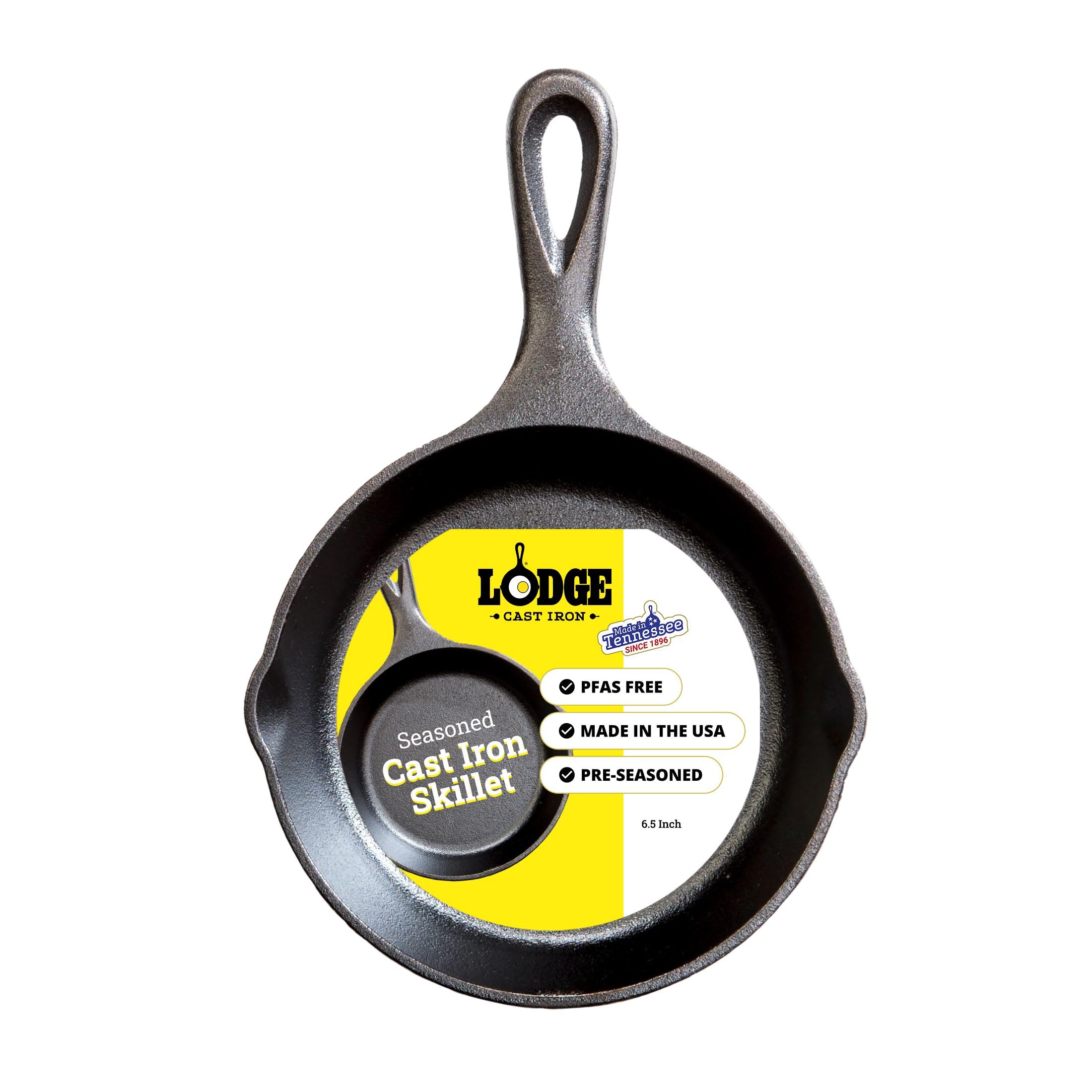
Lodge 6.5-Inch Skillet
Key Features
- Weight: 1.9 lb
- Diameter: 6.5 inches
- Material: Pre-seasoned cast iron
- Heat sources: Electric coil, gas, induction, oven, grill, campfire
- Price: Budget
Six and a half inches is the right size for a solo camper who wants two eggs, a sausage, and a small pile of onions without carrying a full-size pan. At 1.9 pounds, the Lodge fits in a car kit or a canoe pack, and the pre-seasoned surface means it can go straight onto a camp stove or into the coals.
Cast iron this small still holds heat well, and the 500 °F rating gives it room for oven and campfire use. We dry it on the heat and wipe on a thin coat of oil after every wash; that routine is what keeps a small pan from turning into a rusty relic between trips. The bare handle gets hot, so a glove or a folded towel belongs in the kit, and the upside of the small pan is control: it is easy to lift, easy to store, and quick to wipe down when breakfast is over.
Pros
- Compact 6.5-inch size suits solo meals
- Light 1.9-pound pan packs easily
- Pre-seasoned and safe for campfire and oven
- Lifetime warranty
Cons
- Too small for group cooking
The 6.5-inch Lodge is the pan we grab for solo breakfasts and small sides, provided you treat it as a personal skillet rather than a group cooker.
Best for Large Group Meals
Utopia 12-Inch Skillet

Key Features
- Weight: 7.58 lb
- Diameter: 12 inches
- Material: Pre-seasoned cast iron
- Heat sources: Stovetop, oven, grill, campfire
- Price: Midrange
A 12-inch cast iron skillet is the closest thing to a one-pan basecamp kitchen: it holds a full breakfast, a pile of vegetables, or a couple of steaks without crowding. We like the Utopia for that job, and we keep it in the car rather than a backpack.
The pre-seasoned surface is a help, but it is not a guarantee; we cook fatty food first and expect to build up the nonstick layer over several trips. Cast iron holds heat well, and the 450 °F rating covers oven and grill use.
The trade-off is weight: at 3.44 kg, this is a pan you lift with two hands when it is full. The reward is a big, stable cooking surface that does not care whether the heat comes from gas, coals, or an oven.
Pros
- Generous 12-inch cooking surface
- Pre-seasoned cast iron holds heat
- Works on stovetop, oven, grill, and campfire
Cons
- Large footprint crowds small camp stoves
- Rusts if stored damp
We recommend the Utopia 12-inch for basecamp cooks who want the biggest single cooking surface here and do not mind a heavy pan.
How We Tested Camping Skillets
We started by rounding up every skillet that kept surfacing in camping forums, gear reviews, and the cook kits our staffers already owned — bare cast iron, enameled cast iron, carbon steel, spun steel, hard-anodized aluminum, and a handful of ceramic nonstick pans. We cut anything with a handle that couldn’t sit over an open flame, anything with less than an 8-inch cooking surface, and anything priced like a kitchen pan rather than something you’d toss in a dusty tote. That left 14 skillets, which we cooked on for six months.
Testing happened where these pans actually live: weekend car-camping trips, a three-day canoe float, a backyard fire pit, and a long run of breakfasts on a two-burner camp stove that sulks in the wind. Each pan cooked the same menu — bacon, fried eggs, pancakes, a mess of potatoes and onions, and a deliberately wet batch of fried rice. We noted where the browning started, whether it spread out evenly or left a hot ring in the middle with pale, underdone edges, and whether food released on its own or had to be pried loose.
Cleaning was crudely realistic, because camp is crude: a plastic scraper, a splash from the water jug, a paper towel, and no soap on the cast iron and carbon steel. We tracked how much food lifted off in a single pass and which pans needed a soak. Sizing got measured rather than trusted — we traced the flat cooking surface of each one, since a 10-inch skillet with steep walls often gives you closer to nine. Every pan was weighed empty and again loaded with a full batch of potatoes, and the cast iron and carbon steel models were left damp overnight in a closed tote to see what rusted. Durability and value got judged at the end: loose handles after a few hot fires, nonstick flaking at the rivets, seasoning wearing thin in the center, and whether the price felt fair for something you’ll bang against a fire grate.
How to Choose a Camping Skillet
The first decision is not cast iron versus nonstick; it is whether the skillet has to travel in a pack or can live in the car.
Start With How You Carry It
Start with the carry, not the cooking surface. A cast iron skillet is a joy at a basecamp and a burden on a backpack. If the pan rides in a car, the heat retention and fire compatibility are worth the weight. If it goes in a pack, look at aluminum and packed size first; the Jetboil Summit at 10.6 ounces is the clearest example here. We treat a 1.9-pound cast iron pan as a solo or small-kit option, not a group pan to haul up a trail.
Match the Pan to the Heat
Cast iron can sit on coals, go into an oven, and move to a camp stove; that flexibility is why it dominates this list. Ceramic nonstick aluminum is for a stove, not a fire, and the Jetboil is built around Jetboil’s pot support. If you cook over fire most nights, choose bare cast iron and accept the seasoning routine. If you boil water and make eggs on a canister stove, the lighter coated pan makes more sense.
Size It to the Crew
Six and a half inches is a personal pan; 8 to 10 inches is the two-person sweet spot; 12 inches is for family-style meals or a group. The trap is buying a set for the biggest pan and then carrying all three. We like the Cuisinel set because the 10-inch does most of the work, but solo campers should not buy a set for sizes they leave at home. Check the pan’s footprint against your stove’s pot supports before you commit.
Handles and Camp Cleanup
Bare cast iron handles get hot, and silicone covers only buy you a short carry; keep a heat-resistant glove in the kit and keep silicone away from open flame. At cleanup, scrape and rinse while the pan is warm, dry it on the heat, and wipe on a thin oil coat. A pan that goes into the car damp is a pan that rusts. Coated pans need the opposite discipline: no abrasives, no metal utensils, and no high heat.
Frequently Asked Questions
Can I use a cast iron camping skillet on an induction cooktop?
Often yes, if the base is flat and magnetic. The Cuisinel set lists induction compatibility, the Lodge 6.5-inch lists smooth-surface induction, and the Utopia lists gas rather than induction. Test the pan with a magnet before you rely on it, then check the stove manual for pan-size limits.
How do I pack a cast iron skillet without getting everything oily?
Wipe off excess oil, then wrap the pan in a cotton towel or a dedicated skillet bag and keep the handle away from stove parts. A little seasoning transfer is normal; the towel keeps it off your clothes and tent. Do not seal a warm pan in plastic, because trapped moisture is what starts rust.
Does a camping skillet come with a spatula?
Only the Jetboil Summit includes a turner that nests into the handle; the cast iron pans do not. Pack a metal spatula for bare cast iron and a non-metal one for the coated Jetboil, and check that the handle fits inside your camp box.
Final Verdict
For campers who drive to the site and cook for more than one, the Cuisinel set is the place to start: the 10-inch pan is the workhorse, the 8-inch handles eggs, and the 12-inch covers a group, all in cast iron that can go from stove to fire. If your skillet has to fit in a backpack, choose the Jetboil Summit; if you cook for one, the Lodge 6.5-inch is the smaller, lighter answer.