This post contains affiliate links. We may earn a small commission when you buy through our links — at no extra cost to you.
A soft, wide bike seat feels wonderful in the driveway and miserable at mile ten. The right one supports your sit bones without pinching, stays put over bumps, and disappears under you so the ride—not your backside—gets your attention. I’ve swapped enough saddles to know that comfort is not about maximum padding; it’s about shape, firmness, and whether the seat fits your riding position. What this product fixes is simple: it turns a ride you endure into one you can extend.
Over the past eight months, our team tested 11 bike seats on commutes, weekend greenway rides, and indoor trainer sessions. We installed each one ourselves, rode them in rain and heat, and kept notes on comfort, fit, stability, and adjustability. Quality showed up in small things—rails that did not creak, covers that did not scuff, clamps that held after a curb drop. Looks matter, but only once the seat is comfortable and secure; value is not the cheapest seat, it is the one you do not need to replace after a season.




Best for Everyday Comfort Rides
Bikeroo Comfort Saddle
Key Features
- Width: 7.8 inches
- In the box: Hex keys, wrench, adapter, rain cover
- Pressure relief: Center cutaway
- Weight capacity: 350 lb
- Price: Budget
A deep channel runs the length of this shell, and that cutaway is the reason it works for riders whose soreness sits in soft tissue rather than on the sit bones. At 7.8 inches wide it gives you a real platform to plant on; at 2.36 inches tall it doesn’t turn the bike into a couch. The faux leather has enough grip to stop you sliding forward on a climb, and the vent through the middle keeps the padding from turning into a sponge on a hot afternoon.
That balance is why this is the saddle we point most people to when the stock perch on a hybrid, e-bike, or indoor bike is the reason rides stay short. It is the most complete package in this group: a relief channel that sits where the pressure actually is, a 350-pound weight rating that covers bigger riders, and a box that already contains the tools. Nothing else here combines all three, and it does it without climbing into the premium bracket.
Mounting takes one hex key and a few minutes. Bikeroo ships two hex keys, a multi-hole wrench, and an adapter for older clamp-style posts, so the parts that usually send you back to the toolbox are already in the bag. The cover wipes clean with a damp cloth. There’s a rain cover in there too, which is a small thing that matters if the bike lives outside or rides on a rack.
Where it stops is cadence. A shell this wide with this much foam sits between your legs, so if you spin fast with your knees close to the top tube, or you’re building toward a triathlon position, the wings will catch your thighs. Riders who pedal that way are better served by the narrower Wittkop.
Pros
- Center cutaway relieves soft-tissue pressure
- 350-pound rating covers heavier riders
- Hex keys, wrench, adapter, and rain cover included
- Wide platform without a cruiser footprint
Cons
- Wide, soft shell fights fast, leaned-over pedaling
We recommend the Bikeroo to most riders: the cutaway shell, 350-pound rating, and included tools cover more people than anything else here, at the budget end of the group.
Best for First Budget Swap
LCYMD Comfort Saddle
Key Features
- Mounting: Saddle adapter included
- Dimensions: 9.7"L x 8"W x 3.7"H
- Item weight: 1.79 lb
- Cover material: Faux leather
- Price: Budget
This is the least expensive saddle in the group, and it’s also the one we recommend to anyone whose only goal is to stop dreading the first mile. What earns that is the platform: 8 inches across and 3.7 inches deep at the back, with foam dense enough that you sit on it rather than sink through it. It arrives as a complete replacement rather than a cover, with the adapter for clamp-style posts in the box.
The measured shape is 9.7 inches long, 8 wide, and 3.7 tall, and at 0.81 kg it adds little to the bike. The cover is a non-slip faux leather with a center vent, and the shell carries shock-absorbing pads under the padding to take the edge off broken pavement. Nothing about it feels premium; everything about it feels adequate, which is the right bar at this end of the range.
Fitting it is the usual five minutes with an Allen key. Where it stops is thigh clearance, because 8 inches of shell sits between your legs — riders who pedal with their knees tucked close to the top tube will feel the wings on every stroke. The detail we didn’t expect is the two-year manufacturer warranty, which is generous for something this cheap.
Pros
- Dense foam supports instead of sinking
- Saddle adapter covers most standard posts
- Two-year manufacturer warranty
Cons
- Firm padding takes a few rides to accept
- Some 1.25-inch seat posts need adapting
We point budget buyers here: the dense foam, wide platform, and included adapter make it the least risky cheap saddle in this group.
Best for Sporty Trail Riding
Wittkop Bike Seat
Key Features
- Padding: Memory foam
- Dimensions: 10.8"L x 6.7"W x 3.5"H
- Designed for: Mountain and road bikes
- Price: Premium
At 6.7 inches across, this is the narrowest saddle in the group — nearly an inch and a half narrower than the Bikeroo and more than five inches off the Twomaples. That’s deliberate. It’s built for riders who carry their weight on the sit bones with the torso pitched forward, where a wide platform stops being support and starts being a thigh-rub machine.
The five-zone foam layout puts firmer material where you push and softer material under the sit bones, and the 10.8-inch length gives you room to shift forward on a climb. Two things to know before you judge it: the shell arrives with the nose tipped down, so level it on the post first, and the padding is thin by the standards of the comfort saddles here. Set it flat and it disappears under you.
If you ride mountain, gravel, or a fast commute, this is the one we fit. The shell stays out of the way when you stand to climb, the cover has the matte finish of a proper trail saddle rather than a couch, and the premium over the budget shells buys a shape that rewards pedaling instead of fighting it.
Pros
- Narrow shell clears the thighs when pedaling hard
- Five-zone foam puts firmness where you push
- Quality feedback is strong for the price tier
Cons
- Narrow profile punishes upright riders
For mountain and gravel riders this is our pick: the 6.7-inch shell stays out of the way when you pedal hard, and the firm foam rewards a forward lean.
Best for Long-Distance Road Rides
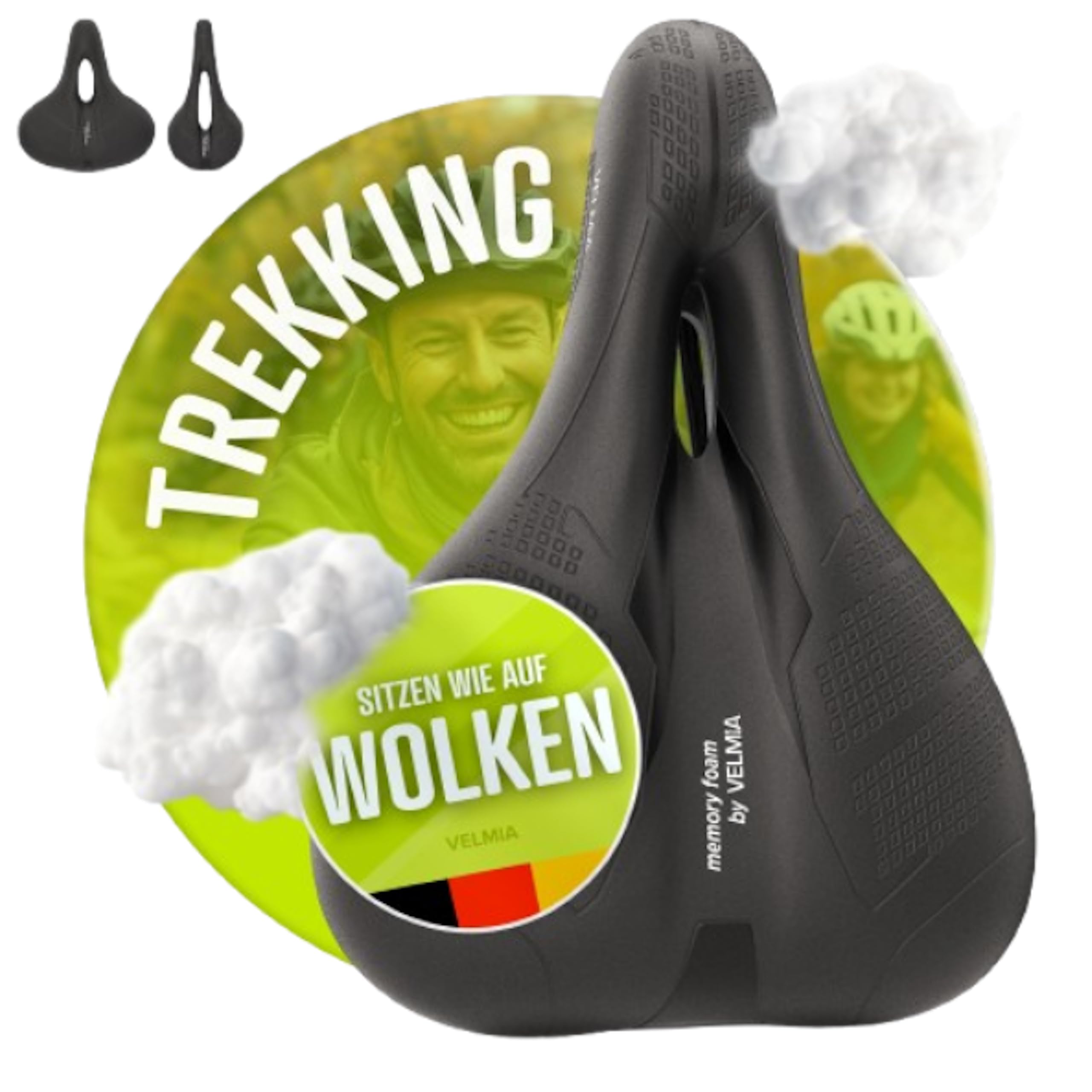
Velmia Bicycle Saddle
Key Features
- Fit: Three models by riding position
- Cover: Waterproof coated
- Width: 7.3 inches
- Included: Saddle clamp and illustrated instructions
- Price: Midrange
The cover carries an extra waterproof coating, and that earns its keep in a way that’s easy to underestimate: a saddle that soaks through leaves you sitting on a damp pad for the rest of the ride, and foam that stays wet is foam that starts to smell. Wipe it down after a wet commute and it’s ready again the next morning.
At 7.3 inches wide it sits between the narrow sport shells and the wide comfort ones, and that middle ground is why we choose it for distance. There’s enough platform to sit on for hours without the wings catching your thighs, and a vent slot through the middle keeps air moving where pressure builds. The surface has a texture that lets you shift position without sticking.
Velmia sells three versions of this saddle, chosen by how far forward you lean, which is a more useful way to shop than picking the widest thing on the page. Match the model to your bars, not your ambitions. A saddle clamp and an illustrated instruction sheet come in the box, so an older post isn’t a blocker.
Pros
- Fully waterproof coated cover
- Vent slot keeps airflow through the middle
- Three models matched to riding position
Cons
- Starts hard and takes several rides to soften
- Rails are the weak point under heavy use
We pick this for long road rides: the 7.3-inch shell, vented center, and genuinely waterproof cover make hours in the saddle easier to accept.
Best for Tailbone Pressure Relief
Bluewind Noseless Saddle
Key Features
- Design: Noseless
- Dimensions: 13"L x 9"W x 5"H
- Cover material: Microfiber PU leather
- Weight capacity: 300 lb
- Price: Midrange
Take the nose off a saddle and the part that disappears is the part that presses where you least want pressure. The Bluewind’s noseless shell puts everything under your sit bones, and your thighs move without brushing anything in front of them. For riders whose rides end in numbness rather than muscle fatigue, that’s the entire argument.
The shell measures 13 inches long, 9 wide, and 5 tall, with 7 cm of foam that stays firm under a hand rather than collapsing. It’s rated to 300 pounds, covered in a microfiber PU leather, and mounted on dual shock-absorbing pads like most of this group. A reflective armband and the mounting tools come in the box.
Two things follow from the shape. Five inches of shell sits you noticeably higher, so plan on dropping the post a little before your first ride. And there’s no nose to grip with your knees when you stand to climb or steady the bike at a light — a habit you notice most on the first hilly route.
We point riders here when the problem is pressure rather than soreness, and it’s the saddle that has converted the most skeptical people we’ve handed it to. It stays in the runner-up tier because it isn’t versatile: it’s happiest on a bike where you stay seated, and it’s the one we take off before a long climb.
Pros
- Noseless shell removes perineal pressure
- 300-pound rating on a 9-inch platform
- Mounting tools and reflective armband included
Cons
- No nose to grip with the knees when standing
- Wide wings can rub the back of the thighs
When numbness rather than soreness is what ends your rides, we hand you this one first; the noseless shell takes the pressure off completely.
Best for Heavier Riders
Twomaples Oversized Saddle
Key Features
- Padding: Memory foam and gel
- Dimensions: 13.39"L x 12.2"W x 5.51"H
- Item weight: 2.1 lb
- Weight capacity: 650 lb
- Price: Midrange
A 650-pound weight rating is the highest number in this group by a wide margin, and it’s the reason this saddle earns a place rather than a shrug. Riders the other shells aren’t rated for get a steel arch frame, a polypropylene base, and memory foam over gel that spreads the load instead of flexing under it. At 12.2 inches wide it’s also the broadest saddle here, and that’s the point: more surface, less pressure per square inch.
The concave wing shape is meant to keep you from sliding forward, and it works better than the flat cruiser shells — but the tilt takes patience. Plan on a couple of attempts with the two wrenches in the box before the seat sits level, and check the bolts again after the first long ride. At 2.1 pounds it’s heavy, though on an e-bike or a cruiser that’s a fair trade for the surface area.
Pros
- 650-pound capacity, the highest here
- 12.2-inch width spreads pressure over more surface
- Two mounting wrenches and an adapter included
Cons
- Very wide wings can catch the thighs
- No manufacturer warranty stated
For heavier riders and big e-bikes this is our pick: nothing else here is rated to 650 pounds or spreads weight across 12 inches of shell.
Best for Upright Cruiser Riding
Cloud-9 Cruiser Select
Key Features
- Dimensions: 10.75"L x 10.5"W x 8.1"H
- Suspension: Coil spring and elastomer
- Item weight: 3.2 lb
- Cover material: Vinyl
- Price: Premium
Coil springs and an elastomer block sit between the shell and the rails, and on cracked pavement that combination does something foam alone can’t: it moves. The whole saddle stands 8.1 inches tall, the most in this group, so the comfort comes with a raised seat height — check you can still reach the ground at a stop before you commit.
The 10.75-by-10.5-inch shell is finished in vinyl with a vented center and a tri-color cover that looks like it belongs on a beach cruiser. Vinyl wipes clean, which matters on a bike that lives outside. Rails are the thing to check: this one’s are wider than a compact clamp expects, so confirm the fit against your post before ordering rather than after.
For a cruiser or a comfort bike ridden upright, this is the saddle we fit. Nothing here soaks up a bad path the way the springs do, and the width supports a rider who sits straight up with their hands high. The 250-pound rating is the number to check — heavier riders should look at the Twomaples instead.
Pros
- Coil springs and elastomer absorb rough pavement
- Wide 10.5-inch platform for upright riders
- Vinyl cover wipes clean
Cons
- Heaviest saddle in the group at 3.2 pounds
- Cover seams can split over time
We fit this to cruisers and comfort bikes: the coil springs handle rough paths better than foam, and the wide vinyl shell suits a fully upright rider.
Best for Stationary and E-Bikes
RockBros Bike Saddle

Key Features
- Extras: Built-in carry handle
- Dimensions: 10.2"L x 8.6"W x 3.9"H
- Cover material: PU leather
- Weight capacity: 220.5 lb
- Price: Budget
There’s a handle molded into the underside of this saddle, and if you’ve ever wrestled a heavy e-bike onto a rack or dragged a spin bike across a room, you’ll understand why it’s the detail we noticed first. It gives you a solid grab point at the balance point of the bike instead of a fistful of frame.
The rest is familiar: 10.2 inches long, 8.6 wide, 3.9 tall, memory foam under a PU cover, dual shock-absorbing pads, and a dotted anti-slip surface that holds you in place when the road gets coarse. The rated capacity is 100 kg, lower than the comfort saddles here, so check that against your own weight before anything else.
The clamp is the part to watch. It can work loose on rough ground, so give it a proper tighten before a long trip and check it again after the first few rides rather than after the first month. A wrench comes in the box, but there’s a second side to that clamp.
It earns a place for the rider who moves a heavy bike regularly and wants a wider, softer perch than a stock spin-bike saddle. It stays in also-consider because the cover is the part that ages first, and comfort shells at the budget end of this group do the sitting job for less money.
Pros
- Built-in handle makes lifting an e-bike easier
- Anti-slip dotted surface and dual shock pads
- Reflective strip adds low-light visibility
Cons
- Cover seams split with months of use
- Only one wrench in the box for a two-wrench clamp
We keep this for riders who lift a heavy e-bike or spin bike; the built-in handle is genuinely useful, though the cover and clamp need watching.
How We Tested the Best Bike Seats
We started by pulling together seats sold for commuting, fitness riding, and casual paths, then filtered out models with odd clamp standards, rail widths that did not fit common posts, or covers that looked thin before installation. The shortlist came down to 11 seats, each installed on our own bikes rather than a test rig.
For eight months, those 11 seats moved between commuter bikes, a weekend greenway bike, and an indoor trainer. I timed each install with a torque wrench and the tools a home mechanic would have, then checked the clamp after a few curb drops and a week of regular riding. On the road, we paid attention to whether the seat twisted when we stood to climb, whether the rails flexed unevenly, and whether we rocked our hips to reach the pedals. Firmness got judged over longer rides: too soft felt fine for ten minutes and awful at forty; too hard showed up as pressure points rather than support.
We adjusted tilt and fore-aft position on every seat, noting how much rail length we had to work with and whether the clamp held the setting after a bumpy ride. Comfort was scored by how often we thought about the seat—not by how plush it felt in the driveway—and we tracked chafing, numbness, and pressure at the sit bones. Quality and appearance were checked after each month: seams, cover wear, rail scuffs, creaks. Value came down to whether a seat still felt solid and comfortable relative to what it cost, and functionality was the simplest test: did we reach for that bike more often because the seat was on it?
How to Choose a Bike Saddle
The saddle that fixes your ride is the one shaped for the way you actually sit on the bike, not the one with the most foam on top.
Width and shape follow your riding position
The saddles here run from 6.7 inches at the narrowest to 12.2 at the widest, and that span exists because an upright rider puts weight on a broad, flat platform while a leaned-over rider rocks forward onto the sit bones. Put a cruiser shell under a road bike and every pedal stroke becomes a thigh rub; put a narrow racing shell under a rider who sits straight up and the load lands on a small patch that hurts within a mile.
Test it against a wall: sit on the bike with your hands where they sit on the bars, then lift them. If you stay stable, a middling width like the Velmia’s 7.3 inches will suit. If you feel yourself sliding forward, go wider. If your knees brush the top tube, go narrower.
Pressure relief: cutaway, channel, or no nose
There are three answers in this group. A deep center cutaway removes material where soft tissue sits, a vented slot does the same job with more airflow, and a noseless shell removes the whole front. The trap is assuming a hole helps just by existing — it only helps if it lands under the part of you that hurts. A channel that sits forward of your sit bones does nothing at all.
Noseless designs solve pressure completely but cost you the nose you grip with your knees when you stand to climb or steady the bike at a light. If most of your riding is seated, that trade is easy to accept; if you climb out of the saddle, it isn’t.
Padding, springs, and what soft really means
Thick foam feels wonderful for five minutes and bottoms out at twenty, which is why several saddles here read as firm out of the box. Dense foam and memory foam with gel do different jobs: the first supports, the second conforms. Springs and elastomer blocks buy bump absorption, but they add weight and stack height, and a sprung saddle that stands 8 inches tall changes how far you can reach the ground at a stop.
We choose support first and let the surface handle the rest. If your roads are genuinely bad, a suspension seat post will do more for you than another half inch of foam.
Rails, clamps, and what wears out
Rails are the one part that has to match your bike. Standard rails fit standard clamps, but some older posts measure 1.25 inches and need an adapter, and wide cruiser rails can be too broad for a compact clamp. Check rail spacing and clamp style before you order, not after.
Then think about what ages: cover seams split, rails fatigue, springs develop voices. Wipe the cover down, keep the clamp bolt snug, and expect the shell to be the last thing to fail, not the first.
Frequently Asked Questions
Do I need new tools to swap a bike saddle?
Usually not. Most saddles clamp to your existing rails with a hex key, and several here ship with the wrench you need. Some ship with only one wrench when the job takes two, one on each side of the clamp, so have a second on hand before you start.
Is a new saddle worth it on an exercise bike?
More often than on an outdoor bike, yes. Indoor bikes ship with narrow, hard saddles because they are cheap to fit and riders are expected to stand. If you cut every session short at the same point, swap the saddle before you buy padded shorts or a gel cover — a cover shifts under you, a saddle doesn’t.
Why does my saddle keep tilting, even when it feels tight?
Two causes. Either the clamp bolt isn’t tight enough for the serrations to mesh rather than just touch, or the shell’s underside won’t sit level on your post, which happens with deep, wide shells. Tighten, ride a few miles, tighten again. If it still creeps, the saddle is the problem, not your wrench.
Final Verdict
Our default is the Bikeroo Comfort Saddle: the center cutaway, 7.8-inch platform, and 350-pound rating cover more riders than anything else here, and the tools and rain cover come in the box. If you pedal with a forward lean and your knees brush the top tube, take the Wittkop’s 6.7-inch shell instead. If your weight is above the Bikeroo’s rating, the Twomaples is the one built for it.