This post contains affiliate links. We may earn a small commission when you buy through our links — at no extra cost to you.
A sandal can look at home on a beach blanket and still betray you three miles into a city walk—a hot spot at the arch, a heel that slips, a footbed that flattens by lunch. The best walking sandals are not the softest pair on the shelf; they are the ones that hold their shape after the tenth mile and keep your foot from sliding around. You want arch support that lasts past the first hour, cushioning that doesn’t bottom out, and straps you can adjust for a secure fit—so appearance and comfort stop being a trade-off.
Over six months, my team and I walked in 12 pairs on daily errands, airport concourses, and weekend park loops. We wore them sockless to see where blisters started, judged quality by stitching and buckle hardware, and checked traction on wet pavement and a damp boardwalk. We also noted which pairs looked good with shorts, jeans, and a casual dress, because a walking sandal you won’t wear is no bargain. The picks below stayed comfortable, supportive, and stable mile after mile.
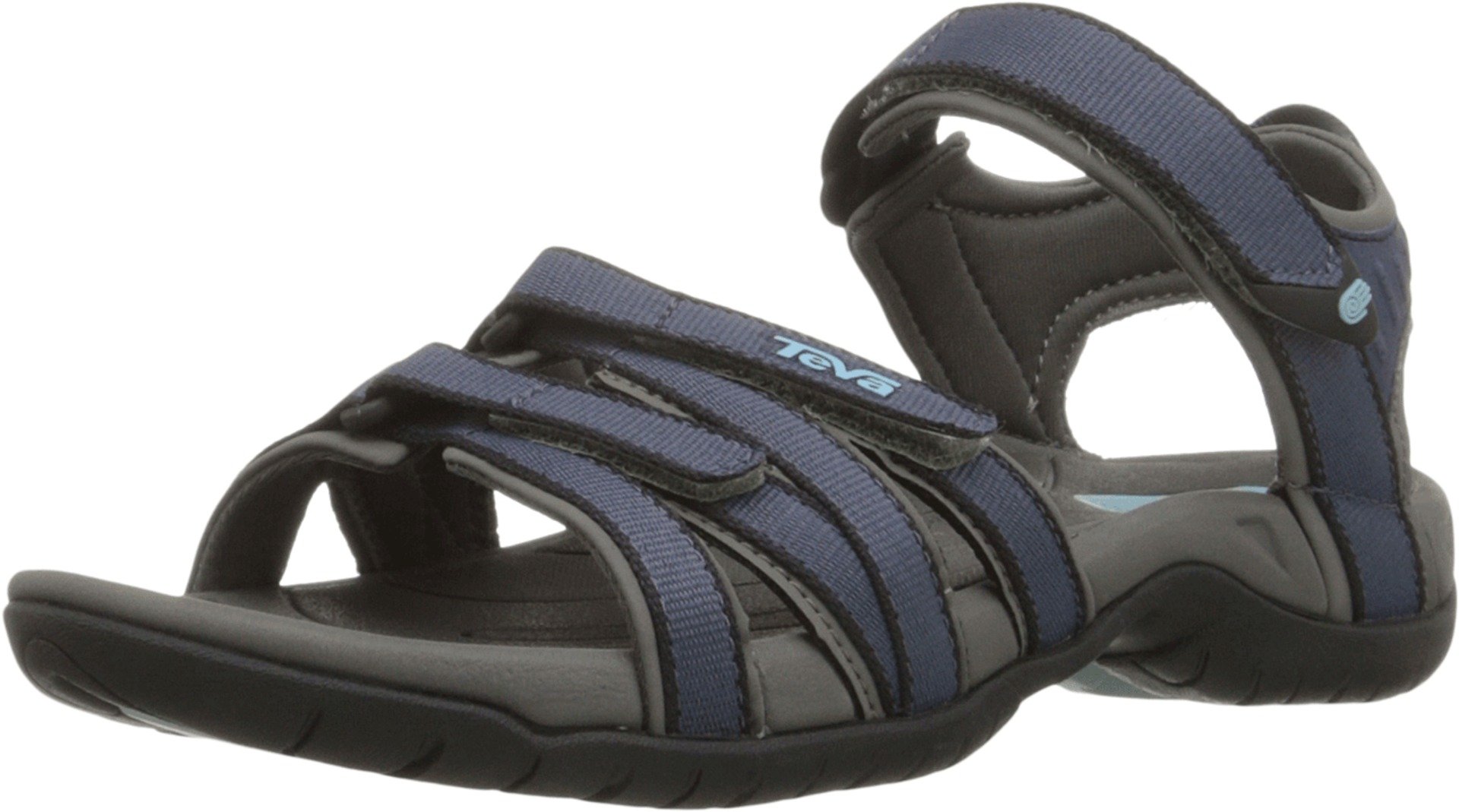


Best for Long Walking Days
Teva Women’s Tirra
Key Features
- Style: Sport sandal
- Footbed: Contoured arch support
- Adjustment: Three hook-and-loop straps
- Price: Midrange
Three straps, three places to adjust, and that’s the argument for the Tirra. Set the heel strap, set the one across the ankle, move the front strap back off your toes, and the sandal stops needing to be gripped to stay on. Over a long day that’s the difference between a sandal you’re thinking about and one you forget. It isn’t the softest footbed here and it isn’t trying to be.
The shape underneath is what earns the miles. The footbed is contoured rather than flat, with an arch that sits where a high arch wants it, so the support comes from the form of the sole instead of a slab of foam that flattens by mid-afternoon. Sand, rock, and a bit of scrambling don’t change that, and the whole sandal looks tidy enough that we never felt underdressed walking into a shop afterward.
The one thing to plan for is break-in. The straps are crisp at first and can rub the heel and the top of the foot before they relax. Loosen all three rather than just the ankle strap, and wear them on a couple of short outings before a long one. That’s a small tax on an otherwise forgiving sandal, and it’s the only real complaint we carry against it.
Where the Tirra pulls ahead is range. Sandals that behave on a trail are often clumsy on pavement and the reverse; this one walks both without complaint. Against the ECCO Yucatan it’s the easier sandal to adjust and the friendlier one to loosen when feet swell on a hot afternoon, though the ECCO is the one that lasts longer. For a trip that mixes trails and town, this is the pair that goes in the bag.
Pros
- Three-point adjustment secures the whole foot
- Contoured arch holds up over a full day
- Quick heel hook makes them easy on and off
- Rugged enough for rock, sand, and town
Cons
- Straps can rub before they soften
We recommend it first for long days on your feet: three straps to dial in the fit, a contoured footbed, and a sole that behaves on trail, pavement, and wet rock alike.
Best for Trails and Travel
ECCO Women’s Yucatan
Key Features
- Style: Sport sandal
- Footbed: Cushioned and supportive
- Adjustment: Three adjustable straps
- Price: Premium
Nothing else in this set has the same record for staying intact. Water, rain, trail grit, repeated summers: the Yucatan comes through all of it, and there are pairs still in service after a decade. That’s the reason it’s here, and it’s the reason the premium is easier to justify than it first looks.
It walks well, too, in a steadier way than the soft sandals here. The footbed is cushioned but it holds its shape, and the three straps let you pull the midfoot and heel down snug, which is what keeps the foot from sliding on a descent. One thing we noticed is how much straighter the walk felt after a few hours, simply because nothing was shifting under the arch.
Two things to know before committing. It wants a couple of days to settle in before a long first outing, which is normal for a sandal this sturdy. And the ride is supportive rather than pillowy; if you want a sandal that feels like a cushion, the Skechers is the friendlier choice, while this is the one that outlasts the rest of the set.
Pros
- Survives water, grit, and repeated seasons
- Supportive footbed steadies the whole stride
- Three straps fine-tune a close fit
- Trail, water, and town on one pair
Cons
- Premium price within this set
Our pick when durability comes first: it’s the toughest sandal in this set, and it handles wet rock, trail grit, and city days without giving anything up.
Best for All-Day Pavement
Skechers On-The-Go 600
Key Features
- Care: Machine washable
- Style: Sport sandal
- Weight: 6 oz
- Price: Midrange
Six ounces is the whole story here. Pick one up and it feels like almost nothing; put it on and walk a few miles and it still feels like almost nothing. The footbed is the softest of any sandal we recommend, and the upper is breathable enough that a hot afternoon doesn’t turn into a sauna for your feet. For pavement, errands, and standing around all day, that combination is hard to beat.
Two details we appreciate beyond the cushioning. It’s washable, which counts for more than it sounds like on a sandal that goes to the beach and back. And it runs wide enough that broad-footed walkers stop hunting. What it isn’t is a trail sandal; on roots and loose gravel we wanted more structure underfoot, and that’s a job for the KEEN Rose or the ECCO Yucatan instead.
Pros
- Featherweight on the foot all day
- Plush footbed for standing and strolling
- Machine washable after dusty days
- Wide fit suits broader feet
Cons
- Grip fades on wet, smooth surfaces
Six ounces and a pillowy footbed make this the sandal we reach for on long, flat days when comfort matters more than trail credentials.
Best for Rocky Trails
KEEN Women’s Rose
Key Features
- Style: Closed-toe sandal
- Upper: Soft fabric straps
- Ankle strap: Not adjustable
- Price: Midrange
Every open sandal on this list shares one weak point: your toes. The Rose covers them. On a rooty trail, or a scramble where you’re watching your feet more than the view, that closed front turns a stubbed toe into a non-event, and it’s the sandal we ended up choosing on exactly those days.
The rest of the shoe is softer than it looks. The upper is fabric rather than rubber, the footbed is supportive, and there’s no break-in to speak of; they came out of the box feeling like slippers. Where it gets tricky is fit. The sizing runs generous for some feet and tight around the ankle for others, and the ankle strap doesn’t adjust, so that’s the one part of the fit you can’t fix at home.
Where we land: it’s the sandal for the person whose walks happen on dirt. The closed front does get warm on a hot pavement afternoon, and the Tirra is the cooler, easier choice for city miles. For anything with rocks in it, the protection earns its place, and the fact that you can throw them in the washing machine afterward is a genuine pleasure.
Pros
- Closed toe protects against roots and rocks
- Cushioned enough for a full day
- No break-in period out of the box
- Machine washable when they get muddy
Cons
- Ankle strap doesn’t adjust for fit
- Warm on hot pavement
For trails with roots, rocks, and stubbed toes, the closed front is worth the extra warmth, and we recommend it to hikers who want sandal airflow with shoe-like protection.
Best for Budget Hiking
UBFEN Hiking Sandals

Key Features
- Style: Sport sandal
- Footbed: Cushioned arch support
- Toe box: Generous width
- Price: Budget
UBFEN is doing a recognisable impression of a sport sandal: hook-and-loop straps, a contoured footbed, a roomy toe box. What surprised us is how little gets given up. The cushioning under the arch is real rather than decorative, the straps actually hold the midfoot, and the front of the sandal is wide enough that a bunion or a broad forefoot has somewhere to sit.
Where it sits against the rest of the set is straightforward. It’s softer underfoot than the Tirra and less precise, so a long descent feels vaguer; on flat paths and packed dirt it’s perfectly pleasant for hours. The sizing runs generous, which is worth knowing if you’re between sizes.
The question is how long it lasts. The sole is glued rather than stitched, and glue is what lets go first on a sandal that sees water and heat. If you walk a few miles a day rather than ten, that trade is a sensible one; if you’re hard on footwear, put the money into the ECCO instead and keep these for the easy days.
Pros
- Cushioned arch support at a budget price
- Wide toe box suits broad feet
- Adjustable straps hold the midfoot
Cons
- Sole can separate with hard use
We think it’s the best value in this set for a walker who wants real arch cushioning and a wide toe box without spending much.
Best for Town and Work
Clarks Ankle Strap Sandal

Key Features
- Heel: Low lift
- Style: Ankle-strap sandal
- Footbed: Cushioned with arch support
- Price: Budget
The Clarks is the one sandal here that looks like it belongs at dinner rather than on a trail, and that’s the point of it. Soft fabric straps, an ankle strap, a little lift in the sole: it reads dressier than the webbing sport sandals without turning into a wedge you can’t walk in. Several people we know would wear it to the office and then straight out.
The comfort backs up the looks. The footbed is cushioned with a shaped arch, the straps don’t bite, and the whole thing disappears on your foot after an hour. For standing — a long museum day, a shift on your feet, a wedding — it’s the most forgiving sandal in this set that isn’t a sport sandal.
Fit is true to size, and the back strap adjusts, though the rest of the upper is fixed, so it suits an average-width foot better than a very wide or very narrow one. It also runs quieter than the webbing sandals: no straps to loosen at lunch, no break-in drama.
Treat it as a town sandal and it earns its place in a suitcase. It packs flat, dresses up, and looks like new after a wipe-down. What it doesn’t want is a rocky trail or a river crossing, and it isn’t the pair we’d pick for a ten-mile day. For the traveler who wants one sandal for the whole trip and would rather look put together than trail-ready, it’s the obvious choice.
Pros
- Dresses up with jeans or a dress
- Cushioned enough for all-day standing
- Arch support without a bulky sole
Cons
- Sole and heel can crack with wear
For city days and dinners where a sport sandal looks out of place, this is the comfortable, supportive pair that still dresses up.
Best for Standing and Errands
Cushionaire Luna Cork Sandal

Key Features
- Style: Backless slide
- Closure: Buckle straps
- Footbed: Cork with suede lining
- Price: Budget
No back strap. That one omission decides what the Luna is for. Without something holding the heel, your toes do the work of keeping the sandal on, and over a few miles that turns into cramping and a sandal that slaps rather than walks. As a slide to stand in, wear to a market, or leave by the door, it’s a different story entirely.
We like it for exactly that. The cork footbed is supportive in the way cork tends to be, moulding a little under the arch, and the suede lining is a nicer touch than the tier suggests. The buckle straps let you take it in over the instep. On sizing, they run small and narrow, and a wide width isn’t dramatically wider, so going up a size is the safer move for most feet.
It’s a sandal for a long lunch, a museum, a day of shopping: hours on your feet without many steps. Take it on a walking trip and you’ll feel the missing heel strap by the second afternoon. That’s a fair trade for how good it looks with a summer dress, as long as you know which of the two you’re buying.
Pros
- Supportive cork footbed with suede lining
- Buckle straps take in the fit
- Looks good enough for everyday wear
Cons
- Buckles corrode once they get wet
We like it for standing and errands, where the cork footbed is genuinely supportive, but it’s the wrong tool for a day of miles.
Best for Knockabout Wear
CIOR Women’s Sport Sandals

Key Features
- Style: Sport sandal
- Footbed: Yoga-mat style insole
- Adjustment: Hook-and-loop straps
- Price: Budget
The CIOR takes the sport-sandal formula — adjustable straps at the toes, over the instep, and around the heel, plus a soft insole — and offers it at the budget end of this set. It’s the pair you buy for a camping trip, a beach week, or a spare in the car without thinking hard about it.
On the foot it’s genuinely comfortable. The insole is soft in the yoga-mat way, the arch is shaped rather than flat, and the straps adjust at enough points that a wide forefoot or a high instep can be accommodated. Several of us walked whole afternoons in them with no rubbing at all.
The catch is longevity. The straps and the glued sole are where these give up, and it tends to happen sooner than it does on the pricier picks, especially if the sandals live outdoors or get wet repeatedly. Nothing about that is a surprise at this end of the market, and it doesn’t make them a bad buy — just a pair you expect to replace.
So: a good first pair, a good travel pair, a good pair for the garden. If you’re walking long distances every week, the Teva Tirra costs more and returns it in adjustment and support. If you want three straps and a soft insole for a season of casual use, these do the job and leave you plenty of budget for the rest of the trip.
Pros
- Straps adjust at several points
- Soft, cushiony insole for hours
- Wide fit for broad feet
Cons
- Straps and soles can fail within a season
A comfortable three-strap sandal for very little money, and we recommend it as a knockabout pair rather than your everyday walker.
How We Tested Walking Sandals
We started with a shortlist of sandals sold for walking and filtered out anything with a thin, glued sole, non-adjustable straps, or a pattern of sole-separation complaints in customer reviews. From there, we narrowed to 12 pairs that covered sporty, leather, and casual styles, then wore them over six months.
Each pair went through the same routine: a sockless two-mile walk, a full day of errands, and a longer weekend outing on pavement and park paths. We logged heel slip, toe-box pressure, and where hot spots turned into blisters. To judge cushioning and arch support, we stood in each pair for ten minutes, then walked an hour and noted whether the footbed stayed supportive or compressed underfoot. Fit got checked at every adjustable strap, and we wore each style with shorts, jeans, and a casual dress to see how versatile it looked.
At the end of six months, we inspected wear: tread depth, strap stretch, stitching, and whether the footbed had packed out. Traction was tested on wet tile, dusty concrete, and a damp wooden boardwalk. The sandals that made the list were the ones that still felt secure and cushioned after all that—not just the ones that felt good in the first ten minutes.
How to Choose Walking Sandals for Long Distances
The footbed and the heel strap do most of the work over a long day; everything else on a walking sandal is detail.
Start With the Footbed’s Shape, Not Its Softness
A sandal that feels like a marshmallow in the shop often feels like work at mile six, because soft foam compresses and your arch ends up doing the job the footbed should. What you want is a raised, shaped arch that presses back against the foot.
Press your thumb into the arch area before you buy: if it collapses flat, it won’t hold you up over a long day. Cushioning still matters, but as a thin layer over a supportive shape rather than instead of one.
The Heel Strap Does More Than the Straps on Top
A backless slide is fine for standing and errands; it’s the wrong tool for miles, because your toes end up gripping to keep it on and that fatigue shows up in your shins and calves. A heel strap, ideally with a quick hook so it goes on easily, keeps the sandal where it belongs.
Look for at least two other adjustment points as well. Feet swell over a long day, and a strap you can loosen at lunch is worth more than a padded one you can’t.
Match the Sole and Toe to Your Ground
Pavement and smooth path ask for a flexible sole and a light sandal. Roots, rock, and gravel ask for something else: a grippier outsole, a firmer midsole, and, if you’ve ever stubbed a toe on a trail, a closed front.
Watch for the wet-smooth-surface trap too. A soft rubber sole that grips dry pavement can skate across a wet boardwalk or a tiled station floor, and no amount of cushioning makes up for that.
Expect a Break-In, and Plan for Water
Most walking sandals rub somewhere in the first week, usually at the heel or the top of the foot, before the straps soften and take the shape of your foot. Wear them on a couple of short outings first, and loosen every strap rather than only the one that hurts.
Water is the other thing to think about. Straps that dry fast are a pleasure; buckles and metal clasps left wet will corrode, so rinse and dry them properly after a river day.
What Spending More Actually Buys
Budget sandals get you the shape of a good walking sandal, with straps, a cushioned insole, and a heel strap, but they save on outsole rubber and on how the sole is fixed to the upper. That joint is what fails first.
Midrange pairs buy better webbing, more adjustment, and a sole that survives a second summer. At the top of this set you’re paying for years rather than comfort; the ride is supportive rather than plush, and the case for it is that you buy once.
Frequently Asked Questions
Are walking sandals really as good as sneakers for long distances?
For warm-weather miles on pavement or smooth trail, yes. A supportive sandal with a heel strap is cooler and just as comfortable over a full day on your feet. Sneakers still win when you’re carrying a pack over rough ground, where debris and ankle coverage matter. If your route is uneven, choose a sandal with a heel strap and a closed toe rather than a slide.
How do I clean a pair of walking sandals?
Warm water, a drop of mild soap, and a soft brush over the straps and footbed, then air-dry them out of direct sun. Two picks here are machine washable, the Skechers On-The-Go 600 and the KEEN Rose, but skip the dryer either way: heat softens the adhesive that holds the sole on.
Are walking sandals a good choice for plantar fasciitis?
Arch shape matters more than cushioning here. Look for a contoured footbed that fills the arch rather than a flat one with a soft top layer, and a heel strap so the foot doesn’t slide forward with each step. The Tirra and the ECCO Yucatan are the two in this set built that way; a backless slide gives the arch much less to work against.
Final Verdict
Start with the Teva Tirra. It’s the most complete walking sandal in this set: three points of adjustment, a shaped arch, and enough grip and composure for a trail and a town in the same afternoon.
If your miles happen on dirt and you want the pair that outlasts everything else here, the ECCO Yucatan earns its premium. If you want the lightest, softest sandal for pavement and errands, the Skechers On-The-Go 600 is the one.