This post contains affiliate links. We may earn a small commission when you buy through our links — at no extra cost to you.
The first genuinely cold morning of the season exposes every weak point in your outerwear. You reach for the jacket that looked good in the store, and by the end of the block your shoulders are hunched and your core is doing math. A good insulated jacket fixes that: it traps warmth without turning you into a marshmallow, fits over a sweater without a wrestling match, and has a zipper that doesn’t catch at your chin.
I’ve worn enough jackets to know the difference lives in the details, not the logo. Over the past six months, our team tested nine insulated jackets on early dog walks, commutes, weekend hikes, and one surprise snowstorm, paying attention to warmth, weight, fit, and how each one held up. The letdowns were rarely about appearance. They were sizing that ran small, pockets too shallow for gloves, and zippers that snagged on the lining. The best ones got those basics right for the money—and the picks below are the ones I’d reach for again.


Best for Everyday Winter Wear
Columbia Heavenly Hooded Jacket
One pound is the number we keep coming back to. That is roughly the weight of a light fleece, and yet this jacket holds its own on a genuinely cold day — the kind that has you scraping a windshield at seven in the morning. Warmth without bulk is the whole trick here, and it is why this is the jacket we hand to most people who ask.
The cut helps. It is close and slightly shaped rather than boxy, which means you can wear it into a restaurant or an office without looking dressed for a summit. The cuffs run long over the back of the hand with thumb holes, and that small flap of fabric is the difference between warm wrists and a cold gap when your gloves and sleeves do not quite meet. The hood is lined in soft fleece, so it sits comfortably against your ears instead of crinkling.
It is cut for women, which is worth saying plainly in a category where most of the heavy hitters are men’s. What it is not is a parka: the trim shape leaves room for a sweater, not a heavy fleece and a hoodie at once, and anyone between sizes or planning to layer should go up. We ended up treating it as a three-season jacket — on its own for most of winter, and as a midlayer under a shell when the wind turns serious.
The other thing we noticed is how often it is simply the right jacket: the school run, a cold stadium, a flight where the cabin is warm and the jet bridge is not. Few insulated jackets look that ordinary while doing that much.
Pros
- Warm for its weight without any bulk
- Shaped cut that avoids the puffer silhouette
- Thumb-hole cuffs close the glove gap
- Works on its own or as a midlayer
Cons
- Premium price next to the budget picks
Our default recommendation for a winter jacket you will wear daily: warm enough for real cold, light enough to forget, and shaped so it does not swallow you.
Best for Shoulder-Season Layering
Carhartt Gilliam Jacket
Key Features
- Type: Insulated
- Weight: 1.2 lb
- Department: Men’s
- Price: Midrange
This is the jacket that lives behind the seat. At a listed 1.2 pounds it is light enough to keep with you for a morning that starts cold and ends mild, and it blocks wind and shrugs off light rain in a way a fleece never manages.
That is why we rate it the best layering jacket in this group. It is warm for its weight without being a jacket you have to strip off the moment you start moving; on a climb it goes in the pack, and at the top it goes back on over a baselayer and does the job of something much heavier.
There is room in the shoulders for a flannel, a thin fleece or a hoodie, which is where this jacket is happiest. Pockets are secure, the cuffs adjust, and the face fabric beads water rather than soaking it through, though a steady downpour will eventually find its way in.
Where it stops is deep cold. This is a shoulder-season and moving-around jacket; on a still, freezing day it is a layer under something else, not a coat. That is the trade for something you will actually carry, and for most hiking and everyday use we think it is the right one.
Pros
- Light enough to carry all day
- Blocks wind and sheds light rain
- Roomy enough for a flannel underneath
- Secure pockets and adjustable cuffs
Cons
- Relaxed cut runs large — try a size down
Our pick when you want one jacket for cool mornings, trail days and the car: light, wind-blocking, and easy to layer over anything.
Best for Extreme Cold
Carhartt Yukon Extremes Active Jac
Two things sell this jacket: it stops wind, and it does not care what the weather does. Sleet, wet snow, a cold wind across an open site — the shell sheds it and the insulation keeps working, which is more than most of the puffers here can claim.
It is also lighter on the body than the heavy work coats it replaces, and that surprised us. The old canvas-and-lining layers felt like armor; this one lets you swing a shovel or climb a ladder without fighting it. Warmth is serious: a long-sleeve shirt underneath is the entire layering system on a cold day.
Our recommendation is narrow but firm. If you are outside because the job puts you there — a barn, a site, a truck yard — this is the best jacket here for it, and the premium buys a tougher shell rather than a trendier one. For a commute, it is overbuilt.
One detail worth knowing: the stretch hem arrives snug and sits high on the hips, then relaxes over the first week or so into something that stays put without riding up. Give it that week before you decide it is too tight.
Pros
- Windproof shell sheds wet snow
- Warm with only a baselayer underneath
- Easier to move in than old canvas coats
- Built for real outdoor work
Cons
- Only two outside pockets
- Sizing runs big — check the chart
The jacket we reach for when the cold is the whole problem: windproof, water-shedding and built like equipment, with the weight to match.
Best for Travel and Packing
Outdoor Ventures Packable Puffer
Key Features
- Hood: Yes
- Weight: 14.4 oz
- Packable: Yes
- Department: Women’s
- Price: Budget
The test we kept coming back to was the packing test. This jacket folds into its own pocket and comes out without a crease, which is not something we can say for the bulkier puffers here. At a listed 14 ounces it adds almost nothing to a bag, and that is the whole reason it earns a place.
As a jacket rather than a packing trick, it is a good one for cold-but-dry days. The hood is roomy enough to pull over a hat, there is an inside zip pocket as well as the hand pockets, and the shell turns mist and light rain without soaking through.
The colors are part of the appeal — the muted ones read as proper outerwear rather than a cheap puffer, and there are enough options to go with a coat you already own. It is the jacket we leave in the car for the half of the year when the weather can turn.
Where it does not work is a hard freeze, and it does not pretend to. Think of it as the layer that turns a cold, damp day into a comfortable one — the jacket you take because carrying it costs you nothing.
Pros
- Packs into its own pocket without creasing
- Light enough to forget in a daypack
- Roomy hood fits over a hat
- Zip pockets, including an inside one
Cons
- Runs large — order your layered size
- Sleeves run long on shorter frames
Our travel pick: it folds into its own pocket, weighs next to nothing, and still cuts the wind on a cold waterfront.
Best for Budget Packing
Amazon Essentials Packable Puffer
Key Features
- Packable: Yes
- Department: Men’s
- Water resistance: Water-resistant
- Price: Budget
Budget puffers usually announce themselves — a thin shell, a rustle like a crisp packet, stitching that gives up before the season does. This one does not. The fabric has some substance, the baffles are tidy, and it keeps drizzle out long enough to get where you are going.
Where it genuinely surprised us is the pockets. There are two deep interior pockets as well as the zip hand pockets, which is unusual at this end of the market. That matters more than it sounds: a phone, a wallet and keys that stay put and stay dry are the difference between a jacket you wear and one you leave at home.
The warmth is for cool weather rather than deep cold — a chilly evening, a spring morning at altitude, a layer under a shell on a wet walk. Rolled into its stuff sack it takes up about as much room as a big water bottle, and it is light enough that you forget it is in the pack until you want it.
Pros
- Two deep interior pockets plus zip hand pockets
- Packs into its own stuff sack
- Water-resistant enough for drizzle
- Warm for cool weather at a low price
Cons
- Sleeves run short for long arms
- Trim shoulders limit heavy layering
The best value in this group: light, water-resistant and packable into its own sack, with interior pockets that punch well above the price.
Best for Ski and Snow
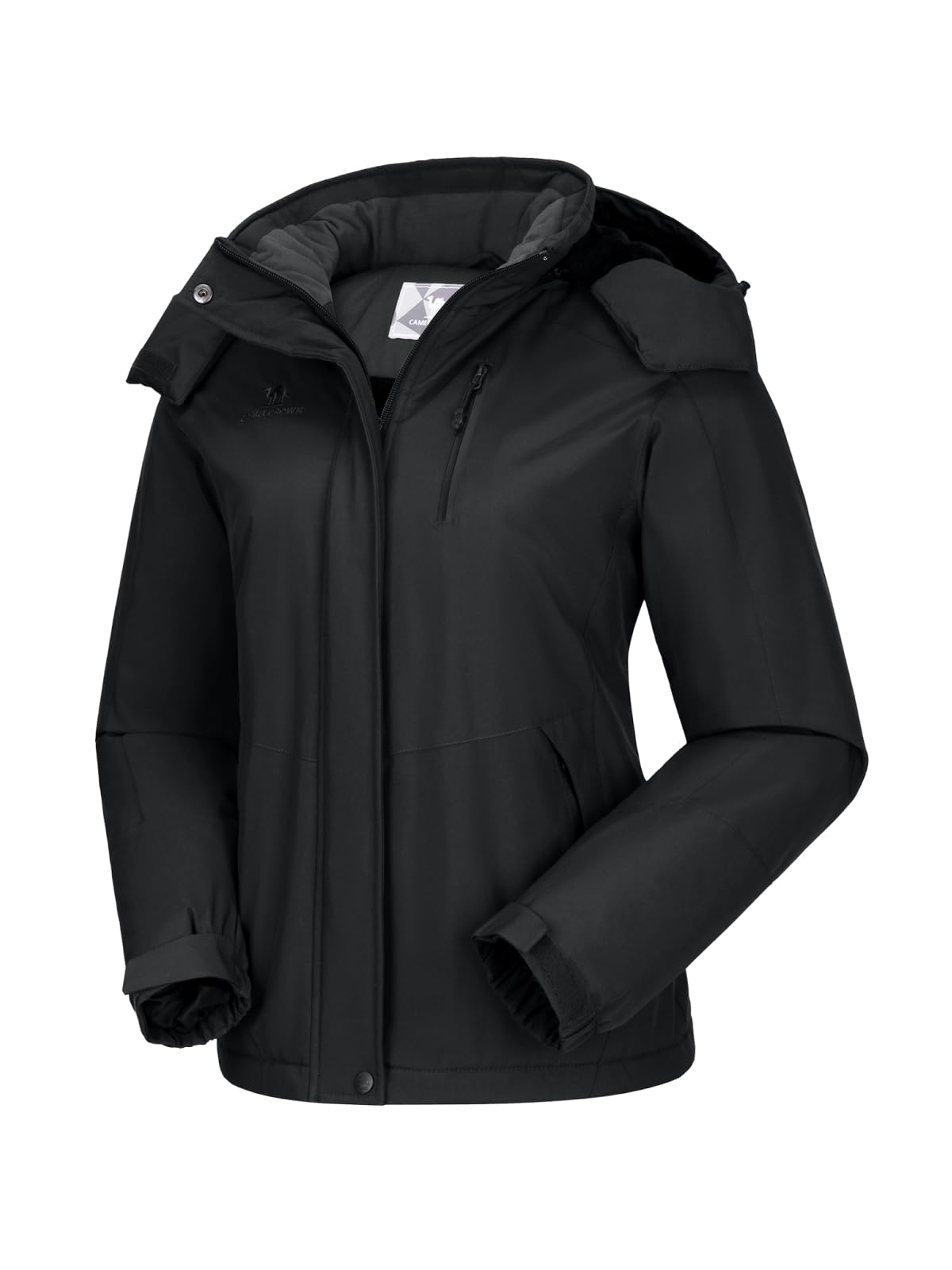
CAMELSPORTS Snow Ski Jacket
Key Features
- Hood: Yes
- Weight: 2.36 lb
- Department: Women’s
- Waterproof: Yes
- Price: Budget
The first thing to know about this jacket is the zip. It is a two-way, and getting both sliders started takes a couple of tries until you learn to hold the hem straight. Once it is engaged it behaves, and the two-way is genuinely useful when you sit down on a lift or drive with the coat on.
Everything else is sorted. The shell keeps rain and wind out, the fleece lining is warm against a baselayer, and there is room for a hoodie underneath without the shoulders going tight. The pockets are the other strength: there are plenty, they zip, and the chest one takes a phone.
We rate it the most complete snow jacket here for the money. It is not a light jacket at a listed 2.36 pounds, but it is not one you notice on a lift either, and it does the wet, windy part of winter properly rather than just looking the part. What decides it is the shell: on a wet, windy hill, the jacket that keeps the weather out is the one you stop thinking about.
Pros
- Waterproof shell keeps rain and snow out
- Fleece lining warms up fast
- Plenty of zip pockets, chest pocket fits a phone
- Room for a hoodie underneath
Cons
- Runs large through the body
A proper snow jacket for the money: waterproof shell, warm fleece lining, and enough zip pockets to keep everything dry on the hill.
Best for Wet Winter Days
TACVASEN Ski Jacket

Key Features
- Type: Ski jacket
- Department: Men’s
- Waterproof: Yes
- Price: Budget
Length is the underrated part of a winter coat. This one covers your backside and the top of your thighs, which is exactly where a cold wind finds you, and it does it without the swagger of a full parka.
The weather protection is better than the price suggests. The shell keeps rain and wet snow out, the wind does not cut through it, and the insulation is warm enough that a shirt underneath is sufficient on a cold day. The sleeves are not short, either, which is where cheaper coats usually give themselves away.
The cut is the compromise. It is a boxy jacket that runs large, so a slim build ends up with a lot of coat around the waist; ordering a size down is the fix, and the extra room is what lets a sweater fit underneath.
We still recommend it, and the reason is simple: the warmth, the length and the waterproofing are the parts that decide whether you are comfortable, and they are all here. What you give up is crispness in the details, not protection from the weather.
Pros
- Covers hips and thighs against wind
- Waterproof and windproof shell
- Warm with just a shirt underneath
- Generous sleeve and body length
Cons
- Zippers are the weak component
Warm, fully waterproof and cut long enough to cover your backside — a lot of winter coat for the money, and the one we point budget buyers to first.
Best for Budget Weatherproofing
Yufawow Winter Ski Jacket

Key Features
- Lining: Fleece
- Weight: 2.98 lb
- Department: Men’s
- Waterproof: Yes
- Price: Budget
The fleece lining is the first thing you notice, and it is what sells the jacket. It takes the shock out of pulling on a cold coat in a way a nylon lining never does, and it means a baselayer is genuinely enough underneath on a raw day.
The shell does its part too. Rain and wet snow bead and run off rather than soaking in, the wind does not cut through, and the pockets — several of them, all zipped — keep a phone dry. For a jacket at this end of the market that is a more complete package than we expected.
It is also less technical-looking than most of the ski jackets here. The shape reads as an ordinary winter coat, which matters if you want one jacket for the slopes and the school run.
We think it is the best value here for genuinely bad weather. It does what the premium jackets in this group do — keeps wind and wet out and stays warm doing it — and it asks for a fraction of the money. If you shop by what you get for the money, this is the one.
Pros
- Fleece lining is warm against a baselayer
- Sheds rain and blocks wind
- Several zip pockets keep gear dry
- Strong value against the premium picks
Cons
- Zip needs a deliberate, straight pull
- Newer design with a short track record
The highest-rated jacket here, and it is easy to see why: warm, properly waterproof and fleece-lined, without paying premium money for it.
How We Tested the Best Insulated Jackets
We started by pulling together a shortlist of insulated jackets from brands we already knew, then narrowed it by checking fill type, shell fabric, available sizes, pocket layout, and whether the price made sense for what the jacket claimed to do. We ended up with nine jackets and wore them for six months, from late fall into early spring. They went on early-morning dog walks, commutes, weekend hikes, errands in wet, windy cold, and one surprise snowstorm. We wore each over a T-shirt and again over a thick sweater to see how the fit changed.
Warmth was the first thing we judged, but not in a lab. We noted how quickly we felt cold standing at a bus stop or waiting outside a coffee shop, and whether the jacket kept heat in when the wind picked up. For weight, we weighed each jacket and then noted whether it packed down small enough for a tote or daypack. Fit and sizing got the same practical treatment: we checked whether the labeled size matched what we normally wear, whether the sleeves were long enough to cover our wrists, and whether the jacket bunched under a backpack.
We also paid close attention to the parts that wear out first. We zipped each jacket up and down with gloves on, watched for fabric snagging near the chin, and checked seams, stitching, and whether the zipper felt sturdy or flimsy. Pockets were loaded with a phone, keys, and gloves to see what actually stayed put. Appearance mattered, too—we wore each one with jeans and with a sweater, and checked whether it kept its shape after being stuffed into a bag. Throughout, we compared what each jacket delivered against its price so value was judged by use, not by the tag alone.
How to Choose an Insulated Jacket
The most useful thing we can tell you about insulated jackets is that warmth is only half the purchase — the other half is whether the jacket handles wind, wet and the layers you wear underneath.
Decide how much jacket you need
The jackets here fall into two families. Light ones, like the Carhartt Gilliam and the packable puffers, are built to go over a baselayer and come off the moment you start moving. Heavy ones, like the Yukon and the snow jackets, are meant to be the outer layer all day.
The trap is reading winter jacket as one standard. A jacket that weighs almost nothing and still claims winter warmth is a layering piece, and it will leave you cold standing still at a trailhead. Buy for how you get cold: moving, or waiting.
Water and wind matter more than another ounce of fill
A wet jacket is a cold jacket, whatever it is filled with. That is why the snow and work jackets here use a waterproof shell while the everyday ones settle for water-resistant fabric. Wet snow and sleet? Prioritise the shell. Dry, hard cold? A softer water-resistant face feels better and costs less.
Watch the word waterproof doing more work than it can. It usually describes the fabric rather than the seams, so if you will be out in steady rain, look for taped seams and a hood that adjusts.
Packability always costs something
A jacket that folds into its own pocket is thinner-shelled and less abrasion-resistant than one built for a worksite, and the listed weights tell most of that story. For travel and hiking the trade is usually right: the Outdoor Ventures and Amazon Essentials jackets earn their place by being carried, not by surviving a barbed-wire fence. For daily wear against rough surfaces, buy the tougher face fabric instead.
Size for the layer underneath
Sizing across this group runs all over the place. The Carhartt work jackets run big, the Columbia runs close, and the packable puffers tend to be generous through the body. The reliable method is to try a jacket over the thickest midlayer you will actually wear, not the shirt you have on when you order.
If the plan is to wear it under a shell, size it close and keep the bulk down. If it is the outer layer, size to the fleece.
Check the hardware before anything else
Zippers are where inexpensive jackets show their age first, and they are the one part you cannot fix with a needle. A chunky main zip, a two-way slider on a long coat, and zipped hand and chest pockets are worth more than another color option. On a jacket you wear daily, the zip is often the difference between one good season and several.
Frequently Asked Questions
Down or synthetic insulation — which is better in wet weather?
Synthetic. Down clumps when it soaks through and stops insulating until it dries, while synthetic fill keeps working when damp and dries faster. If your winters are wet or the forecast is unreliable, synthetic is the lower-risk choice.
Down still makes sense in dry, hard cold, where it gives more warmth for the weight and packs down smaller.
Is a ski jacket too much for everyday wear?
Usually, yes. A ski jacket adds a stiffer waterproof shell and extra length, so it feels heavier and noisier than an everyday insulated jacket, and you pay for weather protection you may only use a few weekends a year.
Keep it for snow and wet hills. For town, a water-resistant insulated jacket such as the Columbia or the Gilliam is more comfortable and layers better under a shell.
How do you stop overheating on a climb in an insulated jacket?
Start cold. If you are warm standing at the trailhead, you will be damp with sweat within a mile. Wear a light synthetic layer over a baselayer, open the chest and cuffs on the climbs, and put the jacket back on the moment you stop moving.
Save the heavier jackets for standing around camp or on a lift, not for walking uphill.
Final Verdict
For most people the answer is the Columbia Heavenly. It is warm enough for a real winter, light enough that you do not dread putting it on, and it does not make you look like a sleeping bag — three things that rarely turn up in the same jacket.
The men’s side of this list starts with the Carhartt Gilliam: the same light, easy idea, though it gives up warmth once the temperature really drops, and the Yukon is the pick for that. If the jacket’s main job is living in a bag, take the packable Outdoor Ventures instead.