This post contains affiliate links. We may earn a small commission when you buy through our links — at no extra cost to you.
Bouldering shoes are a trade-off. The sharper the downturn and the snugger the fit, the better you stick to a steep overhang — and the more your toes complain the moment you peel them off. Lean too far the other way, and you’re smearing off volumes that everyone else seems to float up. The pair you actually want sits somewhere in the middle, and it quietly fixes the maddening stuff: rubber that skates on polished gym holds, a heel that pops off mid-hook, laces you’re retying halfway up a problem.
I climb indoors a couple of evenings a week and get outside whenever I can, and over the past eight months my team and I have rotated 11 pairs through those sessions, from soft, flat neutral shoes to stiff, aggressively downturned ones. The thing that surprised me most: going half a size up from "tight but tolerable" almost never hurt anyone’s climbing — the people who end up miserable are the ones who bought too small. There’s a pair below for most foot shapes and budgets.


Best for Gym Bouldering
Black Diamond Momentum Strap
Key Features
- Upper: Engineered knit upper
- Closure: Two hook-and-loop straps
- Outsole: 4.3 mm rubber
- Price: Midrange
Bouldering is a sport of putting shoes on and taking them off. You pull them on for a problem, work it for a minute, then kick them off to rest, and a shoe that makes that cycle a chore is a shoe you stop bothering with. The Momentum’s two hook-and-loop straps open the whole upper in one pull and close just as fast, which is the most useful thing about it in a gym.
That alone wouldn’t earn the top spot. What does is how little it asks of you elsewhere: a neutral last, a soft-flex midsole, an engineered knit upper that breathes through a long session, and 4.3 mm rubber thick enough to survive plastic. For a first or second pair, it’s the shoe that gets out of the way of your footwork. The catch is the shape — the Momentum runs narrow through the toe box and small for its listed size, so if you’re between sizes take the larger one, and if your feet are broad, look at the Finale below instead.
Thicker rubber is a durability decision as much as a grip one. Soft, sensitive compounds feel wonderful on tiny edges and wear through at the toe within months; the Momentum’s 4.3 mm sole takes the other side of that trade, and on gym plastic it’s the right way round. The knit upper has stayed intact through our sessions, and nothing about the build looks fragile.
None of that makes it a compromise. On vertical gym bouldering and easy rock, the flat last does everything a neutral shoe should: you can stand on small chips, smear on volumes, and leave them on between attempts. The next step up is a specialist’s shoe for steep ground, and that’s a narrower job than most of us are shopping for.
Pros
- Two straps make on and off fast
- Neutral last suits learning footwork
- 4.3 mm rubber lasts on plastic
- Breathable knit upper for long sessions
Cons
- Rubber can leave marks on pale gym walls
We point most boulderers to the Momentum: one shoe for the gym and the odd day on rock, quick on and off, and neutral enough to learn in.
Best for Steep Bouldering
SCARPA Instinct VSR
Key Features
- Department: Unisex adult
- Model number: SCARPA INSTINCT VSR Climbing Shoe-U
- Listed size and weight: 13 x 6.5 x 4.5 inches; 7.6 ounces
- Price: Premium
The Instinct VSR is the most expensive shoe in this group, and it is the most specialized: an aggressive shape, a flexible midsole, and rubber that is happiest on steep ground. Nothing about it pretends to be an all-rounder, and that’s the point.
What the money buys is feel. This is the shoe here for small footholds, toe hooks and heel hooks: the soft midsole lets you read what a chip is doing under your toe, and the shape keeps pressure where you need it when you’re pulling off an overhang. On vertical gym problems it’s overqualified. On anything steep it stops looking expensive.
Aggressive doesn’t have to mean miserable. This is a session-length shoe rather than one you kick off between attempts, and the flexible midsole keeps it from feeling like a vice. The rubber holds up better than thin, sensitive soles usually do, which matters at this price.
So the audience is narrow and specific: climbers who spend their week on overhangs and whose footwork can use the precision. If that’s you, this is the one we reach for, and the difference shows up on the first hard problem of the session.
Pros
- Precise on small footholds and hooks
- Flexible midsole keeps feel without pain
- Rubber outlasts typical soft soles
Cons
- Tight toe box for large toe joints
- Heel volume too roomy for some feet
For steep, technical bouldering the Instinct VSR earns its price: sensitive, precise, and tougher than a shoe this soft has any right to be, if the toe box fits.
Best for First Pair
La Sportiva Tarantulace
Key Features
- Department: Men’s
- Listed since: February 2012
- Model number: 10F
- Price: Midrange
The Tarantulace is the best beginner shoe in this group, and it isn’t the sharpest tool on the wall. It’s a flat, forgiving, comfortable shoe for people still working out where their feet go, which is exactly what a first pair should be. We steer beginners here before we steer them anywhere expensive.
Comfort is the whole argument. The shape is gentle enough for a full gym session and a full day on moderate rock, and it doesn’t punish you for standing around in it — we wore ours for hours without wanting them off. It’s happiest outdoors, on slabby, vertical terrain where you’re edging rather than pulling.
The rubber isn’t the stickiest here, and on polished plastic and smeary volumes you’ll feel the difference against the Momentum. That’s the trade for a shoe this comfortable at this price: it’s built for rock, not for the training wall. None of that makes it a poor gym shoe — the gap is between capable and lively, not between climbing and not climbing.
Pros
- Comfortable for a full session
- Forgiving flat shape for new footwork
- Good value as a first pair
- Suits moderate rock and long days
Cons
- Sizing runs snug and inconsistent
We recommend the Tarantulace as a first pair for climbers who’ll spend as much time on rock as in the gym: comfortable, forgiving, and priced to learn in.
Best for Wide Feet
La Sportiva Finale
Key Features
- Department: Men’s
- Model number: 56H100999
- Listed dimensions: 13 x 6 x 5 inches
- Price: Premium
Most climbing shoes treat wide feet as a problem to be solved with pain. The Finale doesn’t: a wide toe box lets your toes sit closer to flat, which is why it’s the shoe we point wide-footed climbers to before they’ve tried anything else.
The upper molds to your foot over the first few weeks. This is leather, and it ends up feeling shaped around you rather than clamped onto you — the difference is obvious on the second or third session. That, plus a soft midsole, makes it comfortable enough to wear all day, which is rare in a shoe that still climbs well.
Where it belongs is all-day cragging, long moderate routes, and anyone whose feet have been squeezed by narrower lasts. It’s the widest shoe here and it’s built to be lived in rather than to be surgical on the steepest ground. That’s the recommendation: not the sharpest shoe in the group, but the one that makes a full day at the crag bearable.
Pros
- Wide toe box for broader feet
- Leather molds to your foot
- Comfortable enough to wear all day
Cons
- Leather needs a break-in period first
For wide feet and long days, the Finale is our pick: a roomy toe box, leather that molds to you, and enough comfort to outlast your partners.
Best for Tight Budgets
CLIMBX Rave Strap
Key Features
- Closure: Strap
- Department: Men’s
- Listed since: October 2017
- Price: Budget
Cheap climbing shoes die at the toe. That’s the trade at the bottom of this list: the rubber that makes a first pair affordable is the rubber that wears through where you drag your foot onto a hold. The Rave is the least expensive shoe we’re recommending, and it’s the one you should expect to replace first.
It still works. The build is decent for the money, the toe is stiff and stable on small holds, and for a first season in a gym it does everything you need — which is why it’s the pair we suggest to anyone who isn’t sure bouldering will stick. It’s also the sensible choice for a teenager whose feet are still growing.
Sizing is the part to get right. The Rave runs small enough that going up a half size is the safer bet, and grip on polished plastic is competent rather than inspiring. Treat it as a starter shoe with a finite life: we rate it the best budget option here, and it isn’t pretending to be the last pair you’ll buy.
Pros
- Stiff toe helps on small holds
- Good quality for the price
- Beginner-friendly for gym sessions
Cons
- Runs small; size up
- Toe rubber can separate with heavy use
The best budget pick here: buy the Rave as a first pair or for a growing teenager, size up, and expect to wear it out.
Best for All-Round Beginners
SCARPA Origin

Key Features
- Department: Unisex adult
- Model number: ORIGIN Climbing Shoe-U
- Listed dimensions: 13 x 7 x 5 inches; 1.99 pounds
- Price: Premium
The Origin is for the climber who wants one pair to cover everything while they work out what kind of climber they are — gym sessions, a first outdoor trip, some top-rope. It’s a well-made, comfortable, deliberately unremarkable shoe, and nothing about it gets in the way of learning.
The build is the strong part. It’s put together well, the toe holds its shape, and the fit doesn’t stress your feet on a long session. Sizing is the fiddly bit: the Origin runs about half a size small, so start there and be ready to swap if the toes touch the end.
What keeps it out of the top tier is the money. It’s the most expensive of the beginner-focused shoes here, and we think the cheaper Tarantulace and Momentum do the same job with a more forgiving fit. Buy the Origin if it’s the pair that suits your foot; otherwise, save the difference.
Pros
- Well-built for regular use
- Comfortable without stressing the feet
- Works in the gym and outside
Cons
- Runs about half a size small
- Costs more than other beginner shoes here
A well-made, comfortable beginner shoe that costs more than the alternatives here, and worth it only if the fit suits you better than the Tarantulace or Momentum.
Best for All-Day Comfort
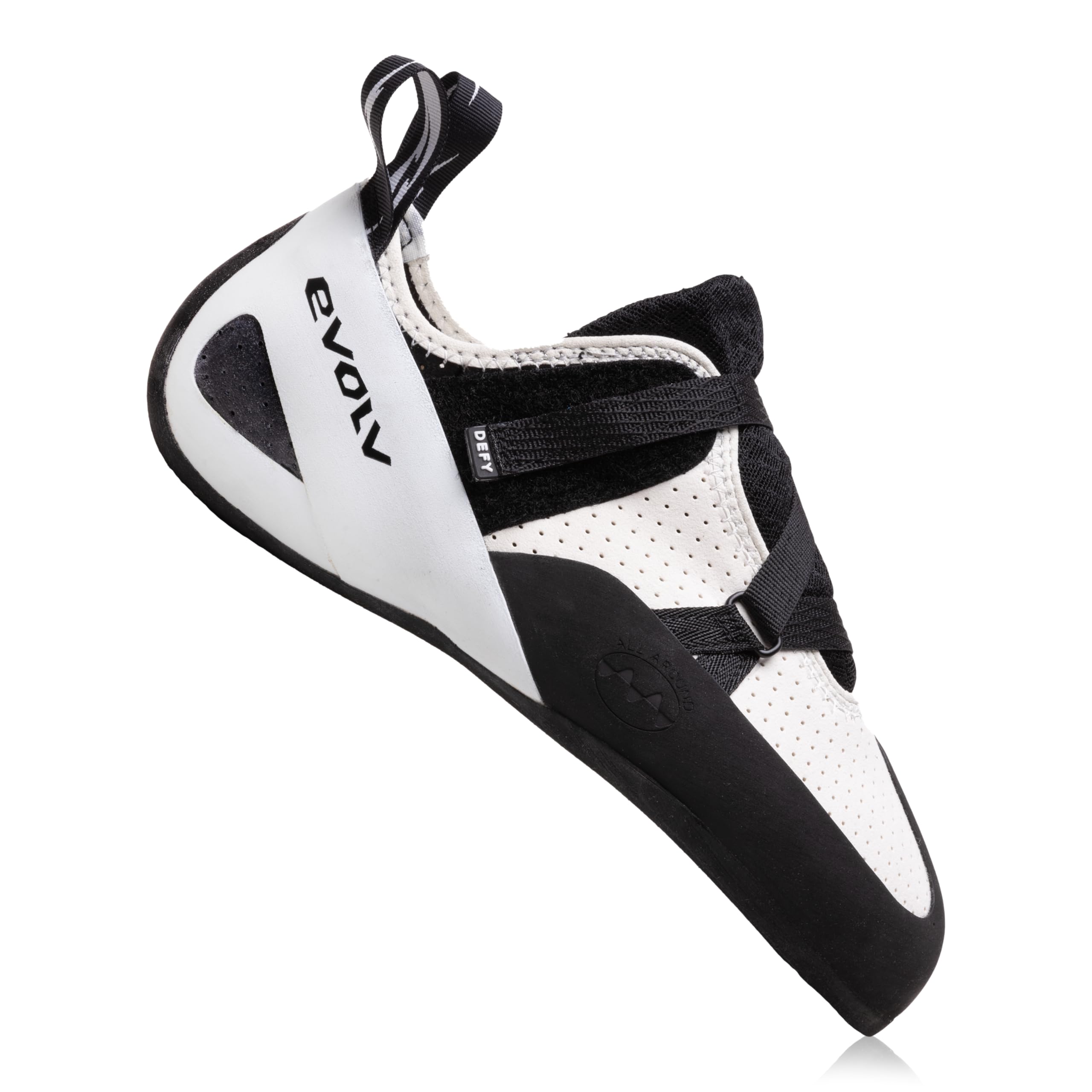
EVOLV Defy
Key Features
- Department: Men’s
- Listed since: January 2021
- Manufacturer: evolv
- Price: Midrange
Comfort is the Defy’s entire argument. It’s soft, easy to get on, and shaped for people who want to keep their shoes on between attempts rather than perching them on their toes. For a long indoor session or a full day outside, that’s not a small thing.
We rate it the most comfortable shoe here for all-day wear, and the one that most needs you to ignore the size printed on the box. The Defy runs short — noticeably short — and crushed toes are the usual result for anyone ordering their street size. Order up a full size and buy from somewhere with an easy return.
Behind the sizing the shoe is solid: the build holds up over months, the rubber is fine on gym plastic, and it sits in the middle of this group on price. If the length works for your foot, it’s a comfortable, durable option — the sizing is the only thing standing between it and a higher place on this list.
Pros
- Soft and comfortable for long sessions
- Easy to get on
- Build holds up over months
Cons
- Runs short; toes get crushed
Comfortable, well-built and let down by length — order the Defy a full size up if you want a shoe you can leave on all day.
How We Tested These Bouldering Shoes
To build the shortlist, we read through hundreds of customer reviews and pulled out the complaints that kept resurfacing: shoes that ran a full size small, rubber that wore through at the toe in a single season, heels that never stopped slipping. From roughly 40 models we chose 11 that covered the real spread of the category — flat and neutral, moderately downturned, and aggressively cambered; lace, hook-and-loop, and slip-on; rubber ranging from soft and sticky to firm and long-wearing.
Each pair got worn for whole sessions rather than a few problems: a weeknight at the gym on slab, vertical, and a 40-degree overhang, plus weekend trips to granite and sandstone when the weather held. On fit and sizing, we compared each maker’s recommended size against the tester’s street shoe, then logged where pressure landed after 45 minutes, whether toes stayed flat or curled, and how much the rand and upper stretched in the first month. Comfort was judged by the walk between problems and by the moment of taking them off, not by how they felt in the first two minutes.
For grip and traction, we worked the same volumes and repeated a set of problems on freshly brushed plastic and on chalk-caked holds, then ran the same checks outside on cool morning rock, where rubber behaves differently. We noted whether toes skated, whether edges held on small chips, and how much heel and toe hooks stayed put. Durability and build quality came down to wear at the toe patch, rand, and stitching at each monthly check, and value was a straight question: what the shoe did for the price and whether enough rubber was left to resole it. We also looked at them — appearance counts, and a shoe that reads like a dusty sack after three sessions is worth saying out loud.
How to Choose Bouldering Shoes
Nearly every shoe here runs small, and fit matters more than rubber, closure or price — get that wrong and nothing else rescues the pair.
Fit before anything else
The old rule — go a size down from your street shoe — is where most first pairs go wrong. Buy for toes that lie flat or curl slightly, never ones jammed straight against the end, and expect to need a bigger number than your normal size in most of the shoes on this list. If you can’t try a pair on, order two sizes from a seller with easy returns and keep the one you can stand up in.
Snug is not the same as painful. A shoe that numbs your toes or forces you to pull it off between problems is the wrong size, however well it grips, and it will teach you nothing about footwork.
Match the last to your climbing
Flat, neutral shoes let the foot sit naturally and suit vertical gym bouldering, slabs and long days — the Momentum and the Tarantulace are both built this way. Aggressive, softer shoes concentrate force on the toe tip and reward good footwork on steep ground, which is the Instinct VSR’s territory.
Buy neutral while you’re learning. Buy aggressive when you’re on overhangs every week and the shoe, not you, is the limit.
Straps for sessions, laces for mileage
Bouldering means taking your shoes off constantly, and a two-strap shoe opens in one motion — worth more than it sounds on a busy gym night, and the reason the Momentum is our default. Laces take longer but hold the whole foot more evenly, which suits long routes and all-day wear.
Boulder indoors twice a week and straps are the practical choice. If your climbing is a full day at the crag with a lot of standing around, laces earn their extra seconds.
Rubber, wear, and where shoes die
Rubber is a trade. Soft, sticky compounds feel better on small holds and wear faster; thicker, firmer ones last longer and feel less precise. Watch the toe, because that’s where a climbing shoe goes first, from dragging your foot onto holds.
A worn sole can be resoled while the rand underneath is intact, so check the tip every few months instead of waiting for a hole to open.
What spending more actually buys
The cheapest shoes here climb perfectly well and wear out sooner. Middle-priced shoes buy better rubber and a more refined fit. The top of the range buys precision and sensitivity that only pay off once your footwork can use them — spend there when the shoe is what’s holding you back, not before.
Frequently Asked Questions
Should I wear socks with bouldering shoes?
No. A sock lets your foot slide inside the shoe, which costs you the fine control you need on small footholds, and it takes up room in something already snug. The exception is a thin liner for blister-prone heels or a pair you share. Keep your toenails short and you won’t miss them.
How long do bouldering shoes last?
Months rather than years if you climb a few times a week, and the toe is the first thing to go. Check the rubber at the tip every few sessions: once the sole is thin but the rand under it is intact, a resoling service can put new rubber on for a fraction of a new pair. Once there’s a hole through to the upper, the shoe is finished.
Do bouldering shoes stretch?
Leather uppers loosen noticeably over the first month; synthetic uppers barely move. A leather shoe should be snug without being painful out of the box because it will give, while a synthetic one holds the fit you buy. Either way, don’t accept a size that curls your toes — that doesn’t improve with wear.
Final Verdict
Most people asking this question should buy the Black Diamond Momentum. It’s neutral enough to learn in, quick on and off between attempts, and built for the gym sessions where most bouldering actually happens. Go up a size if you’re between sizes, and look elsewhere if your feet are wide.
If you’re already climbing steep ground and want a shoe that keeps up, the SCARPA Instinct VSR is the step up and worth the premium. Wide-footed climbers should start with the La Sportiva Finale instead — a roomy toe box changes how a whole session feels.