This post contains affiliate links. We may earn a small commission when you buy through our links — at no extra cost to you.
Many hikers discover their crampons have broken chains or torn rubber after just a few winter outings. That frustration is common because the budget market is crowded with near-identical designs that simply aren’t built for repeated use.
The real difference comes down to how often you hit the trail. A lightweight, budget-friendly pair can handle occasional icy walks, but if you hike weekly, investing in a model with heat-treated steel and reinforced harnesses saves money over time. The choice between portability and aggressive bite also matters for steep terrain.
This article helps you match your hiking frequency to the right level of durability and traction.


Best for Serious Winter Hiking
Kahtoola MICROspikes
Key Features
- Spike Count & Material: 12 heat-treated 400-series SS
- Harness & Strap: TPE with TPU inserts
- Spike Layout: 8 forefoot, 4 heel
- Ease of On/Off: Stretch fit, secure
- Warranty: 4-year limited
- Price: $$$
The Kahtoola MICROspikes use 12 heat-treated 400-series stainless steel spikes that bite into ice and hard-packed snow with noticeable grip on steep terrain. The TPE harness with TPU inserts stays flexible in cold down to -30°C and secures to boots without shifting. For most trail conditions, this traction is sufficient — only on technical ice climbs does a more aggressive crampon become necessary.
Putting them on is straightforward: pull over the toe, stretch the heel strap, and the elastomer harness holds firm. The 11.5-ounce weight won’t weigh down a pack. Over miles of mixed snow and ice, the spikes maintain their edge — occasional snow buildup between spikes clears with a tap.
These are for hikers who head out on snow-covered trails and icy paths regularly, whether day hiking, backpacking, or trail running. The premium pricing reflects the build quality and warranty — if you only need traction for occasional sidewalk or driveway use, lighter and cheaper options like Yaktrax coils exist. For anyone who expects their gear to last multiple winters on real terrain, this set aligns with that use case.
Pros
- Outstanding traction on ice and hard-packed snow, especially on steep terrain.
- Very high build quality and durability through a reinforced harness and heat-treated spikes.
- Easy to put on and stays secure during active movement.
- Backed by a 4-year warranty and strong reputation for longevity.
Cons
- In very rough conditions, chain links can wear and break — an uncommon but possible failure point.
For regular winter hikers who value gear that lasts, the Kahtoola MICROspikes deliver consistent performance across the most common snow and ice conditions.
Best for Steep Icy Terrain
Hillsound Trail Crampon
Key Features
- Spike Count & Material: 11 carbon steel 17mm
- Harness & Strap: Elastomer with textured interior
- Spike Layout: Hinged plate, 17mm
- Ease of On/Off: Velcro strap, secure
- Price: $$$
The Hillsound Trail Crampon I uses eleven 17mm carbon steel spikes on a hinged plate that follows the foot’s natural angle. This design delivers maximum purchase on steep ice and hardpack where other traction systems lose grip, making it a top choice for glacier walking and light mountaineering.
This crampon is a fit for hikers who regularly tackle technical winter routes and wear heavy boots. It is heavier than the leading all-rounder (16 oz per pair) and overkill for gentle trails. Also, the chain links can show wear after a heavy season on abrasive ice – occasional replacement is part of ownership.
Pros
- Aggressive 17mm carbon steel spikes grip securely on steep ice and hard snow.
- Hinged plate and adjustable strap keep the crampon locked on heavy boots during climbs.
- Built with carbon steel and reinforced elastomer for repeated use in demanding conditions.
Cons
- At 16 oz per pair, it carries noticeable heft on long ascents – not for ultralight setups.
- Chain links can wear after a season of heavy use on abrasive ice; occasional replacement expected.
If your winter routes involve sustained steep ice and you prioritize maximum bite over pack weight, this is the right tool. For general trail hiking, the lighter top pick is a better fit.
Best for Budget Winter Hiking
ICETRAX V3 Tungsten
Key Features
- Spike Count & Material: Tungsten carbide (8-10)
- Harness & Strap: High-quality rubber
- Ease of On/Off: Slip-on, easy
- Price: $
ICETRAX V3 Tungsten delivers grip that rivals pricier options, thanks to tungsten carbide spikes and a slip-on design that fits most footwear without fuss. The 4.7 rating from thousands of buyers reflects consistent performance on icy sidewalks and moderate trails. Where the top pick (Kahtoola MICROspikes) wins on long-term durability and warranty, this model matches its traction for a fraction of the price — a clear trade-off in material longevity.
Best suited for budget-conscious hikers, commuters, and ice fishers who tackle moderate terrain a few times a week. In softer snow, the cleat can accumulate snow between the sole, reducing grip until cleared. Heavy regular use may also stress the rubber harness over time — occasional reports of wear or spike loosening exist, so this is a smart choice for lighter use rather than daily abuse.
Pros
- Strong bite on ice and packed snow at a budget-friendly price
- Slips on and off easily over most boots and shoes
- Secure fit stays in place during typical walking paces
Cons
- Under soft snow, the cleat can accumulate snow between the sole, reducing grip until cleared
- With repeated heavy use, the rubber harness may wear or spikes can loosen — occasional reports of breakage
For anyone walking on ice a few times a week rather than tackling technical terrain every weekend, the ICETRAX V3 offers exceptional traction without the premium price tag.
Best for Light Winter Hiking
Tomaje 24-Spike Crampons
Key Features
- Spike Count & Material: 24 stainless steel
- Harness & Strap: Silicone, cold-resistant
- Spike Layout: Double-welded chain
- Ease of On/Off: Velcro strap
- Price: $
The Tomaje 24 Spikes deliver aggressive bite on hard ice and frozen lakes, with a 24-spike double-welded chain that holds well on icy trails. Compared to similar-priced options, these offer more spikes at a lower entry point, though some units have shown the chain links separating from the cleat plate.
These crampons suit winter hikers and ice anglers who need traction on flat to moderate terrain. The silicone harness stays flexible down to -30°C, keeping them easy to put on. For steep ascents or technical ice, a more robust design is a better fit.
Pros
- Effective grip on hard ice and frozen lakes.
- Secure fit and confident traction on icy trails.
- Holds up well for the price with minimal early failures.
Cons
- Chain links may separate from the cleat plate in some units.
- Steep or uneven terrain exceeds the intended use of these crampons.
A capable budget option for winter walks and ice fishing, provided you stay on moderate terrain and accept the occasional unit variance in chain attachment.
Best for Moderate Winter Hiking
WIN.MAX 19-Spike Crampons
Key Features
- Spike Count & Material: 19 stainless steel
- Harness & Strap: TPE, flexible -90°F
- Spike Layout: Standard chain
- Ease of On/Off: Velcro strap
- Price: $
The WIN.MAX Crampons bring 19 stainless steel spikes to the trail at a budget-friendly price, delivering solid grip on icy slopes and packed snow. Unlike premium models such as Kahtoola MICROspikes, these focus on light to moderate use rather than heavy backcountry. However, durability reports note that the chain links may wear prematurely under regular use – a limitation that matters for frequent hikers but less so for occasional outings.
These crampons suit hikers who take winter walks or light day hikes on icy trails, where the traction is more than adequate. The adjustable Velcro strap provides a secure fit over most boots, though those with larger sizes may need to size up. For anyone who only encounters ice a few times a season, the WIN.MAX offers a cost-effective solution without the premium price tag of high-end options.
Pros
- Good grip on icy downhill trails
- Solid build quality for the price
- Secure fit over most boots with adjustable Velcro
Cons
- Durability can vary; the chain links may wear through after modest use
- Sizing runs small for some boot sizes – consider sizing up
For occasional winter hikers who want traction without investing in premium gear, these crampons deliver the grip you need, with the understanding that heavy use may shorten their lifespan.
Best for Occasional Winter Use
Sportneer 28-Spike Crampons
Key Features
- Spike Count & Material: 28 stainless steel
- Harness & Strap: TPE rubber 5mm
- Spike Layout: 16 forefoot, 8 hind
- Ease of On/Off: Stretch fit, tight
- Price: $
The Sportneer crampons offer the highest spike count in their price bracket, with 16 spikes under the forefoot and 8 under the heel. They bite firmly into ice and hard-packed snow, making slick driveways and frozen trails easier to walk on.
This pair is best reserved for light recreational use such as ice fishing, snow shoveling, or short walks on mostly flat terrain. Spikes can snap off after repeated use on abrasive surfaces, and the rubber harness may tear when stretched over large boots. Those planning regular hiking should consider a more durable model with a warranty.
Pros
- Confident bite on ice and hard-packed snow
- Secure grip for stable walking on slick surfaces
- Low price for a high spike count
Cons
- Spikes may break off and rubber can tear after limited use
- Tight harness can be difficult to pull over larger boots
Occasional winter use on flat terrain is where this pair shines; for regular hiking, invest in a more robust model.
Best for Casual Winter Walking
Cimkiz 19-Spike Crampons

Key Features
- Spike Count & Material: 19 stainless steel
- Harness & Strap: TPE (Thermoplastic Elastomer)
- Spike Layout: Standard chain
- Ease of On/Off: Adjustable Velcro
- Price: $
These crampons deliver solid traction on snow and ice at a budget-friendly price, and the adjustable Velcro straps make them quick to put on. However, the construction has inconsistent durability: chains and spikes may detach after moderate use. For occasional winter walks, ice fishing, or emergency car kits, this trade-off is acceptable. Frequent hikers will want a sturdier option.
Pros
- Strong grip on ice and snow
- Easy to put on and remove with adjustable Velcro straps
Cons
- Chains and spikes may detach after moderate use, limiting their lifespan for regular hiking
Best for occasional winter walks, ice fishing, and emergency car kits where heavy use is not expected.
Best for Flat Ice Walking
Yaktrax Walk Cleats

Key Features
- Spike Count & Material: Coils (no spikes)
- Harness & Strap: TPR rubber
- Ease of On/Off: Slip-on, easy
- Price: $
The Yaktrax Walk is an easy-to-use, lightweight cleat that provides effective grip on flat ice and packed snow, making it a go-to for cleared sidewalks and driveways. However, its coil design is not suited for trail hiking or inclines — on steeper ground the coils may lack traction, and the harness can allow the cleat to slip off during more active movement.
Pros
- Effective grip on flat ice and packed snow
- Quick on/off with heel pull tab
Cons
- On inclines, the coil design may not provide enough bite for secure traction
- Cleats can slip off during active movement
Best for flat, predictable winter walks on cleared surfaces — not for trails or inclines where secure footing matters.
Best for Budget Light Use
AOOELLO 28-Spike Crampons

Key Features
- Spike Count & Material: 28 stainless steel
- Harness & Strap: Silicone, cold-resistant
- Spike Layout: Bear claw bionic
- Ease of On/Off: 2 Velcro straps
- Price: $
The 28 stainless steel spikes on this AOOELLO option provide an aggressive bite on ice and packed snow that rivals models costing twice as much. The bear claw bionic design and silicone harness offer solid traction for casual winter trails. However, the limited history of this design means long-term durability and consistency are not yet established — it’s a promising budget pick for occasional outings where a sudden failure wouldn’t be a safety issue.
Pros
- Aggressive 28-spike pattern provides tenacious grip on icy trails
- Low cost for the number of spikes, offering good value per dollar
Cons
- Long-term durability under regular use is unverified given the short history
For budget buyers who want maximum spikes for occasional winter walks and accept some uncertainty about longevity, these crampons are a pragmatic gamble.
Best for Light Ice Hiking
Yaktrax Adventure Grip

Key Features
- Spike Count & Material: 19 triangular SS
- Harness & Strap: TPR rubber
- Spike Layout: Standard
- Ease of On/Off: Tight fit
- Price: $$
The Yaktrax Adventure Grip delivers secure traction on ice and snow with its stainless steel spikes, backed by the brand’s reputation for quality. However, the rubber harness runs tight and the sizing tends to be small, so expect a snug fit and some effort getting them on. This is a good option for Yaktrax loyalists who want spikes for light hiking on icy trails and don’t mind the extra steps to put them on.
Pros
- Good traction on ice and snow with proper spikes
- Quality build consistent with Yaktrax brand
Cons
- Sizing runs small; many need to size up significantly
- Difficult to put on due to tight rubber harness
Best suited for Yaktrax loyalists who value spike traction on icy trails and can work with a snug fit and extra effort putting them on.
Best for Emergency Car Kit
Limm 10-Stud Cleats

Key Features
- Spike Count & Material: 10 stainless steel studs
- Harness & Strap: TPE rubber
- Spike Layout: Studs
- Ease of On/Off: Slip-on
- Price: $
These cleats are very light and easy to stash in a car or daypack for sudden icy patches. Rubber harness and stainless studs provide decent grip on flat ice and packed snow for short distances. But the materials lack the toughness for repeated trail use — the rubber can tear and studs may wear down after a few outings. Fit can also be inconsistent across different boot shapes. This makes them a practical emergency tool rather than a hiking crampon.
Pros
- Good traction on ice and snow for the price
- Easy to put on and take off
Cons
- Rubber harness can tear and studs may wear down with moderate use
- Fit may be loose or too tight depending on boot shape
Keep these in your car or pack for unexpected icy sidewalks or driveways — they are not a substitute for durable hiking crampons on trails.
Best for Occasional Light Use
Azarxis 24-Spike Crampons
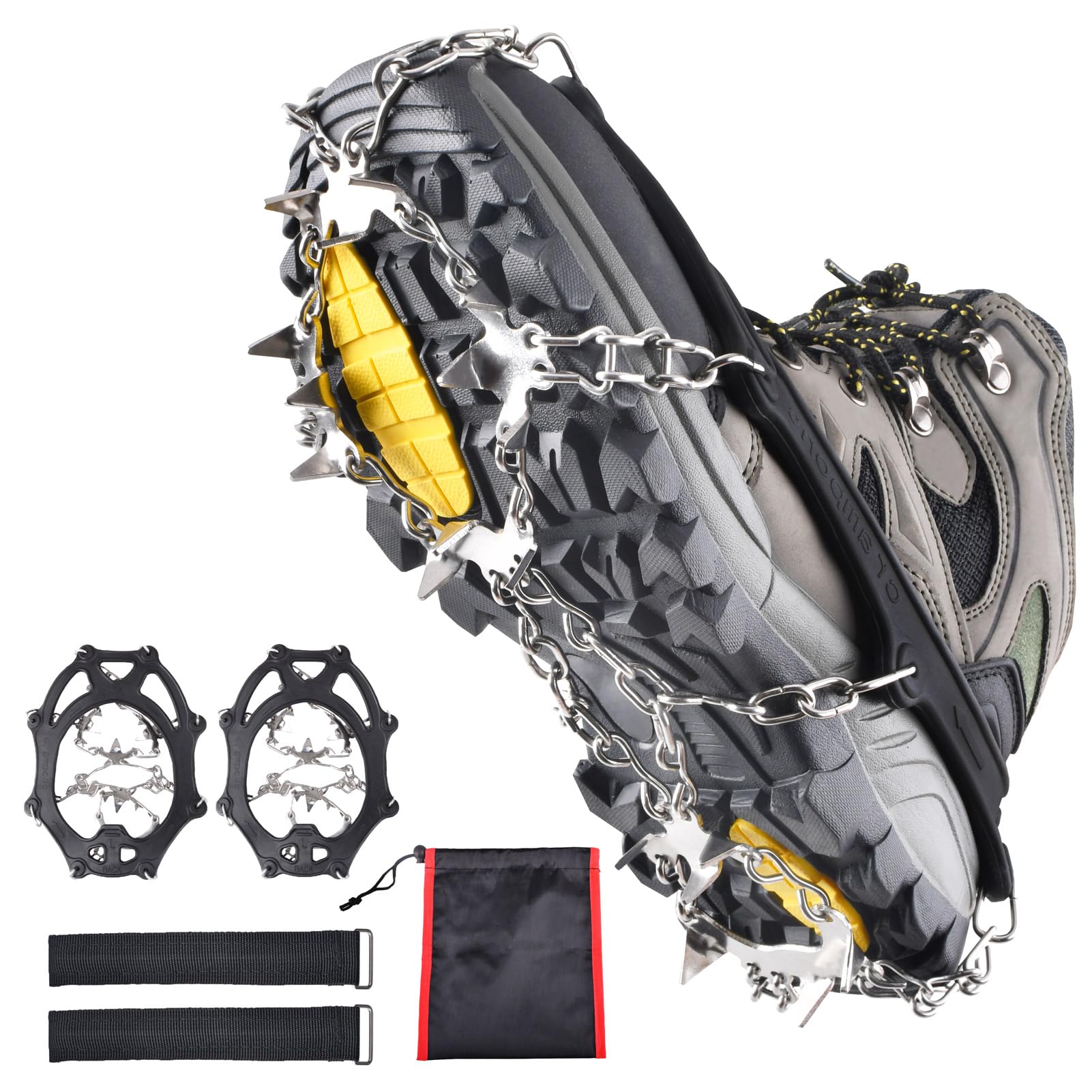
Key Features
- Spike Count & Material: 24 stainless steel
- Harness & Strap: TPR rubber
- Spike Layout: Chain
- Ease of On/Off: 2 Velcro straps
- Price: $
These 24-spike cleats provide decent traction on packed snow and ice for short, flat walks, and the cost is easy on the wallet. However, the rubber harness may fit loosely on some boots, and the chain links can stretch or separate with moderate use. That makes them best reserved for casual, occasional use on level ground – not for hiking on trails or any situation where losing traction could lead to a fall.
Pros
- Good traction on ice and snow for short, flat walks
- Affordable price for occasional winter use
Cons
- Chain links may stretch or separate after repeated use
- Fit can be loose on some footwear, increasing slip-off risk
Best reserved for occasional walks on flat, icy surfaces where you can spare the cost if they wear out quickly – not for hiking or steep terrain.
How to Choose
The single most important factor is matching the crampon’s durability to how often you hike – budget models are effectively disposable after a season of weekly use.
Spike Count and Material
More spikes don’t automatically mean better traction. Spike length and material matter more: tungsten carbide stays sharper than stainless steel, and longer spikes bite deeper into ice. For typical hiking on packed snow and moderate ice, 12 to 19 spikes is sufficient. Higher counts (24-28) are useful on frozen lakes or steep, blue ice where you need extra edge grip. However, more spikes also mean more potential failure points in cheap chain designs.
Harness and Strap Design
The harness rubber must stay flexible in cold without becoming brittle. TPE and silicone compounds that remain pliable down to -30°F are common in both budget and premium models. Budget versions use thinner rubber that tears after repeated stretching. Straps (Velcro or webbing) add security and allow a tailored fit, but they take longer to put on. Slip-on designs are faster but rely on a tight stretch fit – they can pop off if the rubber loses elasticity or your boot shape doesn’t match.
Spike Layout and Length
How spikes are arranged underfoot directly affects stability. Forefoot spikes provide uphill bite; heel spikes aid braking and downhill control. Some designs group spikes in a cluster at the ball of the foot, others spread them evenly. A hinged plate (as seen on more aggressive models) allows the crampon to flex with the foot, improving stability on uneven terrain. Cheaper fixed-plate or chain-only designs can fold or twist under load.
Ease of On and Off
A crampon you can put on with gloved hands in a snowstorm is a real advantage. Slip-on styles are the quickest but must match your boot size precisely. Velcro straps offer adjustability for different boots or layering, but the straps can freeze or get caked with snow. Test the fit at home before a trip – a crampon that’s hard to stretch over your boot in a warm house will be impossible in the field.
Warranty and Manufacturer Reputation
Warranties are a direct signal of confidence. Premium brands like Kahtoola offer multi-year warranties because they use heat-treated steel and reinforced eyelets that survive seasons of use. Budget brands rarely offer any warranty, which matches the expectation that the product is disposable. If you hike more than a handful of times per winter, a warranty-backed crampon will likely cost less per use than buying a new $20 pair each year.
FAQ
Why do my crampons keep breaking after a few hikes?
Most budget crampons use softer stainless steel and thin rubber harnesses that wear out quickly on abrasive ice and rock. Chain links break and rubber tears because the materials aren’t heat-treated or reinforced. If you hike weekly, invest in a model with heat-treated steel and a reinforced harness – the Kahtoola MICROspikes are a proven example built to last multiple seasons.
Are Yaktrax good for hiking on steep icy trails?
No. Yaktrax Walk uses coiled wire that provides grip only on flat, packed surfaces. On inclines, the coils lack bite and slip, and the harness can slide off your boot. For hiking, choose a crampon with actual spikes – the Yaktrax Adventure Grip offers spikes but still struggles with steep terrain and sizing.
How many spikes do I really need for winter hiking?
For moderate winter hiking on packed snow and ice, 12 to 19 spikes is sufficient. More spikes (24-28) help on pure ice or steep slopes, but spike distribution matters more – forefoot spikes for climbing, heel spikes for braking. Very high spike counts on cheap models add failure points without proportional benefit.
Can I use crampons on wet pavement without damaging them?
Avoid pavement. The metal spikes dull quickly on abrasive concrete, and rubber harnesses can tear. Put your crampons on only when you reach snow or ice, and take them off before walking on bare ground. Walking on pavement also reduces the lifespan of the spikes by half or more.