This post contains affiliate links. We may earn a small commission when you buy through our links — at no extra cost to you.
Many campers discover too late that their cooler leaks or doesn’t hold ice as promised. Soft coolers marketed as leakproof often let water out when tipped or ice melts. That is not a design failure but a use-case mismatch between the product and the trip.
The real challenge is matching the cooler to your specific outing: a day hike, a weekend car camping trip, or multi-day off-grid. This guide cuts through marketing hype to highlight what actually matters — real-world ice retention, hinge durability, and whether you truly need a backpack or wheels.
Choosing between portability and ice retention is the central trade-off. A lightweight soft cooler won’t keep ice for days, and a heavy rotomolded beast is overkill for a picnic. The picks below balance these trade-offs for different camping styles.


Best for Weekend Camping
Igloo BMX 25qt
Key Features
- Ice Retention: 2-3 days
- Hinge Durability: Stainless steel
- Portability: 9.8 lbs, handle
- Leakproofness: Leak-resistant
- Capacity vs Weight: 25qt, moderate
- Price: $$
Oversized stainless steel hinges and extra-thick foam insulation keep ice frozen for 2-3 days, enough for a standard weekend trip. The blow-molded shell shrugs off truck bed dings and campsite bumps, and the metal hardware won’t snap like budget plastic hinges. This cooler performs close to premium rotomolded models in moderate conditions, but at a fraction of the cost.
This cooler suits budget-conscious campers who want durable hardware and reliable ice retention without the luxury markup. In extreme heat, expect 2-3 days rather than the 4-5 days of premium rotomolded coolers — a tradeoff that works for casual car camping but not extended backcountry trips. It’s also a natural fit as a truck or SUV cooler for day outings and overnighters.
Pros
- Keeps ice frozen for 2-3 days — enough for a standard weekend trip.
- Steel hinges and body survive rough handling and truck bed use.
- Delivers near-premium performance at roughly half the price of rotomolded coolers.
Cons
- For extended trips in extreme heat, ice melts faster than premium rotomolded models (2-3 days vs. 4-5 days).
For weekend campers who want durable hardware and solid ice retention without the premium price tag, the Igloo BMX 25qt delivers.
Best for Multi-Day Backcountry
YETI Tundra 45
Key Features
- Ice Retention: 3-5 days
- Hinge Durability: Rotomolded body
- Portability: 23 lbs, heavy
- Leakproofness: Sealed bear-resistant
- Capacity vs Weight: 45qt, very heavy
- Price: $$$
Certified bear-resistant and holds ice for days in extreme conditions, the YETI Tundra 45 is built for multi-day backcountry trips where cooler failure isn’t an option. Its rotomolded shell is heavy at 23 lbs empty and priced at a luxury tier, making it overkill for short day trips or casual car camping. This cooler serves serious anglers, hunters, and anyone venturing into bear country who needs reliable ice retention without resupply.
Pros
- Exceptional ice retention keeps contents cold for days even in high heat.
- Superior build quality from rotomolded construction that withstands rough handling.
- Certified bear-resistant for backcountry safety in bear country.
Cons
- Heavy at 23 lbs empty, making short carries a burden when fully loaded.
- Premium price can feel excessive for casual users who rarely need multi-day ice retention.
If you routinely camp in bear country or need days of ice without resupply, this is the cooler to get. For lighter weekend use, the top pick in this set offers a better balance of weight and value.
Best for Short Day Trips
Arctic Zone Titan 48-Can
Key Features
- Ice Retention: 1 day
- Hinge Durability: Zipperless lid
- Portability: 4.4 lbs, carry strap
- Leakproofness: Zipperless, leak-resistant
- Capacity vs Weight: 17L, lightweight
- Price: $$
The Arctic Zone Titan skips zippers entirely, removing the most common failure point in soft coolers. Its Deep Freeze insulation and radiant barrier hold temperatures well for a day at the office, a tailgate, or a short picnic. The removable HardBody liner with SmartShelf keeps sandwiches separate from drinks, so nothing gets crushed.
This cooler suits daily commuters and day-trippers who prioritize convenience and organization over long ice life. The interior is narrow; standard meal prep containers may not fit flat. Ice retention drops off after about 12 hours in warm conditions, so it is not suited for overnight camping.
Pros
- Zipperless lid eliminates jams and seal wear
- SmartShelf and removable liner keep contents organized
- Durable construction handles daily commutes and light outdoor use
Cons
- Narrow interior may not fit standard rectangular meal containers
- Ice retention is insufficient for multi-day trips in hot weather
If your cooler lives in the car for lunches, picnics, or tailgates, the Arctic Zone Titan is a smart, organized choice. For overnight camping, look to the top-pick Igloo BMX instead.
Best for Large Car Camping
Coleman Xtreme 84-Can Rolling
Key Features
- Ice Retention: 1-2 days
- Hinge Durability: Plastic hinges
- Portability: 12.7 lbs, wheels
- Leakproofness: Leak-resistant
- Capacity vs Weight: 50qt, moderate
- Price: $
Holds 84 cans and rolls on wheels – that’s the headline value for group outings. The insulation keeps contents cold for about a day or two; the advertised 5 days isn’t realistic under typical summer conditions. Wheels and handles can break when dragged over rough terrain or loaded heavily, so treat it gently on the way from the car to the beach.
Best for car campers and tailgaters who want massive capacity without spending YETI money. The tradeoff is moderate ice life and hardware that prefers smooth paths – not a cooler for off-road adventures or multi-day trips where ice replenishment is inconvenient.
Pros
- Holds 84 cans (50 quarts) at a budget price – best capacity per dollar in this group
- Wheeled design with telescoping handle makes it easy to move when full
- Double-wall insulation keeps drinks cold for a day or two in moderate weather
Cons
- The 5-day ice retention claim is optimistic – in warm conditions, ice may need replenishing after 24 hours
- Wheels and handles can break when pulled over rough ground or under heavy loads
If you need an affordable wheeled cooler for large groups and can accept moderate ice life and careful handling, this Coleman delivers the most capacity per dollar.
Best for Tradespeople & Work
Klein Tools 17qt Tough Box
Key Features
- Ice Retention: 1 day
- Hinge Durability: Lockable hasp
- Portability: 6.8 lbs, handle
- Leakproofness: Sealed hard shell
- Capacity vs Weight: 17qt, heavy
- Price: $$
This cooler excels where job-site toughness and a 300-lb seat are the priorities. Its polyurethane foam insulation keeps food cold for a full shift, and the lockable hasp secures contents on open job sites. The interior lid pocket provides space for utensils or a phone. It holds 18 cans, enough for a full day on the job. At 6.8 lbs and 17 quarts, it’s heavier and bulkier than typical lunch boxes — fine for truck beds and workbenches, less so for hiking. The shoulder strap length may not suit taller users, though the top handle is adequate for carrying. Given its build quality and dual-purpose design, it offers good value for tradespeople. Unlike camping-focused coolers, it trades overnight ice retention for ruggedness and seating.
Pros
- Withstands drops and impacts on construction sites
- Keeps contents cold through a full work shift
- Doubles as a 300-lb capacity seat
Cons
- Shoulder strap length can be too short for comfortable carrying over winter coats or for taller individuals
- 17-quart size and 6.8-lb weight may be more than needed for daily lunch box use
Best for tradespeople who need a cooler that doubles as a seat and can withstand job-site abuse. Not suited for lightweight hiking or picnics requiring portability.
Best for Day Hikes & Beach
Maelstrom 35-Can Backpack
Key Features
- Ice Retention: 16+ hours
- Hinge Durability: Zipper closure
- Portability: 0.95 lbs, backpack
- Leakproofness: Leaks at zipper
- Capacity vs Weight: 32L, lightweight
- Price: $
The Maelstrom backpack cooler stands out for its thoughtful organization and comfortable backpack design. Separate compartments for food, drinks, and gear, plus a bottle opener and chest buckle with whistle, make it ideal for day hikes where quick access matters.
This cooler suits hikers and picnickers who use pre-packed snacks and sealed ice packs. The zipper is not fully leakproof — water can seep out if the bag is tipped or ice melts. For beach trips where a little moisture is manageable or for carrying sealed drinks, it works well. Avoid using loose ice or tipping the bag sideways.
Pros
- Multiple compartments keep food, drinks, and gear separated for easy day-trip access.
- High-density foam insulation holds temperatures well for a full day out.
- Ergonomic back panel and padded straps make carrying comfortable even when full.
Cons
- Zipper may leak when the bag is tipped or ice melts, allowing water to seep out.
For day hikers who pack sealed ice packs and prioritize organization over absolute leakproofness, the Maelstrom offers solid value.
Best for Budget Camping
Coleman Chiller 48qt

Key Features
- Ice Retention: 1 day
- Hinge Durability: Plastic hinges
- Portability: 8.09 lbs, handle
- Leakproofness: Leak-resistant
- Capacity vs Weight: 48qt, lightweight
- Price: $
At 8 lbs, this cooler is notably easy to carry for its capacity — ideal for day trips where weight matters. The affordable price makes it a low-risk buy for occasional use. However, the lid does not stay open, which can make packing awkward, and wheel durability on wheeled models is a concern. These tradeoffs keep it from competing with sturdier options for regular camping.
Pros
- Lightweight design makes it easy to carry on short trips.
- Budget-friendly price for a 48-quart cooler.
Cons
- Lid may not stay open, making packing and unpacking awkward.
A capable secondary cooler for day outings when weight is the priority and lid convenience isn’t critical.
Best for Personal Lunches
Igloo Profile 16qt

Key Features
- Ice Retention: 1 day
- Hinge Durability: Bail handle
- Portability: 4.4 lbs, handle
- Leakproofness: Sealed
- Capacity vs Weight: 16qt, lightweight
- Price: $
The Profile 16qt is a small, well-built cooler that holds about 24 cans and keeps drinks cold for a full day. Its portability and temperature retention make it ideal for personal lunches or kids’ sports events. However, it’s too small for group camping and lacks the ice retention needed for overnight trips.
Pros
- Build quality is notably solid for a budget-friendly cooler.
- Keeps drinks cold for a full day, suitable for solo outings.
Cons
- Plastic body may develop cracks after a few years in some cases.
A solid personal cooler for daily lunches and short trips, but too small for group camping or overnight use.
Best for Day Hikes & Beach
TOURIT 30-Can Backpack Cooler
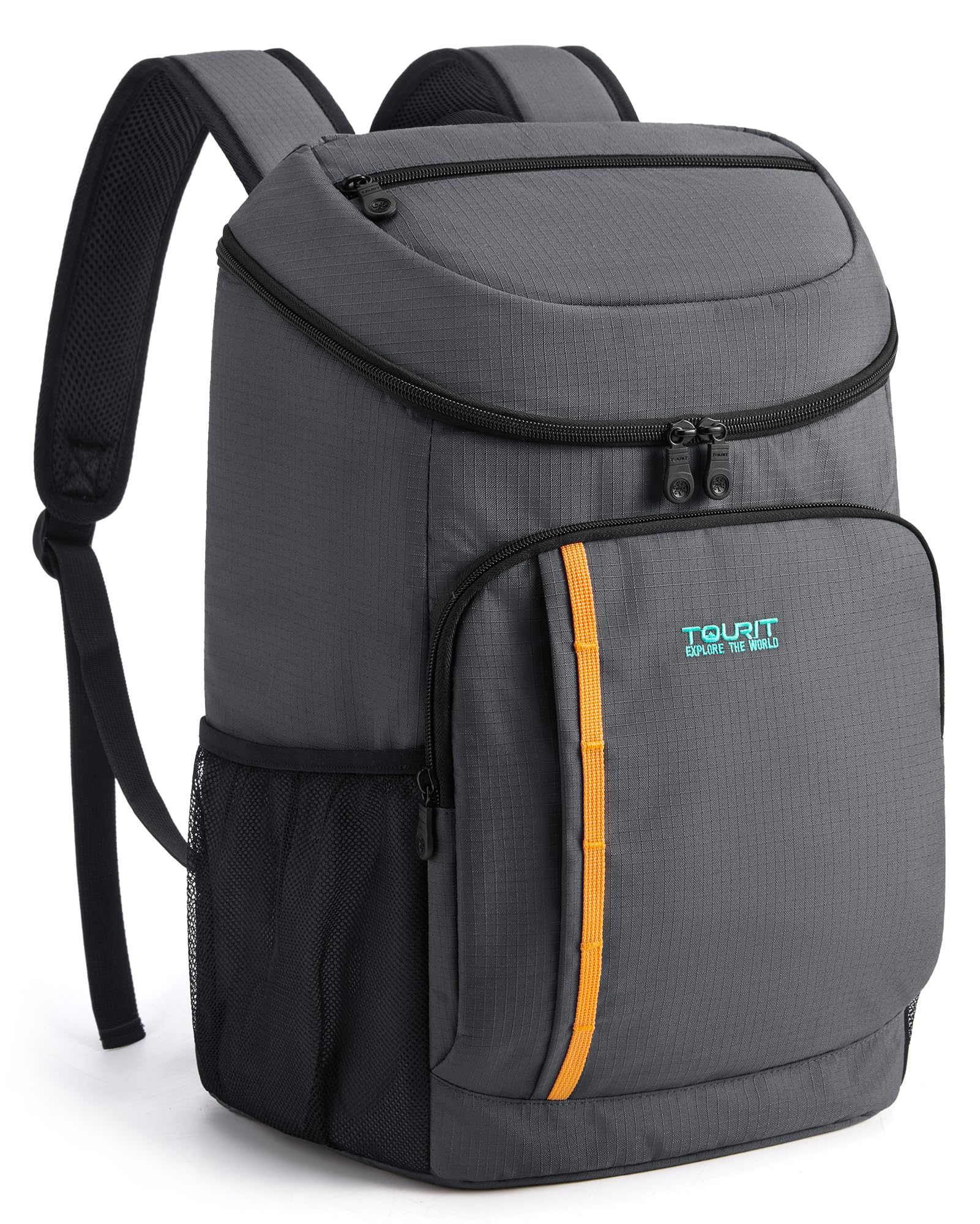
Key Features
- Ice Retention: Half day
- Hinge Durability: Zipper
- Portability: 1.1 lbs, backpack
- Leakproofness: Leaks at zipper
- Capacity vs Weight: 28L, lightweight
- Price: $
The TOURIT backpack cooler offers easy portability for day hikes and beach trips, with a 28-liter capacity that fits 30 cans. The multiple storage pockets add convenience. However, the bag’s zipper leaks when used with loose ice or when tipped, making the ‘leakproof’ label misleading. Compared to other budget backpack coolers, it has fewer organizing pockets. For casual use with sealed ice packs kept upright, it’s a cost-effective option.
Pros
- Excellent portability as a backpack
- Good value for money
Cons
- Leakage through the zipper when used with loose ice or tipped bag
Best suited for short outings where you carry sealed ice packs and keep the bag upright.
Best for Day Hikes & Lunch
SPARTER 33-Can Backpack

Key Features
- Ice Retention: Half day
- Hinge Durability: Zipper
- Portability: 1.1 lbs, backpack
- Leakproofness: Leaks at zipper
- Capacity vs Weight: 21L, lightweight
- Price: $
Dual insulated compartments and waterproof nylon allow organized packing for day trips. Temperature retention is solid with ice packs staying frozen all day. However, zipper leakage with loose ice or tipping and occasional strap breakage after months of use hold it back. The Maelstrom backpack cooler offers a better pocket layout for the same price.
Pros
- Solid construction and good value for a budget backpack cooler.
- Holds ice packs frozen all day with effective insulation.
Cons
- Zipper may leak when using loose ice or if the bag is tipped.
Best for day hikes and picnics where you stick to sealed ice packs and avoid tipping, but not for loose ice or heavy daily commuting.
Best for Dry Snacks & Drinks
Lifewit 30L Collapsible Cooler

Key Features
- Ice Retention: Half day
- Hinge Durability: Zipper
- Portability: 1.5 lbs, collapsible
- Leakproofness: Leaks at bottom
- Capacity vs Weight: 30L, ultra-light
- Price: $
This budget-friendly cooler folds flat for storage and keeps sealed drinks cold for short trips. But the bottom seam can leak when loose ice melts, so it’s best reserved for dry goods or pre-packaged ice packs — not for wet cargo.
Pros
- Folds flat when empty for easy storage in tight spaces.
- Maintains chilly temps for a few hours with ice packs or chilled drinks.
Cons
- Bottom seam may leak when used with loose ice; suited for dry or sealed contents only.
Works for packing dry snacks and canned drinks with ice packs on quick errands, but skip if you plan to bring melting ice or wet items.
How to Choose
The key to a good camping cooler is matching its ice retention and portability to your trip length and transport method.
Ice Retention
Manufacturer claims like ‘keeps ice for 5 days’ are tested in ideal lab conditions. Real-world performance depends on ambient temperature, how often you open the lid, and whether you pre-chill the cooler. A cooler that stays closed and shaded in moderate weather will perform far better than one opened frequently in direct sun.
For overnight trips, a cooler that holds ice for 24-36 hours is sufficient. For multi-day off-grid adventures, look for rotomolded coolers with thick insulation. Pre-cooling the cooler and using block ice instead of cubes can extend ice life by a full day.
Durability of Hinges and Latches
Plastic hinges and latches are the first failure point on budget hard coolers. They crack under repeated use or when the cooler is fully loaded. Metal or stainless steel hardware, as found on the Igloo BMX and YETI Tundra, lasts for years without breaking.
Check user reviews for reports of broken lids or wheels before buying. A cooler that cannot close securely loses its insulation efficiency, and a broken latch on a trip is a genuine headache.
Portability
Weight and carry method determine whether a cooler is suitable for your camping style. Backpack coolers under 2 lbs are ideal for day hikes but sacrifice ice retention. Wheeled coolers with telescoping handles are perfect for car camping on flat ground but their axles can break on rough terrain.
Hard coolers without wheels become unwieldy once loaded. If your campsite requires a long walk from the car, a soft backpack cooler or a wheeled model with robust wheels is worth the extra cost.
Leakproofness
Soft coolers almost never provide the waterproof seal that ‘leakproof’ suggests. Zipper closures allow water to seep out when the bag is tipped or ice melts. The only way to guarantee no leaks is to use sealed ice packs or place loose ice in a separate dry bag inside the cooler.
Hard coolers with a drain plug can leak if the plug is not tightly sealed. Check the plug’s O-ring and consider adding a backup seal. For both types, assume that some moisture will escape and pack electronics and dry clothes accordingly.
Capacity vs. Weight
Larger coolers offer more space but become heavy when filled with ice and food. A 50-quart loaded cooler can weigh over 50 lbs, making it difficult to carry without wheels. Balance your need for capacity with the distance you will have to move the cooler.
For solo or couple camping, a 25-45 quart cooler is manageable. For groups, a wheeled 50+ quart model is more practical. Remember that the weight of ice is roughly proportional to volume: each quart of ice adds about 2 lbs.
FAQ
Why does my soft cooler leak even though it says ‘leakproof’?
Most soft coolers use zipper closures that are not waterproof when ice melts or the bag is tipped. The term ‘leakproof’ often only means the liner resists moisture, not that the zipper seals. Use ice packs in sealed bags, not loose ice, to prevent leaks.
How do I fix a cooler lid that won’t stay open?
Many budget hard coolers lack a lid stay mechanism. You can add a bungee cord to prop the lid open, or use a stick. For a permanent fix, look for coolers with built-in gas struts or a lid stopper — the Igloo BMX and YETI Tundra both have secure lid stays.
Do Coleman coolers actually keep ice for 5 days?
In controlled lab conditions, some Coleman models can hold ice for 5 days. In real-world use with regular opening and warm weather, expect 1-2 days. Pre-chilling the cooler, using block ice, and minimizing openings can extend the time, but plan to replenish ice for trips longer than a day.
Is a backpack cooler better than a hard cooler for hiking and camping?
It depends on the trip. Backpack coolers are lightweight and hands-free, ideal for day hikes with pre-packed snacks. Hard coolers offer far better ice retention and durability for car or basecamp camping. For multi-day trips where you carry the cooler, a backpack is necessary; for stationary use, a hard cooler wins.