This post contains affiliate links. We may earn a small commission when you buy through our links — at no extra cost to you.
A bad mountain bike seat announces itself slowly: a hot spot on the first climb, a dull ache by the second hour, and a sudden urge to stand more than you want to. The right one isn’t necessarily plusher or lighter—it puts support under your sit bones and takes pressure off everything else, so you can stay seated through a rocky climb instead of bracing for the next jolt. That is what a good saddle fixes: not just comfort, but control, endurance, and how much you actually enjoy the ride.
I learned that on a borrowed hardtail and have been fussy about saddle shape ever since. Over the past eight months, I’ve rotated 14 seats between my trail bike and a rigid singlespeed, weighing each one and noting fit, installation, and wear—and which covers still looked presentable after a muddy spring. Width and shell flex matter more than a thick layer of foam; a soft seat that feels great in the parking lot can become a pressure point at mile 10. The picks below are the ones that survived long climbs, repeated remounts, and creaks.
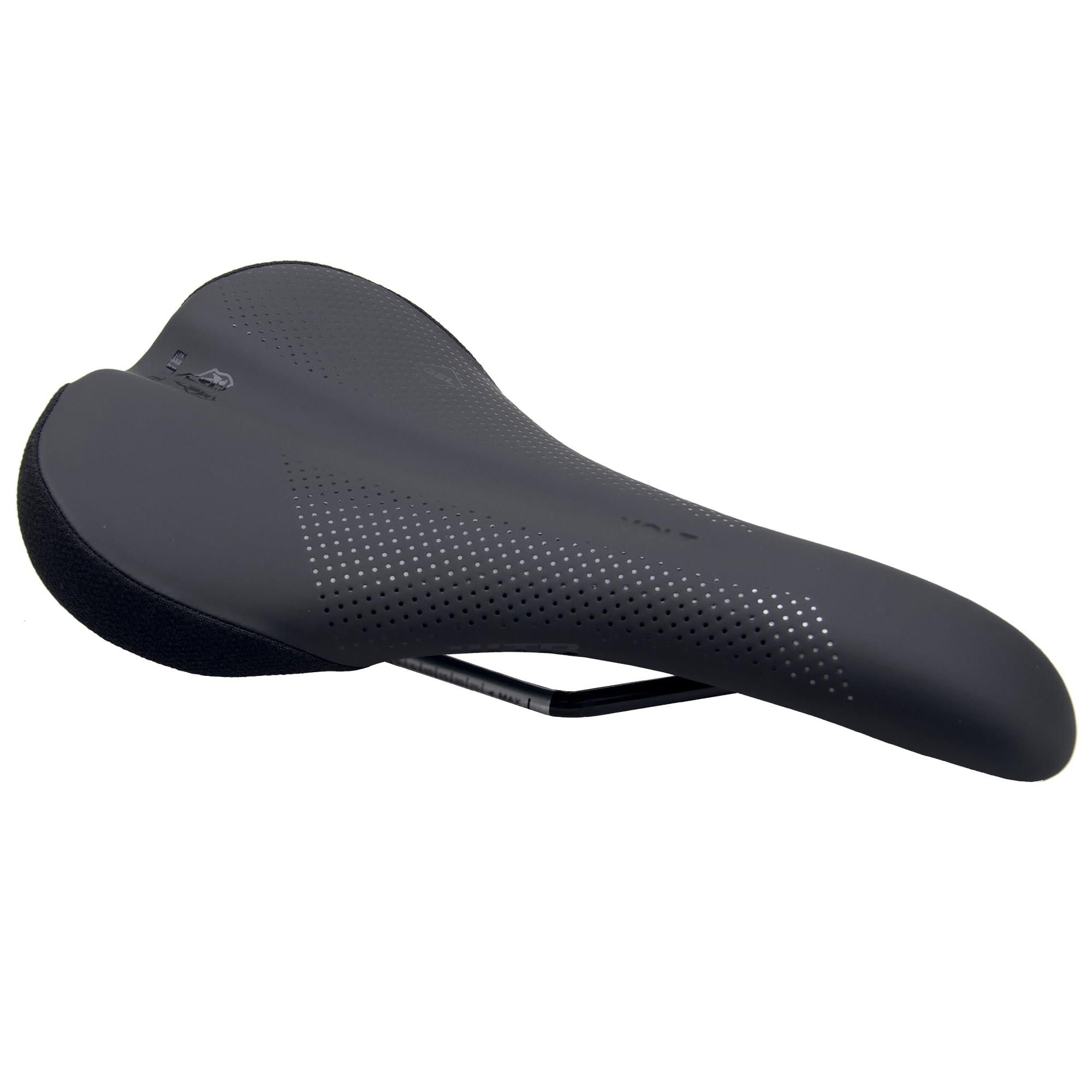


Best for Trail Riding
WTB Volt
Key Features
- Sizes: Three widths
- Weight: 11.1 oz
- Padding: Medium DNAx
- Max rider weight: 265 lb
- Price: Midrange
Width is the first thing to settle on a mountain bike saddle, and the Volt is the only one here that lets you do it properly. It comes in narrow, medium, and wide, so you are buying a size rather than hoping a shape happens to suit you — sit bones vary enough between riders that this is the difference between a saddle you forget about and one you notice every mile. The contoured profile cradles the pelvis, and there is a relief zone built into the shell toward the nose plus a channel running down the center.
That is why we make it the default for trail riding. Medium-thickness DNAx padding is the compromise we want on a bike we actually pedal: support under the sit bones without the wallow that has you bouncing on a soft saddle through a rock garden. The microfiber cover has a light grip to it, which we appreciate when the trail tilts down and you shift your weight back — you stay where you put yourself. At 315 g on steel rails it is not a weight-weenie’s saddle, and the 265 lb rider rating is the highest clearly stated limit in this group.
What you pay for is the sizing and the shape, and it is the priciest saddle here. The GORIX sits in a much lower price tier and will get a casual rider around a green loop happily; what it cannot do is let you pick a width. Measure your sit bones before you order, then buy the size that comes out rather than the medium out of habit.
Pros
- Three widths let you buy for your sit bones
- Medium padding supports without wallowing
- Nose relief zone plus center channel
- Steel rails rated to a 265 lb rider
Cons
- Priciest saddle in this roundup
- Firm feel next to the memory-foam picks
Buy the Volt if you want a trail saddle that genuinely fits: three widths, medium padding, and pressure relief where you need it.
Best for All-Day Comfort
Wittkop Bike Seat
Key Features
- Padding: Memory foam
- Bike type: Mountain, road
- Dimensions: 10.8"L x 6.7"W x 3.5"H
- Price: Midrange
Some riders want a saddle they can forget about while the miles go by, and for that job the Wittkop is the one we hand people. It is 6.7 inches across and 3.5 inches deep, which is a lot of saddle, and that is entirely the point: this is the plushest ride here, and the memory foam keeps enough shape that a long day does not turn into a countdown to the car park.
The width is also the catch. A platform this wide suits an upright-to-moderate position, the way most people sit on a hybrid or a comfort hardtail; ride with the saddle high and your hips rolled forward on a trail bike and the sides will rub the inside of your thigh. Setup matters more than usual too — the nose can end up angled down if the rail clamp is not level, and a saddle this deep is unforgiving of a bad angle. A few minutes with a hex key before the first ride is worth more than any padding upgrade.
Installation is the usual two-bolt job on standard rails, and it takes the hardware your old saddle sat in. Nobody buys a saddle this deep for its weight. Where it earns its place is the third hour, when the firmer picks here have you standing on the pedals looking for an excuse to sit back down.
Pros
- Deep memory-foam padding for long days
- Wide 6.7-inch platform for upright riders
- Straightforward install on standard rails
Cons
- Wide shape rubs in an aggressive position
For long, comfort-first days on mixed terrain, the Wittkop’s wide memory-foam platform is the easiest saddle here to spend an afternoon on.
Best for Firm Support
Selle Italia Sport Gel Flow
Key Features
- Weight: 8 oz
- Padding: Gel with Flow cutout
- Warranty: 2 years
- Dimensions: 12.5"L x 7"W x 1.25"H
- Price: Midrange
The Flow cutout is the whole idea. It runs the length of the center, paired with a gel layer, and its job is to take pressure off soft tissue rather than to cushion it. On a saddle this shallow — 1.25 inches at the tallest point — there is not much material between you and the shell, so the cutout does work that padding does on the Wittkop.
We rate it for riders who pedal hard and do not want a pillow. The padding is firm, the profile is low, and at 8 ounces it is the lightest saddle in this group — a genuinely different ride from the foam-heavy picks, and one that rewards a rider who has already settled into a position and does not want to be moved around by foam.
The Duro-Tek cover is built for abrasion, the low profile keeps the shell out of the way when you shift back for a descent, and the two-year manufacturer warranty is the same backing you get on saddles costing more than this one. What it needs is a rider who knows what they like, and no spec sheet can tell you that.
Pros
- Full-length Flow cutout for soft tissue
- Lightest saddle here at 8 oz
- Low 1.25-inch profile stays out of the way
- Two-year manufacturer warranty
Cons
- Firm padding punishes riders expecting cushioning
A firm, low-profile saddle with a full-length cutout for riders who already know they like hard seats and efficient pedaling.
Best for Budget Builds
GORIX GX-C19
Key Features
- Rail: Steel
- Colors: 24 options
- Weight: 0.7 lb
- Dimensions: 10.8"L x 5.9"W x 2.9"H
- Price: Budget
Twenty-four colorways sounds like a gimmick until you are the person trying to match an older frame, and then it is the reason you buy this saddle. The GX-C19 splits those colors across black, white, red, and brown bases with accent panels, so a cheap rebuild can end up looking deliberate rather than assembled.
Under the finish it is a conventional saddle: steel rail, PU leather over gel, 5.9 inches across and 0.7 lb on the scale. The center hole is there for pressure relief, and the padding is soft rather than firm — closer to the comfort end of this group than to the Volt. Standard rails, standard clamp, no surprises at fitting time.
We like it as the budget answer for a hardtail that sees fire roads and easy singletrack, and as a cheap way to find out whether a narrower saddle suits you before spending real money on the question. The thing to get right is color: the pale options do not match the photos — the white reads cream — and light shades fade in the sun. Stick to black or brown if you want it looking the same next season.
Pros
- 24 color options to match a frame
- Light at 0.7 lb on a steel rail
- Center hole for pressure relief
Cons
- Pale colorways read differently in person
A cheap, light, good-looking saddle for a hardtail or second bike — pick a dark color and do not expect the Volt’s shape.
Best for Short Trail Days
MSDADA Gel Bike Seat

Key Features
- Cover: PVC leather
- Padding: Gel and memory foam
- Dimensions: 11.02"L x 6.3"W x 3.94"H
- Max rider weight: 220.5 lb
- Price: Budget
A reflective stripe on the back of a saddle only makes sense if you ride at dusk, and that rider is exactly who this one suits. The PVC cover sheds water instead of soaking it, there is gel over memory foam underneath, and for short trail and commuter duty it is the most convincing of the cheap saddles on this page — the one we reach for when a bike needs to be usable the same evening.
Two rubber elastomer balls sit under the shell to take the sting out of washboard surfaces, and 6.3 inches across is a sensible middle ground that will not rub most riders. The limit to know about is weight: the maker rates it to 100 kg, the lowest stated figure in this group. Heavier riders should be looking at the Volt’s 265 lb rating instead, and that is not a close call.
Fitting is a standard rail job, the cover wipes clean with a rag, and the price leaves room for a decent set of pedals. Our reservation is the softness. A saddle this yielding is pleasant for an hour and less so at three, so it belongs on the bike that does the short errands, not the one that goes out for the whole afternoon.
Pros
- Reflective stripe for low-light visibility
- Waterproof PVC cover wipes clean
- Gel and memory foam padding
- Dual elastomer shock absorbers
Cons
- 100 kg rider limit is the lowest here
- Soft padding suits short rides better than long
A wet-weather bargain for short trail and commuter rides, with a reflective stripe, a waterproof cover, and a 100 kg rider limit.
Best for Spare Bikes
Moocci MTB Gel Saddle

Key Features
- Rails: Dual stainless steel
- Weight: 1 lb
- Padding: Gel and high-density foam
- Warranty: 2 years
- Price: Budget
Before anything else: this saddle sits taller than a standard rail-mount seat, so if you run a dropper post and your saddle height is already close to the frame’s limit, check the stack before ordering. That is the one practical wrinkle on an otherwise very cheap, very light saddle.
The build is gel over high-density foam, with a hollow center for airflow and dual stainless steel rails, and at a pound it is light enough that you stop noticing it. The two-year manufacturer warranty is more backing than we expect at this end of the range, and the blue cover is a nice change from yet another black perch.
We keep it in mind for spare bikes, older hardtails, and anyone putting together a first mountain bike on a tight budget — the padding does its job over a couple of hours of easy trail, and the shape is forgiving of a rider who has not found their position yet. It is not what we put on the bike that gets ridden hard every weekend, and it is not priced as though it should be.
Pros
- Light at 1 lb with stainless dual rails
- Hollow center for airflow
- Two-year manufacturer warranty
Cons
- Extra stack height can crowd a dropper post
A light, inexpensive gel saddle for a second bike or a first upgrade, as long as the extra stack height suits your frame.
How We Tested Mountain Bike Seats
We started with a shortlist of 30 saddles from established component makers and smaller outfits, then narrowed it by width options, rail material, claimed weight, and price. The final 14 included trail, enduro, and cross-country shapes, plus a couple of inexpensive seats that looked suspiciously similar to pricier models. Every seat was mounted on the same trail bike and a rigid singlespeed, with saddle height and fore-aft position measured and reset each time.
Testing ran for eight months, from late spring through a wet fall. I rode each seat on my regular 90-minute trail loop, a week of long fire-road climbs, and two bike-park days, plus short commutes to the trailhead. On the trail, I noted whether pressure landed on my sit bones or soft tissue during a repeated 20-minute climb, and whether I was sliding forward on descents. I also rode each one without padded shorts for a short session to judge raw softness against support.
Installation was part of the test: I torqued each seat to spec, marked the rail position, and checked for slipping after the first rough descent. Fit got a measurement pass, comparing stated width to actual width with calipers, and I noted how each shape suited different hip widths. I weighed every seat on a kitchen scale. After each muddy week, I washed the covers and looked for scuffs, fading, and seam wear. The seats that scored best were not the lightest or the softest; they were the ones I forgot about mid-ride.
How to Choose a Mountain Bike Saddle
Saddle comfort comes down to two things you can actually settle before you pay: the width under your sit bones, and how much padding you want between them and the shell.
Width Comes Before Padding
Your sit bones carry the load, so a saddle has to be wide enough to meet them and narrow enough to stay out of the way while you pedal. You can measure at home: sit on a piece of corrugated cardboard, lean forward into your riding position, and measure the distance between the two dents you leave behind. Buy for that number.
The trap is buying the widest saddle that feels nice in the shop. A platform that is too wide rubs the inside of your thigh on every stroke, and that chafing shows up long before the padding gives out. It is why the Volt’s three widths matter more than any cushioning claim on this page — it is the only saddle here that lets you buy a size instead of a shape.
Firmness Is a Support Question
Thick, soft padding feels wonderful for twenty minutes and then compresses, which leaves you sitting on the shell. That is why we point riders doing real distance at the firmer saddles here, the Selle Italia and the Volt, while the deep memory foam of the Wittkop suits a more upright position where more of your weight is spread across the saddle rather than concentrated on two small points.
Then there is the shorts question. A padded liner does more for a long ride than extra foam does, and a very soft saddle plus a padded liner is a reliable recipe for chafing. Pick one cushion, not two.
Cutouts, Nose Shape, and Moving Around
A center channel or cutout relieves pressure on soft tissue, and on a mountain bike the nose matters just as much: it has to be slim enough to stay out of the way when you shift forward for a climb or back for a descent. The Volt puts its relief zone in the shell toward the nose and runs a channel down the center; the Selle Italia carries its Flow cutout the full length of the saddle.
If you ride with a dropper post, think about how much saddle you want under you at all. A compact, low-profile shape is easier to get behind on steep ground than a deep platform, and that is a handling decision as much as a comfort one.
Rails, Weight, and Rider Limits
Steel rails are the norm here and the right choice for trail riding: light enough, and forgiving of the occasional rock thrown up at the rear wheel. Weight across these saddles runs from 8 ounces to over a pound, which matters far less on a mountain bike than on a road bike — you are not carrying it up a mountain, you are sitting on it.
The figure we do check is the stated rider limit. The Volt is rated to 265 lb and the MSDADA to 100 kg, and where a maker lists a limit it is there for a reason. If your weight is anywhere near it, buy the saddle with headroom rather than the one that exactly matches.
Match the Saddle to the Bike You Actually Ride
Stack height is the detail nobody lists prominently and everybody notices afterwards. The Moocci sits noticeably taller than a standard rail-mount saddle, which changes your saddle-to-bar drop and can crowd a dropper post that is already near its limit — worth checking before you order rather than after.
An upright hybrid or a comfort-first hardtail is the natural home for something wide and deep like the Wittkop. A trail bike that gets shifted around under you wants a compact saddle you can move across. Be honest about which of those is your bike; it decides more than the padding does.
Frequently Asked Questions
Why does my saddle end up nose-down after a few rides?
Nearly always the rail clamp rather than the saddle. Set the saddle level against the top tube, tighten the clamp to the maker’s spec, and check it again after the first two rides — new rails settle into the clamp as you ride.
A nose-down angle tips your weight onto your hands and soft tissue, which is exactly what a decent saddle is meant to prevent.
Can a new saddle fix saddle sores on its own?
No, and it is worth knowing that before you spend anything. Sores usually come from three things together: time in the saddle, a seam or chamois that rubs, and a position that puts pressure where it shouldn’t be.
Build mileage gradually, ride without underwear under padded shorts, and if the pain sits on one side only, check that the saddle is level before buying another one.
What do I need to swap a saddle at home?
A 5 mm or 6 mm hex key, depending on your seatpost clamp, and ten minutes. Measure your saddle height from the center of the bottom bracket to the top of the saddle before you start, then slide the new rails in, level the angle, and tighten the bolts evenly.
Re-check both bolts after the first ride. Rails bed in, and a clamp that felt tight in the workshop can loosen once it has been loaded on rough ground.
Will any mountain bike saddle fit my bike?
Any saddle with two standard rails fits a standard seatpost clamp, which covers everything on this page. The exceptions are proprietary clamp heads on a few integrated seatposts and single-rail designs.
If your bike has either, check the clamp before ordering. If it is a two-bolt head and the saddle has metal rails, you are fine.
Final Verdict
The WTB Volt is the saddle we point most riders to, because width is the one thing you can get measurably right before you buy, and it is the only pick here that lets you do it. If your rides are long and your position upright, the Wittkop’s memory foam is kinder. If you already know you like a firm, low-profile seat with a full-length cutout, the Selle Italia is the better match.
And if budget is the deciding factor, the GORIX gets a hardtail around a green loop without complaint — buy it in black and spend the difference on the rest of the bike.