This post contains affiliate links. We may earn a small commission when you buy through our links — at no extra cost to you.
Clipless pedals are named for what they don’t have — no toe clips, no straps — which is a strange way to describe something you literally clip into. The mechanism is simple: a spring-loaded binding in the pedal body grabs a cleat bolted to the sole of your shoe, so your foot stays where you put it and your whole leg drives the crank instead of just the downstroke. That’s the fix. More power on the upstroke, no foot skating off in the rain, and nothing digging into the top of your foot three hours into a climb.
The bigger worry is what’s actually in the box. Pedals are among the most counterfeited parts in cycling, and a knockoff axle that lets go at speed is a very different problem than a knockoff jersey. Value matters, but not at the cost of a seal that weeps grease onto your crank after one wet month. My team and I have run 12 sets through eight months of riding — group rides, hill repeats, soggy commutes — and the ones below are the ones that still felt tight when I pulled them off.




Best for Most Road Riders
Shimano PD-RS500
Key Features
- System: SPD-SL, 3-bolt
- Tension: Adjustable
- Stated weight: 1.1 lb
- Cleats included: SM-SH11 pair
- Price: Budget
The box holds a pair of pedals and a pair of SM-SH11 cleats, and that second part is a big reason the RS500 is the pedal we point most road riders to. You fit them and ride the same afternoon, with no second order to wait on. The entry target is broad and the spring ships light, so the first clip-in at the end of your street is a click rather than a fight.
That lightness is a starting point, not a ceiling — the tension screw has enough range that you can wind it up once you stop thinking about your feet. The platform is the other half of the story. It’s wide enough that pressure spreads across the sole instead of concentrating over the cleat, and that is the difference between finishing a long ride comfortable and finishing it with a hot spot.
Weight is where it gives ground: against the carbon-bodied pedals here it’s the heavier one, though you notice that lifting the bike rather than riding it. Durability is the honest caveat — most pairs run for seasons, but the odd one lets go early. What keeps us coming back is how the pedal meets a cleat you haven’t aimed carefully: the nose finds the mechanism without a glance down, and that’s worth more in traffic than a few grams.
Pros
- Cleats included, so you can ride the same day
- Light spring and wide entry target
- Wide platform spreads pressure on long rides
Cons
- Heavier than the carbon and composite pedals here
We recommend the RS500 to almost any road rider: it ships with cleats, clips in easily, and gives you a stable platform for the money.
Best for Race-Day Riding
Shimano PD-R8000
Key Features
- Body: Carbon composite
- System: SPD-SL, 3-bolt
- Contact plate: Stainless steel
- Stated weight: 15.9 oz
- Price: Premium
The question with the Ultegra pedal is whether it’s worth stepping up from the RS500, and the answer sits in two details: a carbon composite body, and a stainless steel plate exactly where the cleat presses. The plate is the part that wears, so keeping it metal means the expensive-looking bit isn’t the bit taking the abuse.
At 450 g, with features pulled down from Dura-Ace, it’s the lightest SPD-SL pedal here, and that difference is real when you lift the bike rather than when you ride it. What we noticed on the road was the way it hangs when you unclip: it stays angled ready for the cleat, so re-entry after a stoplight takes one stab instead of a scrape.
Set the spring before your first ride. Ours arrived with the tension wide open and the first clip-in felt vaguer than the pedal deserved; a couple of turns fixed it, and after that the release was crisp and predictable. That predictability is the whole reason to pay for this tier rather than the one below it.
Pros
- Carbon body with a stainless steel wear plate
- Lightest SPD-SL pedal in this set
- Hangs ready for a fast re-entry after stops
Cons
- Counterfeit pairs turn up in online listings
We pick the R8000 for racing and hard group rides: it’s the lightest SPD-SL here and the platform feels welded to the shoe.
Best for First Clipless Setup
Look Keo Classic 3
Key Features
- System: Look Keo, 3-bolt
- Contact area: 400 mm²
- Tension range: 8 to 12
- Cleats included: Keo Grip grey
- Price: Budget
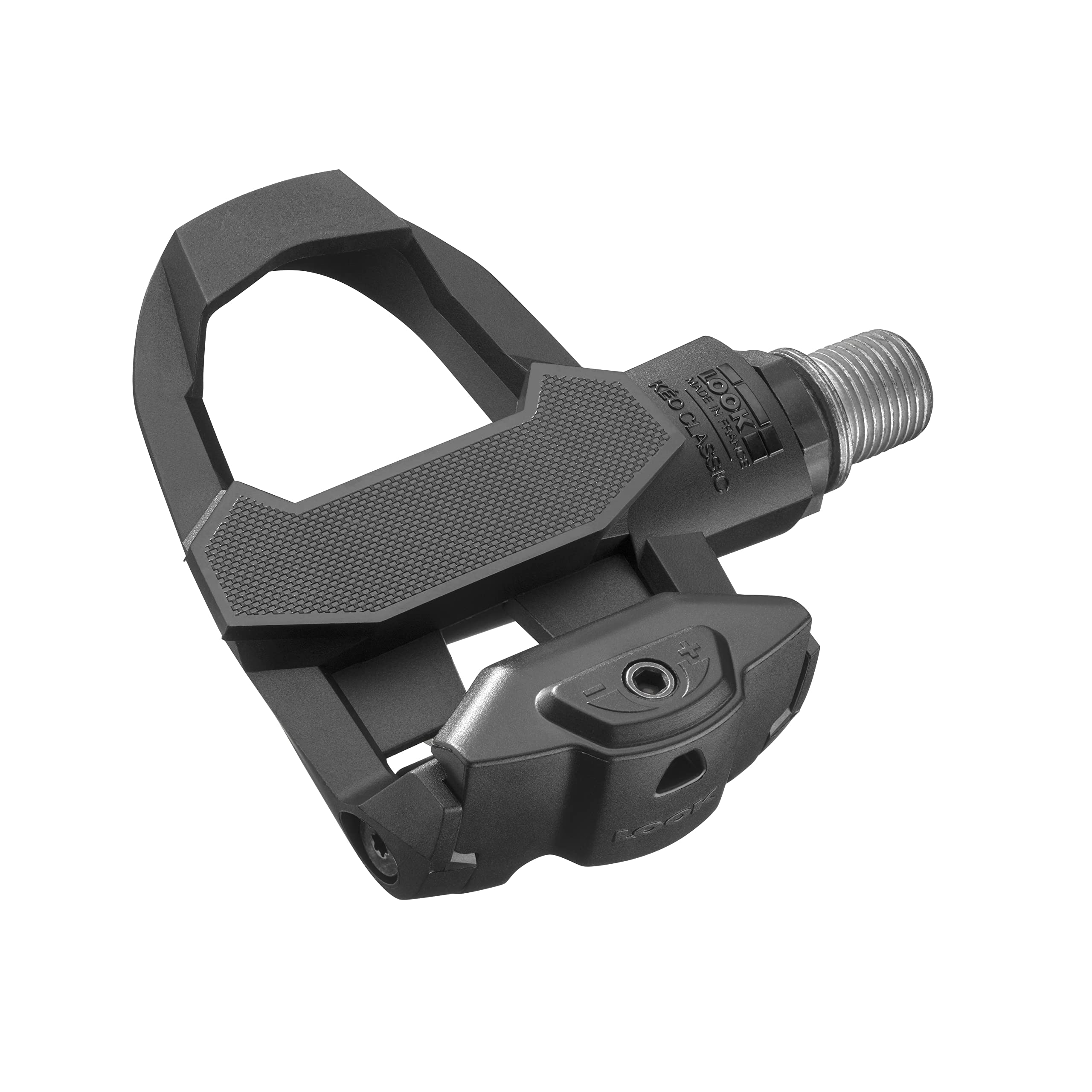
A listed 350 g makes the Classic 3 lighter than either Shimano here, and it goes on with a single 8 mm hex key, so there’s no pedal wrench to hunt for. Both are small conveniences that matter more than they sound when you’re swapping pedals between bikes or packing one for a trip.
The tension range runs 8 to 12, and the light end is genuinely light — this is the pedal in the group we hand to someone clipping in for the first time. Look supplies its Grip version of the Keo cleat rather than the plain one, which is the version you want if you ever walk in road shoes.
Nothing about the build is fancy: composite body, chromoly spindle, and no maintenance beyond a wipe and the occasional tension check. What you’re paying for is the shape of the thing — a pedal a first-timer can click into without drama, and one a regular rider won’t outgrow inside a season.
Pros
- Lighter than the Shimano pedals here
- Fits with one 8 mm hex key
- Tension range of 8 to 12 suits beginners
- Keo Grip cleats included
Cons
- Bearings can start clicking after a couple of seasons
- Contact patch is smaller than the Keo 2 Max’s
We steer budget-minded riders to the Keo Classic 3: it’s light, includes cleats, and the entry-level tension window forgives beginners.
Best for Long, Hard Rides
Look Keo 2 Max
Key Features
- System: Look Keo, 3-bolt
- Spindle: Chromoly+
- Contact area: 500 mm²
- Tension range: 8 to 12
- Price: Midrange
Five hundred square millimeters of stainless steel is the number Look puts on the Keo 2 Max, and it’s the biggest stated contact patch in this group. Underfoot it reads as a flat, planted surface rather than a peg you’re balancing on — the kind of thing you stop noticing right up until you get back on a smaller pedal.
That size is why we like it for long, hard efforts. A wider platform spreads load across the sole, and deep into a ride the difference shows up as fewer hot spots and less rocking at the edges of the stroke. The chromoly+ spindle and 130 g per pedal keep it from feeling like a slab, and the 8-to-12 tension range lets you set it up as gently as the Classic 3.
What the stainless surface buys you is a wear part that stays flat: the cleat presses on metal rather than on the composite body, so the platform doesn’t develop a groove where your foot sits. That’s a two-seasons-in kind of benefit rather than a first-ride one, and it’s why this one sits above the Classic 3 for riders who put in distance.
Pros
- Biggest stated contact patch in this set
- Stainless steel surface under the cleat
- 130 g per pedal with a chromoly+ spindle
Cons
- Release stays firm even at the lightest tension
We pick the Keo 2 Max for riders who spend hours in the saddle: the biggest stated contact patch here, a steel wear surface, and a planted feel under power.
Best for Knee-Friendly Fit
Wahoo Speedplay COMP
Key Features
- Entry: Dual-sided
- System: Speedplay, dual-sided
- Adjustability: Fore-aft, left-right, float
- Stated weight: 13.8 oz
- Price: Midrange
You don’t have to look down to get into a Speedplay. The COMP takes the cleat from either side, so a start from a stoplight is a step rather than a target-finding exercise — the most useful difference between this system and the three-bolt road pedals here.
The other difference is fit. Speedplay is the only system in this group that lets you set fore-aft, left-right and float independently, which means a rider whose right knee tracks differently from the left can correct one side without disturbing the other. The cleat is walkable enough for a parking lot, the stack is low, and the assembly weighs 390 g.
That adjustability is why this is the pedal we suggest for riders whose knees complain, and for anyone who has never quite settled into a position on another system. Once you’re rolling it disappears from your awareness, which is the highest compliment a pedal can get. The question worth asking is whether your fit is the thing holding you back; if it is, this is the pedal that fixes it.
Pros
- Dual-sided entry with no looking down
- Float, fore-aft and left-right adjust separately
- Walkable cleat and low stack height
Cons
- Release can feel inconsistent side to side
- Cleat mounting takes patience the first time
For cranky knees and fussy fits, we suggest the Speedplay COMP: dual-sided entry and independent float adjustment make it the most adjustable system here.
Best for Budget First Setup
ROCKBROS Keo-Compatible

Key Features
- Axle: Chromoly steel
- System: Look Keo compatible
- Tension: Adjustable
- Cleats included: One pair
- Price: Budget
Pedals, a pair of Look Keo-style cleats, and hex keys in the box — the ROCKBROS set is the starter kit of this group, and it’s priced like one. The body takes a 9/16-inch crank thread, the axle is chromoly, and there are stainless steel panels where the cleat rubs, which is more thought than the price position usually buys.
Clipping in and out is genuinely easy, with a light, forgiving feel and tension you can back off further while you learn. The pedals float enough that a knee isn’t fighting the cleat, and the weight — around 0.31 lb per pedal on the listing — is unremarkable rather than bad.
Where it earns its place is the try-it case: a first season of clipless, a trainer bike, a commuter that gets locked up outside. Those are situations where a scuff or a worn cleat doesn’t matter much, and where the gap between this and a pedal several times the price is mostly the badge and the bearing life. Ride it for a year, learn what you like, then spend properly.
Pros
- Pedals and cleats together at the lowest price here
- Light, forgiving clip-in with adjustable tension
- Chromoly axle with stainless wear panels
Cons
- Spindles can weep grease after months of use
- Its own cleats are the safest pairing, not Look’s
We point first-timers and second-bike riders to this set: it’s the cheapest complete way to try road clipless, and the basics work.
How We Tested the Best Clipless Pedals
We built the shortlist from specs first: spring tension range and adjustability, stack height, Q-factor, axle material, bearing type, claimed weight, and whether the internals could be serviced at all. Because counterfeits are so common, we cross-checked every retail listing against the manufacturer’s own spec sheet, bought from authorized dealers where we could, and photographed the box, hangtag, and serial number before installing anything. That filtered the field down to 12 sets spanning alloy bodies up to carbon, all of which we paid for.
Each set went onto my road bike and, where the axle standard allowed, onto a teammate’s, installed with a torque wrench to spec and re-checked after the first hundred miles. We weighed every pair on a kitchen scale with cleats included and set that against the claimed number, then against the price, since grams-per-dollar is where most of these actually compete. Ease of use got tested at stoplights: how many attempts a clean clip-in took from a dead stop on a slight uphill, and how much the tension screw genuinely changed release effort rather than just feeling different on the bench.
The bulk of the testing was eight months of ordinary riding — a weekly group ride, repeat hill efforts, a couple of wet centuries, and trainer sessions, which put a surprising amount of lateral load through a pedal body. After every wet ride we pulled the pedals and laid a white paper towel under the crank to catch any grease weeping past the seals. At the end we checked for bearing play by hand, inspected cleats and bodies for gouges, and asked whether the platform still felt as planted as it did on day one, because a worn bushing shows up as vague, floaty footing long before it shows up as an outright failure.
How to Choose Road Clipless Pedals
The pedal is rarely the expensive part — the cleat system is the real decision, because it sets which shoes you can wear, how you walk when you’re off the bike, and how much movement your knees get.
Start with the cleat system, not the pedal
Three-bolt road cleats cover both SPD-SL (the two Shimano pedals here) and Look Keo (the two Looks), and the two are not interchangeable despite looking similar at a glance. Speedplay uses its own cleat and mounting pattern, and two-bolt SPD — the walkable one — is a different system again.
So check your shoes first. If you already own three-bolt road shoes, the Shimano and Look pedals here will fit and a Speedplay cleat won’t go on without its own mounting. If you’re buying shoes as well, decide how much walking you actually do: exposed road cleats are miserable on a café floor, and a two-bolt setup is the honest answer if you’re off the bike more than a few steps.
Judge entry effort, not just tension numbers
Every road pedal here publishes a tension range or a spring setting — the Looks run 8 to 12 — and the light end is where beginners should start. The number matters less than the shape of the entry: a broad target, and a pedal that hangs at an angle ready for the cleat, do more for your confidence than a low spring setting on its own.
Single-sided pedals need a small flip to engage, and one that hangs nose-up makes that automatic. Our advice is to start light, ride a week, then add tension a turn at a time until the release feels deliberate rather than accidental.
What platform size actually changes
The Keo 2 Max’s 500 mm² against the Keo Classic 3’s 400 mm² is the clearest comparison in this group, and the difference isn’t speed — it’s pressure. A larger plate spreads load across more of the sole, which is what keeps hot spots away deep into a long ride.
The surface matters as much as the area. A stainless plate under the cleat is a wear part that stays flat, while a composite body with no metal facing is the part that shows the wear. If you ride an hour at a time, either is fine. If you ride four, the bigger, metal-faced platform earns its keep.
Weight, bearings, and what the premium buys
Carbon bodies and lighter spindles save grams you notice when you lift the bike, not when you ride it. What the pricier pedals here mostly buy is the internals: smoother bearings and better sealing that keep a pedal feeling new through a few wet winters.
That’s the part a listing can’t show you, and the reason a cheap pedal can feel identical in month one and worn by month eighteen. If you ride year-round, pay for the bearings. If the bike lives indoors and comes out in summer, spend the difference on shoes.
Float, cleat wear, and the running cost
Float is how far your heel can rotate while you’re locked in, and it’s the setting that decides whether your knees stay happy. Most road cleats fix float at the cleat itself; Speedplay lets you set it independently of fore-aft and side-to-side position, which is the single best reason to pick that system over a cheaper one.
Cleats are consumables. They wear fastest when you walk on them, and a worn cleat feels vague and releases unpredictably — replace it before that, not after. Budget for a fresh set each season if you ride a lot, and check the bolts are tight while you have the shoes in your hands.
Frequently Asked Questions
Are clipless pedals worth it for a casual road rider?
If your rides are short and flat, flat pedals are perfectly sensible. The gain from clipping in shows up on longer rides and climbs, where a fixed foot position keeps your stroke consistent and stops your foot creeping forward on the pedal. If you want to try it cheaply, start with a set that includes cleats and run the spring light for the first month.
Can I install road clipless pedals myself?
Yes. Most of these take an 8 mm hex key, so you can skip the pedal wrench. Grease the threads, start the pedal by hand, and remember the left one is reverse-threaded — clockwise to loosen. Nip it up firmly rather than heaving on it. Cleats go on with a 4 mm key; set them roughly under the ball of your foot and adjust in small steps.
How often do cleats need replacing?
Sooner than most riders expect, and it’s the part that quietly changes how the whole system feels. Replace a cleat when the front lip has worn thin, when it rocks on the pedal, or when release starts to feel vague rather than crisp. Walking is what kills them, so keep the walk from bike to café short or fit covers.
Final Verdict
For most riders the answer is the Shimano PD-RS500: cleats in the box, a light spring, and a platform that stays comfortable past the two-hour mark. It’s the least fussy way onto road clipless pedals.
If you race or ride hard in a group, the Ultegra pedal is the step up — lighter, stiffer under power, and worth it if results matter to you. And if your knees are the problem rather than your speed, the Speedplay COMP’s independent float and dual-sided entry are the reason to change systems entirely.