This post contains affiliate links. We may earn a small commission when you buy through our links — at no extra cost to you.
Buying a road saddle is a gamble in a way a helmet isn’t: you can read every review, measure your sit bones, and still end up counting down the miles to the driveway. I’ve watched riders obsess over bar tape and then grab whatever saddle matched the bike’s paint. Over six months I’ve run 12 different saddles on my road bike, mixing weekday trainer sessions with longer weekend rides, and the gap between good and bad shows up around mile 30.
Padding is the least useful spec to shop by. Shape, width, and support matter more, and a firm saddle that fits can beat a plush one that doesn’t, which is why a mid-priced pick can outperform a boutique one. Comfort, fit, and value come down to the same decision. Quality shows in the cover and rails, installation takes ten minutes with a torque wrench, and looks stop mattering if the cover scuffs in a week. These are the saddles that earned a permanent spot.


Best for All-Round Road Use
GORIX GX-C19
Key Features
- Rail: Steel
- Width: 5.9 in
- Weight: 7.05 oz
- Center cutout: Center hole
- Price: Midrange
A 5.9-inch width and a hole through the middle is the short version of why the GX-C19 is the saddle we point road riders to first. The shell measures 10.8 by 5.9 by 2.9 inches, the steel rails sit at a standard 2-inch spread, and the listed weight is 0.2 kg. The detail that decided it for us is the taper: the nose stays narrow enough that our thighs stopped brushing the sides once we settled into a rhythm, and the center hole lifts weight off the soft tissue exactly where a road position puts it.
We also appreciate that it does not pretend to be a race saddle. The padding is soft rather than race-firm, the PU leather has enough grip to stop you sliding forward on a descent without gluing you in place, and the color range is wider than anything else here. For a road bike ridden at a weekend pace, that combination does more than a hard, thin plank. The ROCKBROS is the sharper tool for a fast position; this one is the more forgiving choice for everything else, and at 5.9 inches it stays clear of your pedal stroke in a way the wider saddles here do not.
The rest is the boring part that matters: standard rails, no adapter to misplace, and a shell that mounts with the clamp already on your bike. Twenty-four colorways sound like a gimmick until you are matching a frame, but black is the safe order and the pale ones are the gamble. If you want to find out whether a narrower saddle suits you without much risk, this is the one to try.
Pros
- Narrow 5.9-inch shape clears the pedal stroke
- Center hole relieves soft-tissue pressure
- Standard steel rails mount without an adapter
Cons
- Light colorways arrive off-white or pinkish
We recommend the GX-C19 as the default road-bike saddle: a narrow 5.9-inch shape, a center cutout and standard rails make it the least risky swap for anyone riding at a weekend pace.
Best for Light, Tapered Builds
ROCKBROS Bike Seat
Key Features
- Nose: Narrow taper
- Cover: PU leather
- Weight: 9.24 oz
- Max rider weight: 220 lb
- Price: Budget
At 262 grams with a nose that tapers hard out of a wider rear platform, the ROCKBROS is the saddle for riders who spin rather than sit. We liked the shape straight away: you can move forward for a climb and back for a flat without the cover dragging your shorts, and the matte PU finish has just enough friction to hold a position. It ships with a hex key and an open-end wrench, which is the whole toolkit for a two-bolt clamp, and the airflow channel down the middle keeps the surface from turning into a puddle on a warm climb.
Two numbers decide who should not buy it. The 220 lb (100 kg) rider limit is the lowest in this group, and the foam is thin, which is great for an hour of hard riding and less great for a four-hour day. Heavier riders should look at the HUGEOAKS and its 352 lb rating; anyone who wants to sink into a saddle should look at the Wittkop. For a light rider on a road bike, the shape is right and the money is small.
Pros
- Tapered nose lets you shift position
- 262 g keeps the build light
Cons
- 220 lb rider limit is the lowest here
- Thin padding runs out on long days
Buy this if you are under the 220 lb limit and want a light, tapered saddle you can shift around on; the thin padding is the trade you are making.
Best for Long Comfort Days
Wittkop Bike Seat
Key Features
- Padding: Memory foam
- Bike type: Road and mountain
- Dimensions: 10.8 x 6.7 x 3.5 in
- Pressure zones: Five-zone layout
- Price: Premium
Some riders want to finish a long day without thinking about their sit bones, and the Wittkop is built for exactly that. Its five-zone layout puts memory foam where the sit bones land and softer material through the middle, the shell measures 10.8 by 6.7 by 3.5 inches, and the cover is sealed against rain.
Angle is the thing to sort out before your first ride. The saddle arrives with a pronounced forward slope, and a nose-down saddle loads precisely the spot the padding is meant to protect. Level it against a straight edge, tighten the clamp, then ride, because the shape makes far more sense once it sits flat. Leave it sloped and it feels like it is trying to slide you off the front.
It is the most expensive saddle in this guide, and we think it earns that for riders doing two-hour-plus days in a fairly upright road position. Drop your bars low and the 6.7-inch width and soft foam start to feel like too much saddle; the GORIX is the better shape for that. For everyone else, this is the comfort benchmark of the group.
Pros
- Five-zone memory foam for long days
- Cover is sealed against rain
- Wide platform spreads the load
Cons
- Premium price for a comfort-first saddle
Our pick for riders who want to finish a long day without thinking about the saddle, as long as you level it properly and accept it is the priciest comfort seat here.
Best for Numbness Relief
Planet Bike ARS Classic
Key Features
- Cover: Lycra
- Weight: 16 oz
- Dimensions: 10.6 x 6.5 x 3 in
- Relief channel: Full-length recess
- Price: Midrange
Planet Bike shelves the ARS with cruisers and hybrids, and that label tells you more than most marketing copy. The 10.6 by 6.5 by 3 inch shell is shaped for a rider sitting fairly upright, the lycra cover is soft and slightly stretchy, and the foam is dense rather than plush. At 16 ounces it is not a weight-weenie’s saddle.
The full-length center recess is why we keep handing it to riders whose problem is numbness rather than soreness. A hole at the back of a saddle only helps while you are parked on it; a channel running the whole length keeps working as you shift around. On a road bike with the bars a couple of inches above the saddle, that design did what we wanted, and the firm foam kept it feeling like a saddle rather than a sponge at the end of a long ride.
It is shaped for men, so women should start with the VELMIA or the Wittkop instead. Give the foam a few rides before judging it, too: it feels unyielding on the first and generous by the fourth. Standard rails and a limited lifetime warranty round out a package that sits in the middle of this group.
Pros
- Full-length channel for numbness relief
- Firm foam that does not collapse
- Limited lifetime warranty
Cons
- Lycra cover looks tired before the foam does
If numbness rather than soreness is your problem, the ARS is the one we hand over: its relief channel runs the full length of the shell, not just the back.
Best for Budget Road Builds
ZHIQIU Bike Saddle
Key Features
- Cutout: Center channel
- Weight: 13.8 oz
- Padding: High-density PU
- Dimensions: 11.02 x 6.1 x 2.76 in
- Price: Budget
The ZHIQIU is the least expensive saddle in this guide, and it is the one we reach for when someone is rebuilding an older road frame and does not want much money tied up in the seat. The shape is right: 11.02 by 6.1 by 2.76 inches, a three-groove top with a center cutout, and high-density polyurethane filling instead of the marshmallow foam that turns a road position into a chafing problem. For a bike that gets ridden a few times a week, it is the best value here.
What you give up is refinement. The cover is rubbery, grippy enough that sliding back an inch mid-ride takes a deliberate lift rather than a shift, and at 0.39 kg it is not light. The steel rails are unremarkable, which is fine, and the cutout does its job. Go in expecting a workmanlike seat rather than a finished one and it is hard to argue with.
Pros
- Lowest price in this guide
- Narrow 6.1-inch shape suits a road position
- Center cutout with a three-groove top
- High-density foam resists bottoming out
Cons
- Grippy cover makes position changes harder
- Not light at 0.39 kg
The best value in this guide for a road bike ridden a few times a week, as long as you can live with a grippy cover and unremarkable hardware.
Best for Upright Casual Riding
LCYMD Bike Seat

Key Features
- Cover: Faux leather
- Weight: 1.79 lb
- Padding: High-density foam
- Dimensions: 9.7 x 8 x 3.7 in
- Price: Budget
Eight inches across is cruiser territory, and that one number explains both the LCYMD’s popularity and why we will not put it on a road bike. The shell measures 9.7 by 8 by 3.7 inches, the pad is high-density foam under a faux-leather cover, and at 0.81 kg it weighs more than double the ROCKBROS.
Where it works is upright riding. On a hybrid, an e-bike, or anything with swept bars, that width supports the whole pelvis instead of two small points, and the dual shock-absorbing pads under the shell take the edge off rough pavement. The supplied adapter mounts to most standard posts but not all of them, and posts around 1.25 inches are the ones that give trouble, so check the clamp on your bike before ordering.
On a road bike the width is a problem you cannot pad your way out of. At eight inches the rear corners catch the back of your thighs on every downstroke, and the saddle pushes you forward onto the narrow part you were trying to avoid. For a casual or electric bike it is a cheap, comfortable upgrade. For a road bike, it fights you.
Pros
- Wide platform for upright and e-bike riding
- Dual shock pads soften rough pavement
- Adapter and mounting hardware included
Cons
- Eight-inch width fights a road pedaling stroke
A comfortable, cheap upgrade for a hybrid or e-bike; we do not recommend it for a road bike, where eight inches of width works against your pedal stroke.
Best for Cushioned Upright Rides
VELMIA Bicycle Saddle
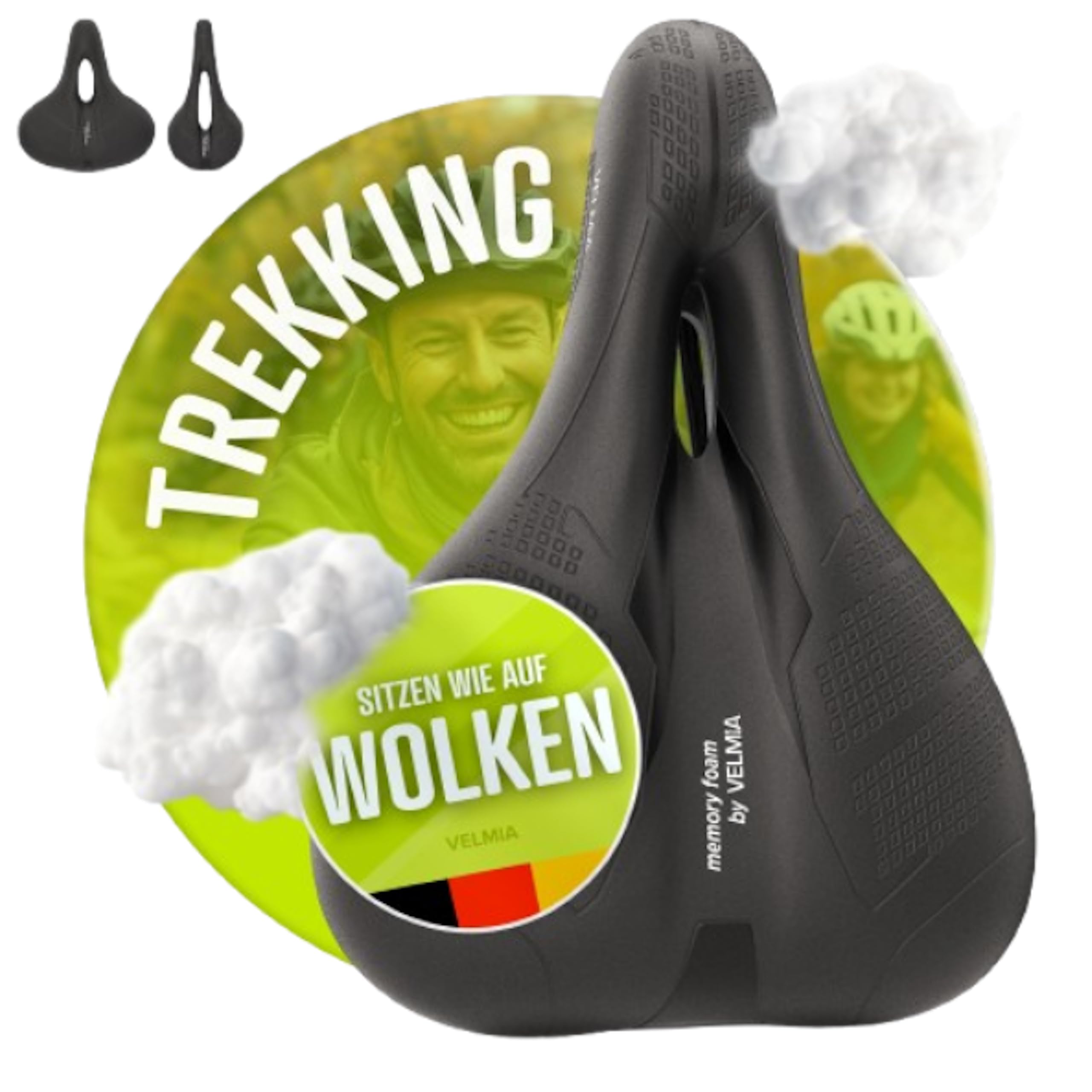
Key Features
- Cover: Waterproof
- Width: 7.3 in
- Padding: Memory foam
- Ventilation: Center slot
- Price: Midrange
VELMIA builds this saddle in three versions matched to riding position, which is more thought than most brands put into a bike seat, and the version here measures 7.3 inches across. That is wide enough to spread load and narrow enough that it is not a cruiser seat. The memory foam layer sits under a waterproof cover, and a slot down the center keeps air moving.
The vent is more useful than it sounds. On a road bike you spend most of the ride in one position, and a saddle that traps heat and sweat becomes a chafing problem long before the padding gives out. The slot runs deep enough to matter and does not leave a hard edge against your inner thigh.
The foam starts firm and takes several rides to give. If you expect to sink into a saddle from the first mile, this is not the one. What it does offer is a shape that stays out of the way while you pedal, which matters more over ten miles than a soft first impression.
It is a comfort saddle rather than a light one, and the rails are the part to look after: check the clamp torque and do not overtighten it. Where it makes sense is a road bike set up for commuting or relaxed weekend rides, with the bars level with or above the saddle. For a low, fast position the GORIX is the better shape and the cheaper risk.
Pros
- Memory foam under a waterproof cover
- Center slot improves airflow
- Three versions matched to riding position
Cons
- Firm foam takes several rides to soften
Worth it if you want memory foam, a vent slot and a saddle built for an upright position; road riders chasing weight and a narrow nose should keep looking.
Best for Adjustable Width Fit
HUGEOAKS Adjustable Seat

Key Features
- Padding: Memory foam
- Hardware: 304 spring steel
- Width settings: 7.08, 7.87 and 8.66 in
- Max rider weight: 352 lb
- Price: Premium
Two plates slide sideways to change this saddle’s width between 7.08, 7.87 and 8.66 inches, and that mechanism is the whole reason to consider it. The arc-shaped hardware is 304 spring steel, the padding is memory foam, and it carries a 352 lb rider rating, the highest here.
The idea solves a real problem. Sit-bone width varies a lot between riders, and most saddles give you one guess at it. Being able to widen the platform after a few rides, without buying another saddle, is genuinely useful for anyone who has never found a comfortable seat. The spring steel also adds a little give over broken pavement.
The catch is the nose. At its narrowest this is still a wide saddle, and the nose is broad enough that you cannot slide back behind it on a steep descent, which is a real limitation once you start riding aggressively. The foam is firm as well, closer to a platform than a cushion.
At the top of the price range this is a specialist purchase, and we rate it for riders whose discomfort comes from sit-bone width that no fixed saddle ever matched, on a bike ridden fairly upright. If you want a fast road position, the width and the nose get in your way; the GORIX costs less and fits that job better.
Pros
- Three width settings adjust after purchase
- 352 lb rider rating, highest here
- Spring-steel hardware adds some give
Cons
- Wide nose blocks moving back on descents
- Premium price for a problem-solving saddle
The pick for riders whose pain comes from sit-bone width that no fixed saddle matched, provided you ride fairly upright and can live with a wide nose.
How We Tested 12 Road Saddles Over Six Months
To build the shortlist, I read spec sheets and geometry charts — width, rail material, flat versus curved profile, cutout versus no cutout — then cross-checked those numbers against owner reviews and dropped anything that came in only one width. Twelve saddles made the cut, and each one lived on my road bike or a loaner for six months, rotating through weekday trainer sessions, 20-mile after-work loops, and longer weekend rides.
Installation got timed. I mounted each saddle with a torque wrench, set the tilt and fore-aft position, then checked after the first three rides whether the rails had slipped or the clamp had marked them. Fit came first: I measured my sit bones on a pressure pad and compared that number with each saddle’s published width, then noted whether I sat on the nose or settled into the rear.
Comfort was logged, not vibed. After every ride I wrote down whether I felt pressure, numbness, or hot spots, and whether I was sliding forward or shifting every few miles. Firmness and cushioning got judged on those same rides — a deep-padded saddle often felt great for 10 miles and miserable by 30, while a firmer one either disappeared underneath me or never did.
Quality and durability showed up over the months: I checked cover seams for fraying, rail finishes for scratches, and whether the shell creaked after a wet ride. Appearance counted too — whether the cover scuffed easily and whether the color options suited the two-tone paint schemes most road bikes actually come in. Value was the last question: did each saddle earn its place compared with the others at the same end of the range?
How to Choose a Road Bike Saddle
On a road bike the shape of the saddle decides whether you are comfortable, and the padding is a distant second.
Width and nose shape come first
Sit bones come in different widths, and a road position rotates your pelvis forward so your weight lands on a smaller, more forward patch of the saddle. That is why the 5.9-inch GORIX feels supportive to a rider who finds the 8-inch LCYMD unbearable, while the reverse holds on a hybrid. Around six inches suits most road riders; if your thighs rub the rear corners on every stroke, go narrower rather than softer.
Nose width matters as much as overall width. A broad nose pushes your legs apart through the downstroke, which shows up as chafing on the inner thigh rather than soreness in the seat. Look at the taper before you look at the cushion.
What a cutout can and cannot do
A center hole or channel takes pressure off the soft tissue forward of the sit bones. A full-length recess, like the one on the Planet Bike ARS, keeps working as you shift around; a hole at the rear only helps while you are sitting exactly on it.
What a cutout cannot do is rescue a saddle that is too wide or too soft. Sink deep into foam and the channel closes under you. If numbness persists with a cutout, check that the nose is level before you buy another saddle, because a nose-down tilt recreates the problem the hole is meant to solve.
Firm beats soft once you pass an hour
Soft foam feels wonderful for ten minutes and compresses after thirty, leaving you on the shell. Firm foam spreads load across the sit bones instead of letting them sink. That is why the denser pads here hold up over long rides and the softest saddles in this group are the ones people stop using.
Match firmness to distance. A short commute on a hybrid can take the softest seat you like. Anything over an hour rewards a firmer pad, and the shape still matters more than the cushion.
Rails, clamps and the five-minute swap
Almost every saddle here uses two steel rails at standard spacing, so the saddle itself will fit. What varies is the clamp on your seat post: two-bolt micro-adjust clamps, single-bolt clamps, and older posts that need a separate adapter. Check which one you have before ordering, and confirm the saddle ships with the hardware it needs.
Rider weight is the other number to check. The lightest saddles here are rated to 220 lb and the adjustable HUGEOAKS goes to 352 lb. Riding past a stated limit is how rails bend.
Frequently Asked Questions
Do I need padded shorts with a comfort saddle?
Not always. Shorts help with chafing and add a little cushion, but they cannot fix a saddle whose shape is wrong. Ride the new saddle in the shorts you already own for a few rides; if you are still sore, the problem is width, angle or firmness, and more padding on your body will not solve it.
How do I set the height and angle on a new saddle?
Wrap a strip of tape around your seat post at the current height before you loosen anything, and measure from the center of the bottom bracket if you want to be precise. Set the new saddle level using a phone or a straight edge across the top, then slide it forward or back a few millimeters until your knee sits over the pedal axle.
Can I put one of these saddles on a trainer or spin bike?
Usually yes. Most spin bikes and trainers use standard rails, so a road saddle mounts the same way. Expect to feel more weight on it, though: sitting upright puts load on a wider area, so a saddle with a cutout and a little more width, such as the Planet Bike ARS, tends to suit indoor sessions better than a narrow race shape.
Final Verdict
Start with the GORIX GX-C19. At 5.9 inches wide with a center hole and standard rails, it fits a road position without a fitting session or an adapter, and it is the least risky way to find out whether a narrower saddle solves your discomfort. If you are a light rider who wants something slimmer to move around on, the ROCKBROS is the alternative, provided you stay under its 220 lb limit. If numbness rather than soreness is the problem, go straight to the Planet Bike ARS.